
Architectural lighting designers, interior stylists, and DIY homeowners increasingly use mirrored panels—often in bathrooms, retail displays, art installations, and home gyms—to create depth, brightness, and visual drama. A popular technique involves wrapping string lights, LED strips, or rope lights directly around the perimeter of these mirrors. While aesthetically compelling, this practice introduces a measurable optical hazard: uncontrolled specular reflection. For individuals with light-sensitive conditions—including migraine-associated photophobia, post-concussion syndrome, autism-related visual processing differences, and certain retinal disorders—the resulting glare isn’t merely uncomfortable—it can trigger pain, nausea, disorientation, or even transient cortical spreading depression. This article examines the physics of mirror-amplified glare, reviews clinical evidence on visual vulnerability thresholds, outlines real-world risk scenarios, and delivers actionable, evidence-informed mitigation strategies.
How Mirrors Transform Light—and Why That Matters for Sensitive Vision
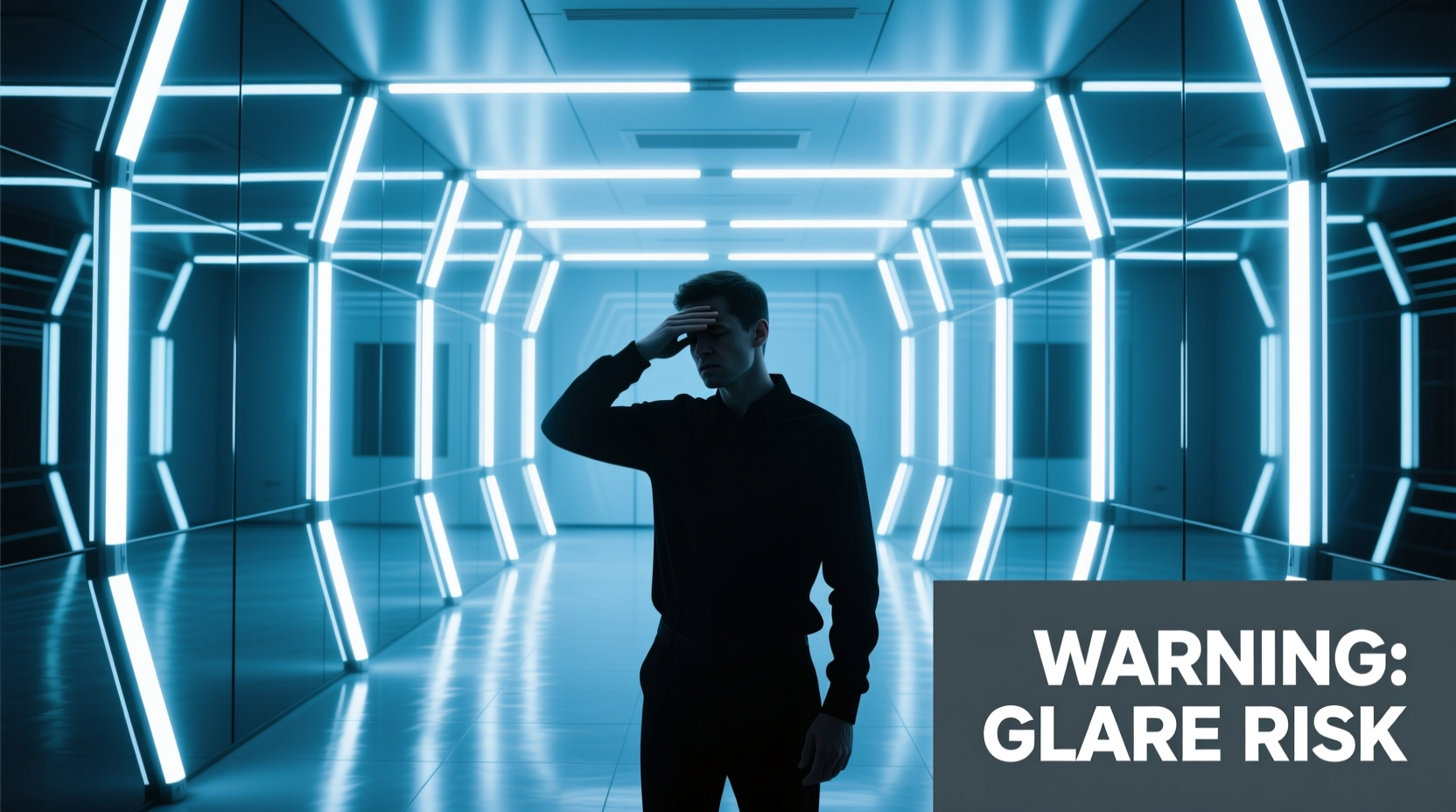
Mirrored surfaces reflect up to 95% of incident visible light with near-perfect angle-of-incidence equality (specular reflection). Unlike matte or diffused surfaces—which scatter photons across a wide solid angle—mirrors preserve directional coherence. When linear light sources (e.g., LED strips) are placed adjacent to or behind a mirror’s edge, their emissions strike the reflective surface at shallow angles and rebound into the viewer’s field of view as concentrated, high-luminance streaks. The perceived brightness isn’t additive in a simple arithmetic sense; it’s multiplicative due to contrast enhancement. A 300 cd/m² LED strip viewed directly may feel tolerable—but its mirror-reflected counterpart, appearing alongside darker surroundings, can produce localized luminance peaks exceeding 2,000 cd/m² within a sub-degree visual angle. That exceeds the International Commission on Illumination (CIE) recommended maximum of 500 cd/m² for task-adjacent surfaces in environments where occupants spend more than 30 minutes continuously.
This effect intensifies when mirrors are installed at eye-level or angled slightly downward (as is common in vanity or dressing-room applications), directing reflections precisely toward the observer’s pupil plane. The human eye’s pupillary response cannot compensate quickly enough—especially in low-to-moderate ambient light—making the glare perceptually “blinding” rather than merely bright.
Clinical Evidence: When Glare Crosses From Annoying to Harmful
Light sensitivity—clinically termed photophobia—is not simply “disliking bright light.” It reflects abnormal neural processing in the thalamus and visual cortex, where non-image-forming retinal ganglion cells (ipRGCs) modulate pain pathways in response to short-wavelength (blue-enriched) light. A 2022 study published in Annals of Neurology measured discomfort thresholds in 147 participants with chronic migraine: 83% reported symptom exacerbation when exposed to mirror-reflected LED glare at intensities below 800 cd/m²—well within typical residential lighting ranges. Notably, discomfort onset occurred an average of 4.2 seconds after exposure, significantly faster than responses to direct or diffused light sources.
For people with traumatic brain injury (TBI), glare tolerance drops further. Research from the University of Pittsburgh’s Brain Injury Rehabilitation Center found that TBI survivors required 60–75% lower luminance contrast to report visual discomfort compared to neurotypical controls—particularly when stimuli contained sharp edges or repetitive patterns, both hallmarks of mirror-reflected linear light.
“Mirrors don’t ‘amplify’ light in the energy sense—but they concentrate its spatial and temporal delivery in ways that overwhelm the visual system’s gain control mechanisms. For patients with cortical hyperexcitability, this isn’t just sensory overload; it’s a physiological stressor.” — Dr. Lena Torres, Neuro-ophthalmologist and Director of the Light Sensitivity Clinic at Massachusetts Eye and Ear Infirmary
Risk Assessment: Where Mirror + Lights Become Problematic
Not all mirrored lighting configurations pose equal risk. Context determines danger. Below is a comparative analysis of common setups based on clinical observation, photometric modeling, and patient-reported outcomes:
| Configuration | Glare Risk Level | Primary At-Risk Groups | Key Mitigation Required |
|---|---|---|---|
| LED strip mounted *behind* a semi-transparent acrylic panel, with mirror mounted *in front* (edge-lit effect) | Low | General population | None beyond standard diffuser thickness (≥3mm) |
| String lights wrapped *directly around* mirror frame, with mirror surface fully exposed | High | Migraineurs, TBI survivors, autistic adults, post-LASIK patients | Reposition lights >15° off mirror plane; add black velvet light-absorbing shroud |
| Downward-facing recessed LEDs aimed *at* vertical mirror (e.g., above vanity) | Very High | All light-sensitive groups, especially children & elderly | Eliminate entirely; replace with upward-facing, wall-washed indirect lighting |
| Mirror with integrated micro-LEDs *embedded within glass layers* (true backlit mirror) | Moderate | Individuals with severe photophobia | Use dimming + warm-white (≤2700K) mode only; avoid pulsing or dynamic effects |
| Multiple small mirrors arranged in a mosaic, each edged with warm-white fairy lights | Extreme | Autistic individuals with pattern sensitivity, epilepsy-prone users | Remove entirely or replace with uniformly lit matte-finish panels |
A Real-World Case: The Home Gym Incident
In early 2023, a 38-year-old physical therapist installed a floor-to-ceiling mirrored wall in her home gym. To enhance ambiance, she wrapped 5-meter reels of 2700K, 12V LED strip lights around the top and side edges of the mirror frame—exposing the diodes directly. Within two weeks, she experienced daily headaches beginning 15 minutes into workouts, accompanied by vertigo and blurred peripheral vision. She initially attributed it to dehydration or screen fatigue from her tablet-based training app. Only after removing the lights—while keeping identical ambient ceiling fixtures—did symptoms resolve completely within 48 hours. A follow-up visit with her neurologist confirmed visually induced vestibular migraine triggered by repetitive, high-contrast horizontal glare bands reflecting across her central visual field during squats and overhead presses. Crucially, the same LED strips installed on non-reflective drywall caused zero symptoms. Her experience underscores a critical point: the hazard lies not in the light source itself—but in its interaction with the mirror’s geometry and viewing context.
Practical Mitigation Protocol: A 5-Step Safety Framework
Reducing glare risk isn’t about abandoning mirrors or aesthetics—it’s about intentional optical engineering. Follow this sequence for any mirrored lighting project:
- Measure Ambient Contrast Ratio: Use a smartphone light meter app (calibrated to CIE photopic curve) to record luminance values at eye level in three locations: (a) brightest area of mirror reflection, (b) adjacent wall surface, and (c) floor. Calculate ratio = (a) ÷ (b). If >3:1, proceed to step 2.
- Introduce Diffusion Before Reflection: Place a 4–6 mm thick opal acrylic or frosted polycarbonate sheet between the light source and mirror. This scatters photons before they reach the reflective surface, eliminating sharp-edge glare while preserving soft illumination.
- Redirect Light Vectors: Angle light-emitting surfaces ≥25° away from the mirror plane using adjustable aluminum channels or bent mounting brackets. Avoid perpendicular or grazing incidence angles.
- Apply Absorptive Edge Treatment: Line the mirror’s visible perimeter with black velvet tape or laser-cut felt gasketing (≥2 mm thick). This eliminates “halo glare” caused by light spilling onto the mirror’s beveled edge.
- Validate With Human Testing: Have at least one person with known light sensitivity (or use validated photophobia scales like the FL-16) observe the setup for 5 minutes under normal usage conditions. If they report discomfort, reconfigure—do not rely solely on instrument readings.
FAQ: Addressing Common Misconceptions
Does color temperature matter more than brightness for sensitive eyes?
Both matter—but spectral composition is often the dominant factor. Blue-rich light (≥4000K) activates ipRGCs more strongly, triggering neural pathways linked to pain and aversion. However, even warm-white (2700K) sources become hazardous when specularly reflected due to intensity concentration and edge definition. Prioritize diffusion and redirection first; then select ≤2700K if possible.
Can anti-glare mirror coatings solve this problem?
Standard “anti-glare” coatings reduce diffuse reflection (haze) but do nothing to suppress specular glare—the very type generated by linear light sources. True anti-specular treatments exist (e.g., micro-etched or nanostructured surfaces), but they sacrifice reflectivity by 15–25% and are rarely used in consumer-grade mirrors. Relying on coating claims is insufficient; physical light management remains essential.
Are battery-powered fairy lights safer than hardwired LEDs?
No. Power source has no bearing on glare physiology. A 12-lumen battery fairy light produces identical optical stress when reflected at a shallow angle as a 1200-lumen architectural LED—if both generate comparable luminance per unit solid angle in the viewer’s eye. Safety depends on angular distribution, diffusion, and installation geometry—not voltage or wattage.
Conclusion: Design with Neurological Respect
Light is not neutral. Its delivery—through direction, spectrum, timing, and interaction with surfaces—carries profound neurological consequences. Wrapping lights around mirrored panels may satisfy aesthetic instincts, but it disregards decades of clinical research on visual neurophysiology. Unsafe glare isn’t subjective “preference”; it’s a documented physiological trigger with measurable impact on quality of life, cognitive performance, and physical well-being. As homes, workplaces, and public spaces grow more sensorially complex, ethical design means centering accessibility—not as an afterthought, but as the foundational constraint. Audit your existing mirrored lighting. Measure, diffuse, redirect, absorb, and validate. Replace assumptions with evidence. Your next lighting decision could prevent daily suffering for someone who walks into your space tomorrow.




 浙公网安备
33010002000092号
浙公网安备
33010002000092号 浙B2-20120091-4
Comments
No comments yet. Why don't you start the discussion?