
For decades, the image of a perfectly wrapped Christmas tree—lights spiraling from base to tip in tight, even coils—defined holiday tradition. It promised uniform brilliance, a “full” glow, and that unmistakable, nostalgic shimmer. But today, scrolling through design blogs, Instagram feeds, or high-end showroom displays, you’re just as likely to see trees draped in wide satin ribbons, cascading metallic garlands, or minimalist clusters of oversized bulbs—while the lights themselves recede into the background, or vanish entirely. This shift isn’t merely aesthetic whim. It reflects deeper changes in how we live: smaller urban spaces, heightened fire safety awareness, evolving notions of elegance, and a growing preference for intentional, low-maintenance decor. The question isn’t whether ribbon styling is “prettier”—it’s whether tightly wrapping lights remains functionally sound, culturally relevant, or even safe in today’s homes.
The Origins and Logic Behind Tight Light-Wrapping
Tight wrapping emerged from practical necessity. Before LED technology, incandescent mini-lights generated significant heat and consumed substantial energy. To maximize visibility—and compensate for dimmer individual bulbs—decorators wrapped strands closely, often using 500–1,000 bulbs on a standard 7-foot tree. The technique created visual density: no bare branches showed, and the tree appeared luminous from every angle. It also served a structural purpose—wrapping helped hold lightweight tinsel or early plastic garlands in place before adhesive hooks or specialized clips existed.
But this method carried inherent trade-offs. Achieving even tension required patience and physical dexterity; too-tight wrapping could crush delicate branch tips or cause premature needle drop. More critically, the dense layering trapped heat near the trunk and inner branches—a genuine concern when bulbs operated at 150–200°F. Fire departments have long cautioned against overloading outlets and clustering heat-generating lights near dry foliage. A 2019 U.S. Fire Administration report noted that 16% of home Christmas tree fires involved decorative lighting, with improper installation (including bundling and insulation) cited as a contributing factor in nearly one-third of those cases.
Ribbon Styling: More Than Just a Trend
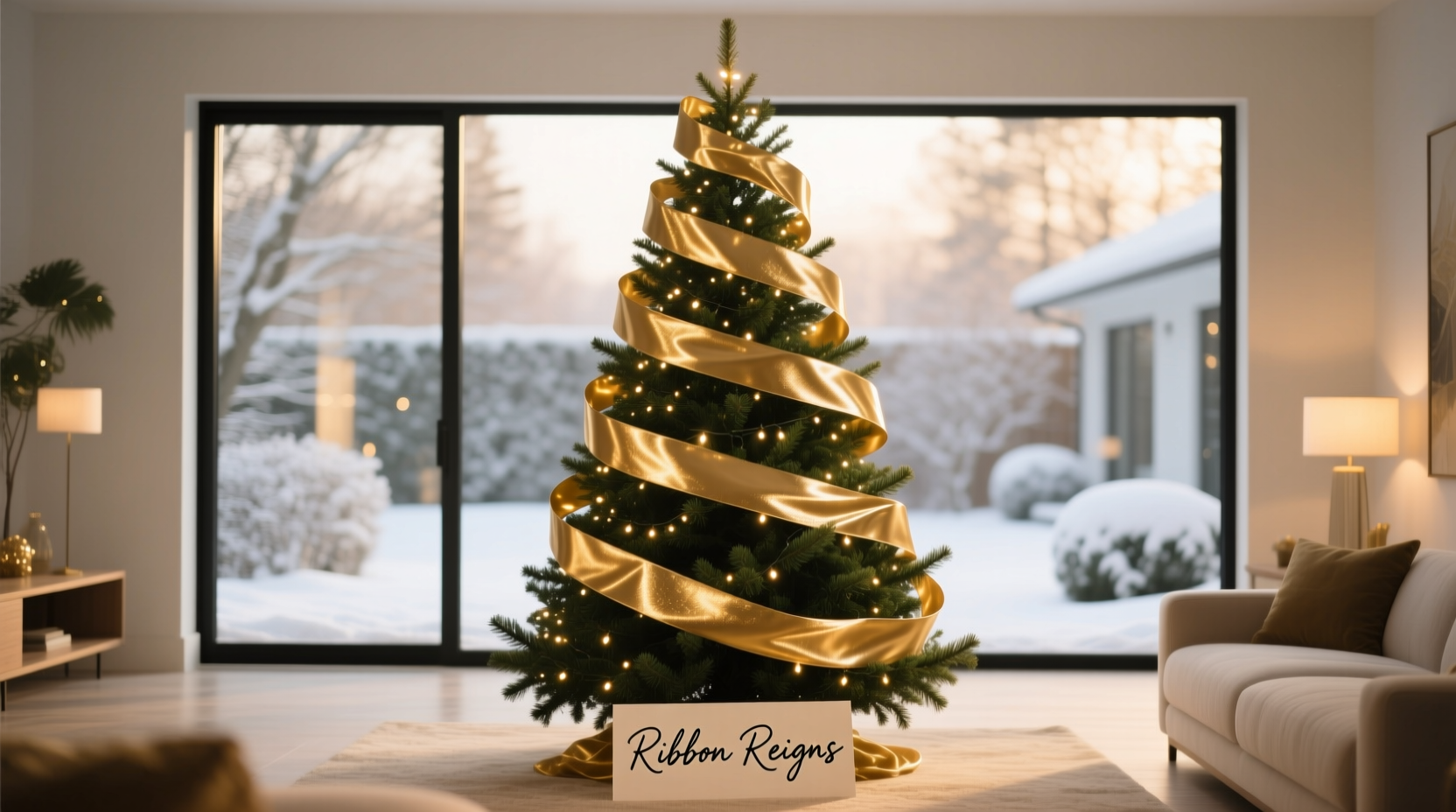
Ribbon styling—using wide fabric ribbons, velvet cords, or sculptural metal garlands as the primary vertical element—represents a fundamental rethinking of tree architecture. Rather than treating lights as the dominant feature, ribbon styling treats them as ambient support. Ribbons are typically draped in loose, asymmetrical loops or waterfall patterns, drawing the eye upward while revealing texture, depth, and the natural silhouette of the tree. Lights, if used, are placed sparingly: clustered at branch tips, strung vertically along the ribbon’s path, or embedded within ornament groupings.
This approach aligns with contemporary interior design principles: negative space matters, texture trumps uniformity, and authenticity (showing the tree’s form) reads as more sophisticated than artificial fullness. Designers like Amber Lewis of Amber Interiors emphasize “editing” over accumulation—“A tree shouldn’t shout,” she notes. “It should invite quiet appreciation.” Ribbon styling inherently supports that ethos. It also accommodates real-world constraints: it’s faster to install (no precise coiling), easier to adjust mid-season, and far simpler to store—ribbons coil flat; tangled light strands do not.
“The most elegant trees I’ve styled in the past five years use ribbon as the spine—not the lights. When lights are the star, the tree feels like a prop. When ribbon leads, the tree feels like part of the room.” — Maya Chen, Award-Winning Holiday Stylist & Author of *Seasonal Space*
Head-to-Head: Practical Comparison of Both Approaches
To move beyond subjective preference, consider objective performance across key criteria. The table below compares tightly wrapped lights and ribbon styling across seven measurable dimensions:
| Criteria | Tightly Wrapped Lights | Ribbon Styling |
|---|---|---|
| Installation Time (7-ft tree) | 45–75 minutes (requires ladder, precision, frequent adjustments) | 12–22 minutes (draping is intuitive; no measuring or counting needed) |
| Fire Risk Profile | Moderate–High (heat buildup, potential wire abrasion, outlet overload common) | Low (ribbons are non-electrical; lights used minimally and spaced) |
| Tree Health Impact | Moderate (tight wrapping compresses branches, impedes airflow, accelerates drying) | Low (no pressure on branches; better air circulation) |
| Storage & Reusability | Challenging (tangling, bulb breakage, kinked wires; 30% failure rate after 2 seasons) | Simple (ribbons fold or roll; lights stored separately and undamaged) |
| Design Flexibility | Low (uniform look dominates; hard to integrate varied textures or colors) | High (ribbon color/texture sets tone; lights, ornaments, and picks layered intentionally) |
| Accessibility | Difficult (requires mobility, hand strength, visual acuity for even spacing) | High (suitable for all ages and abilities; adaptable for wheelchair users) |
| Perceived Modernity (2020–2024) | Dated (associated with 1980s–2000s mass-market decor) | Contemporary (featured in Architectural Digest, Domino, West Elm campaigns) |
A Real-World Shift: The Case of the Downtown Loft Tree
Consider Elena R., a graphic designer living in a 650-square-foot Chicago loft with radiant floor heating and exposed brick walls. In 2018, she followed her mother’s method: 900 incandescent lights, wrapped in perfect 4-inch spirals, plus two layers of tinsel. The tree looked “like a department store,” she recalls—but it overheated the corner, triggered her smoke alarm twice (once during a Zoom call), and left her with sore shoulders and frayed wires by New Year’s. She abandoned lights entirely in 2020, opting instead for ivory velvet ribbon, matte black glass ornaments, and three strategically placed warm-white LED spotlights aimed at the tree’s crown and base. The effect was serene, architectural, and deeply personal. Neighbors began asking where she’d “gotten that beautiful ribbon tree.” By 2023, she’d refined it further: using a single 10-foot spool of charcoal-gray grosgrain, draped asymmetrically with three large-scale pinecone clusters wired with micro-LEDs. Total setup time: 14 minutes. No ladders. No burnt fingers. No post-holiday light sorting. Her tree no longer competed with her space—it completed it.
How to Transition Thoughtfully: A 5-Step Ribbon Integration Framework
Moving away from tight wrapping doesn’t mean discarding lights—or tradition. It means integrating them with intention. Follow this proven sequence to build a balanced, modern tree:
- Choose your ribbon first—Select width (2–4 inches), texture (matte > shiny), and color (neutral tones like charcoal, oat, or forest green offer maximum versatility).
- Drill the rhythm—Stand back and identify 3–5 major vertical “spine points” on your tree (e.g., central trunk, left upper third, right lower quarter). These guide where ribbon loops begin and end.
- Drape, don’t tie—Begin at the topmost spine point. Let the ribbon fall naturally, creating soft, uneven loops. Secure only at start/end points with discreet floral wire or clear twist ties—never knots that mar fabric.
- Place lights as punctuation—Use no more than 100–200 warm-white LEDs. Cluster 3–5 bulbs at each loop’s lowest point, or wrap micro-strands loosely around ribbon ends. Avoid horizontal runs—they recreate the “wrapped” look.
- Anchor with weight and contrast—Add 3–5 substantial ornaments (wood, ceramic, or heavy glass) at ribbon termini. Their mass prevents shifting and grounds the airy ribbon visually.
FAQ: Addressing Common Concerns
Won’t a ribbon-styled tree look “too sparse” or “under-decorated”?
Not if executed with intention. Ribbon styling relies on hierarchy—not volume. A single 3-inch-wide ribbon carries more visual weight than 500 scattered lights. The perceived “sparseness” usually stems from using thin, flimsy ribbon or failing to anchor it with substantial ornaments. Depth comes from layering: ribbon + textured ornaments + dimensional picks (dried citrus, eucalyptus, birch twigs) + focused lighting—not density.
Can I still use my existing light strands with ribbon styling?
Absolutely—and you should. Repurpose them strategically. Wrap a single strand vertically along the trunk beneath the ribbon (invisible but adds subtle warmth). Or coil short sections around ornament hooks for “glowing accents.” Discard only damaged or excessively tangled strands; the rest gain new life as supporting elements, not the main event.
Is ribbon styling more expensive than traditional lighting?
Initial investment differs, but long-term value favors ribbon. A quality 10-yard spool of velvet ribbon costs $25–$45 and lasts 10+ years with proper storage. Meanwhile, replacing two sets of 500-bulb LED strands every 3–4 years (due to controller failure or tangling) averages $60–$90. Factor in saved time, reduced fire insurance risk, and preserved tree health—and ribbon styling delivers superior ROI.
The Verdict: Outdated? Yes—But With Nuance
Tightly wrapping Christmas trees with lights is functionally outdated—not because it’s “wrong,” but because it solves problems that no longer dominate our holiday priorities. We no longer need to mask sparse branches with light density; modern flocked or premium-cut trees hold shape beautifully. We prioritize safety over spectacle, convenience over ritual, and authenticity over uniformity. Ribbon styling isn’t a rejection of light—it’s a refinement of its role. It acknowledges that illumination serves atmosphere, not coverage; that beauty resides in rhythm, not repetition; and that the most memorable trees reflect the people who live with them, not a decades-old manual.
This evolution isn’t about discarding sentiment—it’s about honoring it more thoughtfully. Your grandmother’s tightly wrapped tree spoke of care, patience, and abundance in a different era. Your ribbon-draped tree speaks of presence, discernment, and harmony with your lived environment. Neither is lesser. But one aligns decisively with how we decorate, live, and celebrate now.




 浙公网安备
33010002000092号
浙公网安备
33010002000092号 浙B2-20120091-4
Comments
No comments yet. Why don't you start the discussion?