
In political science, few works have reshaped the understanding of political parties as profoundly as John Aldrich’s Why Parties?. First published in 1995, this seminal text reframes the purpose and evolution of American political parties not as static institutions, but as dynamic responses to the needs of politicians, voters, and governance. Aldrich moves beyond conventional views that treat parties merely as organizations or electioneering tools, instead positioning them as essential mechanisms for solving collective action problems in a democracy. This article provides a thorough analysis of the key concepts in Aldrich’s work, unpacking their implications for modern politics.
The Central Thesis: Parties as Solutions to Collective Action Problems
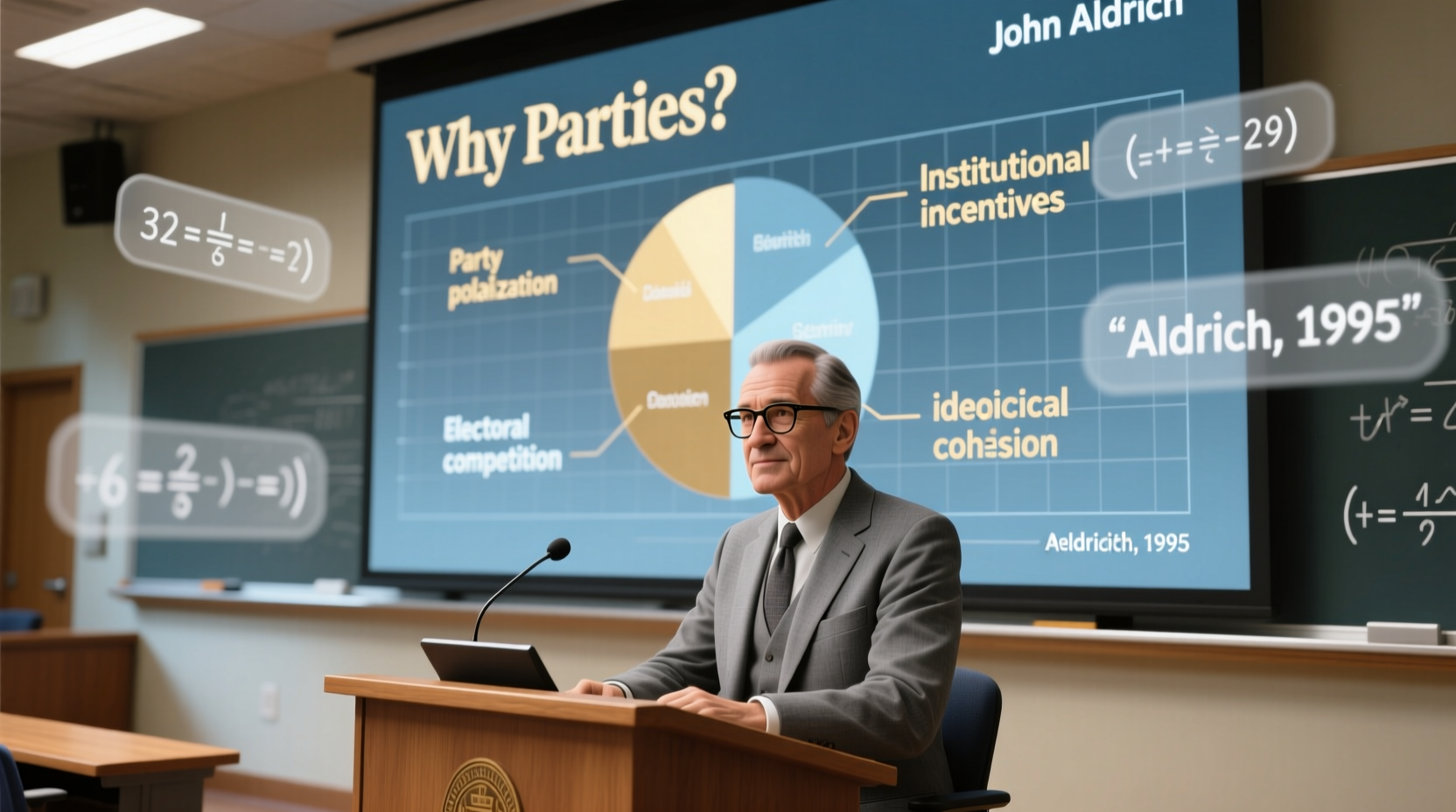
Aldrich argues that political parties exist primarily because individual politicians face significant challenges in achieving their goals—especially winning office and shaping policy—on their own. Without coordination, candidates would struggle to pool resources, build broad coalitions, and present coherent platforms. The party, therefore, emerges as a rational response to these obstacles.
According to Aldrich, parties are not ends in themselves but vehicles created by office-seeking politicians to overcome three core problems:
- Coordination failure: Without a party label, voters cannot easily identify which candidates share similar ideologies or policy preferences.
- Resource aggregation: Running effective campaigns requires money, volunteers, and infrastructure—resources that are more efficiently pooled under a party umbrella.
- Credibility commitment: A party brand allows candidates to signal consistency and reliability, helping voters trust promises across time and candidates.
This instrumental view of parties contrasts sharply with earlier institutional or sociological models that emphasized parties as grassroots movements or reflections of societal cleavages. Aldrich instead treats them as top-down constructs driven by strategic actors pursuing power.
Party Evolution: From Congressional to National Organizations
A critical contribution of Why Parties? is its historical account of how American parties evolved in response to changing political environments. Aldrich traces two major phases:
1. The Congressional Party Era (1830s–1930s)
During this period, parties were primarily controlled by members of Congress who used them to coordinate legislation and manage nominations. The party was less about mass mobilization and more about elite cohesion. Caucuses and conventions served as mechanisms for legislators to align on leadership and policy direction.
2. The National Party Era (Post-1930s)
The rise of presidential dominance, expanded suffrage, and federal bureaucracy transformed parties into national campaign organizations. Presidents began using the party as a tool to advance their agendas, leading to stronger party centralization. The Democratic and Republican parties developed formal structures—national committees, fundraising arms, and professional staff—to support presidential elections and policy advocacy.
This shift reflects Aldrich’s broader argument: parties adapt structurally to serve the strategic interests of ambitious politicians. As the presidency became the focal point of power, parties reorganized to maximize electoral success at that level.
“Parties are not natural entities; they are created by politicians who find it in their interest to cooperate over time.” — John Aldrich, Why Parties?
Functions of Political Parties in Modern Democracy
Aldrich identifies several enduring functions that parties perform in democratic systems. These are not inherent features but outcomes of rational political calculation. Below is a summary of these roles:
| Function | Description | Beneficiaries |
|---|---|---|
| Nomination Coordination | Prevents multiple candidates from splitting the vote within the same ideological camp. | Candidates, voters, office-seekers |
| Campaign Resource Pooling | Enables shared use of data, advertising, field operations, and fundraising networks. | All party-affiliated candidates |
| Policy Agenda Formation | Provides a platform that signals policy priorities to voters and legislators. | Leaders, bureaucrats, interest groups |
| Voter Information Simplification | Reduces uncertainty by offering a heuristic (party label) for candidate evaluation. | Low-information voters |
| Governing Coalition Building | Facilitates legislative coordination once in power. | Executive and legislative leaders |
Crucially, Aldrich emphasizes that these functions only persist as long as they serve the interests of those who sustain the party. If politicians can achieve their goals independently—through media fame, personal wealth, or digital campaigning—the relevance of the party diminishes.
Case Study: The Rise of Donald Trump and Party Strain
The 2016 U.S. presidential election offers a compelling real-world test of Aldrich’s framework. Donald Trump, a political outsider with no prior elected office, leveraged celebrity status, direct media access, and populist messaging to win the Republican nomination—bypassing traditional party gatekeepers.
Initially, much of the GOP establishment opposed Trump, revealing a tension between party elites and a candidate who did not rely on conventional party resources. Yet, once he secured the nomination, the party apparatus gradually aligned behind him. Why?
Applying Aldrich’s logic: despite initial resistance, Republican office-seekers calculated that opposing Trump would risk alienating a large segment of the electorate. Supporting him—even reluctantly—offered better odds of electoral success. Thus, the party adapted not out of ideological alignment, but strategic necessity.
This case illustrates both the resilience and fragility of parties in the Aldrich model. They remain powerful coordination tools, but their influence depends on whether politicians perceive value in cooperation.
Key Takeaways and Practical Insights for Political Observers
Understanding Aldrich’s theory equips analysts, students, and engaged citizens with a sharper lens for interpreting party behavior. Below is a checklist to apply his framework when observing contemporary politics:
- Identify whether a political move strengthens party cohesion or reflects individual ambition.
- Assess whether candidates depend on party infrastructure or operate independently.
- Examine how party platforms evolve in response to electoral incentives rather than ideological purity.
- Watch for moments when party leaders resist or embrace outsider candidates—and why.
- Consider how changes in campaign finance or media technology affect the need for party coordination.
Frequently Asked Questions
Does Aldrich believe parties are necessary for democracy?
Aldrich does not argue that parties are inherently necessary, but rather that they emerge when they solve practical problems for politicians and voters. In systems where alternative coordination mechanisms exist (e.g., strong independent media, digital campaigns), parties may weaken or transform.
How does Aldrich’s view differ from other party theories?
Traditional theories often see parties as expressions of social identities (e.g., class, religion). In contrast, Aldrich adopts a rational choice approach, treating parties as strategic tools created by self-interested politicians. His model is more functional than cultural.
Can Aldrich’s theory explain third-party success?
Limitedly. His model explains why third parties struggle: they lack the established infrastructure and credibility of major parties. However, if a third-party movement offers a superior solution to coordination or information problems, it could gain traction—though historically, such breakthroughs are rare in the U.S. system.
Conclusion: Applying Aldrich’s Framework Today
John Aldrich’s Why Parties? remains essential reading for anyone seeking to understand the mechanics of American politics. By shifting focus from parties as institutions to parties as instruments, Aldrich reveals the underlying logic of political organization. His insights help explain phenomena ranging from party polarization to the rise of populism.
In an era of increasing candidate independence, digital campaigning, and voter volatility, the survival of parties hinges on their continued utility. As long as politicians benefit from coordination, branding, and resource sharing, parties will endure—not because they are beloved, but because they are effective.




 浙公网安备
33010002000092号
浙公网安备
33010002000092号 浙B2-20120091-4
Comments
No comments yet. Why don't you start the discussion?