
When it comes to understanding our inner world, few tools are as accessible or powerful as expressive writing. Whether you're navigating grief, stress, anxiety, or simply trying to make sense of daily life, putting emotions into words can be transformative. But in an age where digital devices dominate, a critical question arises: Is handwriting your thoughts in a journal more effective than typing them on a keyboard when it comes to processing emotions?
The answer isn't just about preference—it's rooted in neuroscience, cognitive psychology, and real-world outcomes. While both methods offer benefits, they engage the brain differently, influence emotional depth, and impact long-term memory and insight in distinct ways. Understanding these differences can help you choose the right tool for emotional clarity, healing, and personal growth.
The Cognitive Impact of Handwriting
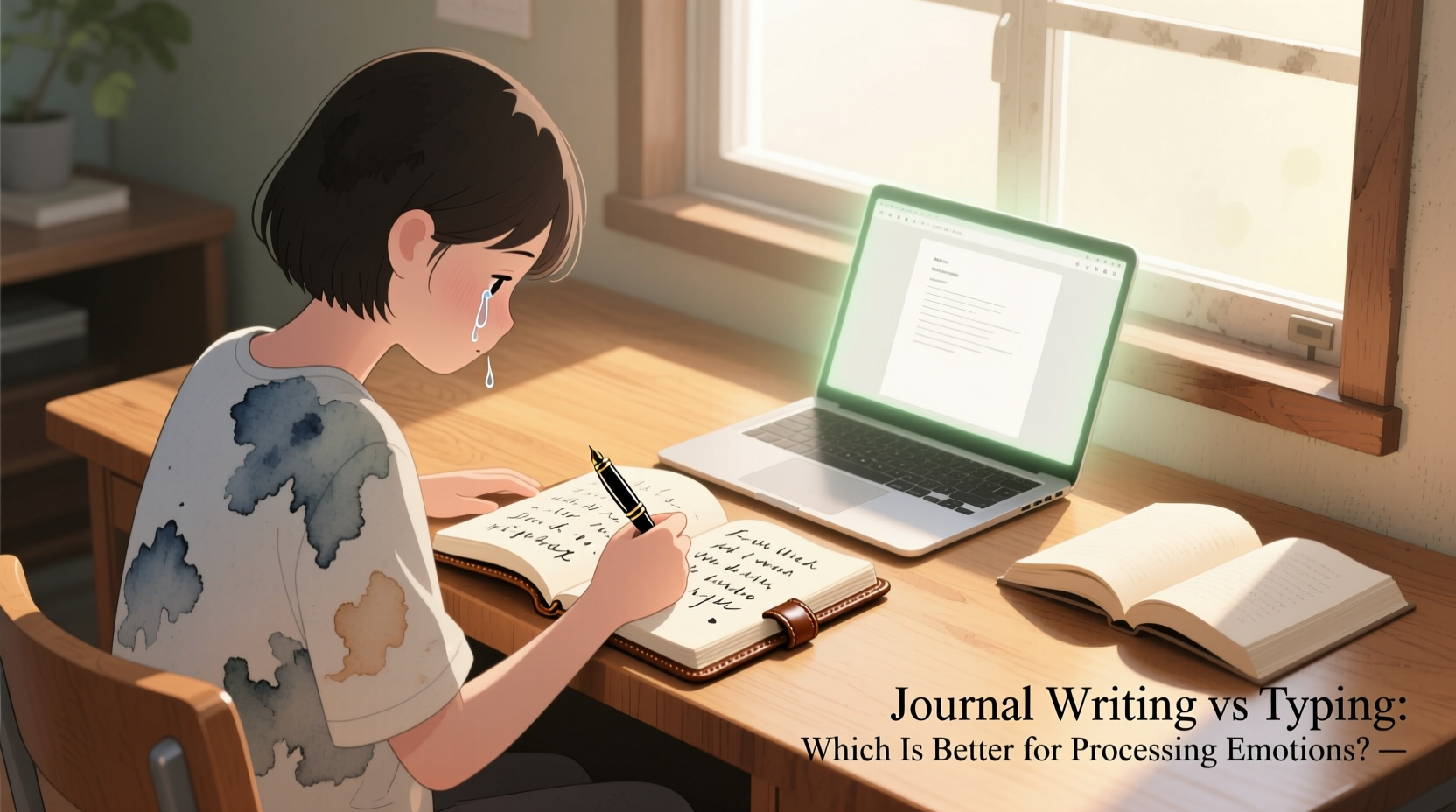
Handwriting is a slower, more deliberate process than typing. This slowness is not a flaw—it’s a feature. When you write by hand, your brain engages in deeper cognitive processing. The physical act of forming letters activates regions associated with language, thinking, and memory, particularly the reticular activating system (RAS), which helps filter information and focus attention.
Studies have shown that students who take handwritten notes retain information better than those who type them. This same principle applies to emotional expression. Because handwriting forces you to slow down, you’re more likely to reflect before writing, leading to richer, more thoughtful articulation of feelings.
Neuroscientist Dr. Stanislas Dehaene explains: “The hand is not just a passive tool; it’s an active participant in learning and cognition. Writing by hand creates stronger neural pathways than typing.” This deeper engagement supports introspection, making handwritten journaling especially effective for unpacking complex emotions like guilt, shame, or unresolved conflict.
Typing: Speed, Accessibility, and Emotional Distance
Typing offers undeniable advantages: speed, legibility, searchability, and convenience. For individuals managing high-stress jobs or living with anxiety, being able to quickly offload thoughts into a digital document can provide immediate relief. The ability to edit, reorganize, and even password-protect entries adds a layer of control that some find comforting.
However, this efficiency comes at a cost. Typing often encourages surface-level processing. Because thoughts can be entered rapidly, there’s less time for reflection between keystrokes. This can lead to emotional dumping—venting without insight—where feelings are expressed but not truly examined.
Additionally, the familiarity of digital devices introduces psychological associations. Your laptop or phone is likely tied to work, social media, or communication, creating a subtle mental barrier to vulnerability. You may unconsciously censor yourself, knowing the device holds other identities and audiences.
That said, typing can be ideal for people with physical limitations, those who struggle with fine motor skills, or anyone for whom handwriting causes discomfort. In such cases, the accessibility of typing makes emotional expression possible where it might otherwise be avoided.
Comparative Analysis: Journal Writing vs Typing
| Aspect | Handwriting | Typing |
|---|---|---|
| Speed | Slower, promotes reflection | Faster, enables rapid expression |
| Cognitive Engagement | High—activates memory and emotional centers | Moderate—less neural integration |
| Emotional Depth | Greater potential for insight and catharsis | Risk of superficial venting |
| Privacy & Security | Physical control, but risk of loss/theft | Digital encryption options, but hacking risks |
| Long-Term Review | Less searchable, tactile experience | Easy to search, copy, organize |
| Accessibility | Requires mobility and vision | More inclusive for diverse abilities |
This comparison reveals that neither method is universally superior. The choice depends on your goals: deep emotional processing favors handwriting, while quick documentation or structured planning may benefit from typing.
A Real Example: Sarah’s Journey Through Grief
Sarah lost her father suddenly in a car accident. Overwhelmed by guilt and sorrow, she began journaling every evening. At first, she typed her thoughts into a notes app on her phone. While it helped her release immediate emotions, she noticed she wasn’t gaining clarity—just repeating the same painful loops.
On the advice of her therapist, she switched to a leather-bound journal and pen. The change was subtle but profound. Without autocorrect, distractions, or the temptation to reread old texts, she found herself pausing between sentences, noticing nuances in her grief. After three weeks, she wrote: “I’m not angry at him for leaving. I’m angry at myself for not saying I loved him enough.” That sentence marked a turning point.
Sarah didn’t abandon typing entirely. She used it later to compile themes from her handwritten entries, creating a timeline of her healing. But the breakthrough—the moment of emotional truth—came through the slower, more intimate act of writing by hand.
“Writing by hand creates a sacred space for the self. It’s a ritual of presence that typing rarely replicates.” — Dr. Rebecca Thomas, Clinical Psychologist and Expressive Writing Researcher
When to Choose Each Method
Understanding the strengths of each approach allows you to use them strategically. Here’s a practical guide to help you decide when to write and when to type:
Choose Handwriting When:
- You’re exploring deep emotional pain or trauma
- You want to increase self-awareness and gain insight
- You’re practicing mindfulness or gratitude journaling
- You need to disconnect from digital noise and reconnect with yourself
- You’re working through relationship conflicts or identity questions
Choose Typing When:
- You need to capture many thoughts quickly (e.g., after a stressful meeting)
- You plan to share reflections with a therapist or coach
- You want to track mood patterns over time using keywords or tags
- You have physical challenges that make handwriting difficult
- You’re compiling insights from multiple journal entries for analysis
Step-by-Step Guide to Maximizing Emotional Processing
To get the most out of your journaling practice, follow this evidence-based sequence:
- Set the Environment: Find a quiet space. Put away your phone. Use soft lighting and a comfortable seat. If handwriting, choose a pen that feels good in your hand.
- Clarify Your Purpose: Ask yourself: Am I venting? Seeking solutions? Exploring memories? Naming the goal shapes the method.
- Write Freely for 10–15 Minutes: Focus on stream-of-consciousness expression. Don’t worry about grammar or structure. Let emotions flow.
- Pause and Reflect: After writing, sit quietly for 2–3 minutes. Breathe. Notice how your body feels. Did anything surprise you?
- Revisit and Highlight: Circle key phrases or emotions. Underline moments of clarity. If typing, use bold or color coding.
- Ask Insight Questions: “Why did this upset me?” “What need was unmet?” “How is this connected to my past?” Write answers in a new section.
- Optional: Transfer Insights Digitally: Type a brief summary of your main takeaway for future reference or therapy discussion.
This hybrid approach leverages the depth of handwriting with the organizational power of typing, creating a sustainable emotional processing routine.
FAQ: Common Questions About Journaling and Typing Emotions
Is one method better for reducing anxiety?
Handwriting tends to be more effective for reducing anxiety because it slows down thought spirals and promotes mindful awareness. However, for acute stress, typing can serve as a fast pressure valve. The key is to move from expression to reflection—regardless of medium.
Can digital journaling apps be as effective as paper journals?
Some apps—like Day One or Penzu—offer secure, distraction-free environments that mimic the privacy of a physical journal. They include prompts and reminders that can support consistency. However, the screen itself remains a potential trigger for distraction. Success depends on strict usage habits, such as disabling notifications and using full-screen mode.
How often should I journal to see emotional benefits?
Research suggests that just 15–20 minutes of expressive writing 3–4 times per week can significantly improve emotional regulation and reduce symptoms of depression. Consistency matters more than duration. Even five minutes of honest writing can shift your internal state.
Checklist: Optimize Your Emotional Journaling Practice
- ☑ Choose the right tool based on your goal (handwriting for depth, typing for speed)
- ☑ Journal at the same time each day to build habit strength
- ☑ Avoid self-censorship—write as if no one will ever read it
- ☑ Use open-ended prompts like “What am I avoiding feeling?” or “What does this anger protect me from?”
- ☑ Re-read past entries monthly to track emotional patterns and growth
- ☑ Combine methods: handwrite raw emotion, type structured summaries
- ☑ Protect privacy—lock your journal or enable encryption on digital files
Conclusion: Choose Intention Over Convenience
In the debate between journal writing and typing for emotional processing, the winner isn’t determined by technology—but by intention. Handwriting excels at fostering deep introspection, emotional integration, and lasting insight. Typing offers speed, accessibility, and utility for organization and sharing. The most emotionally intelligent approach isn’t to pick one forever, but to use each when it serves your needs.
If your goal is healing, self-discovery, or breaking through emotional blocks, reach for pen and paper. If you need to capture fleeting thoughts, collaborate with a therapist, or manage high-volume stress, typing has its place. What matters most is showing up for yourself—with honesty, patience, and courage.




 浙公网安备
33010002000092号
浙公网安备
33010002000092号 浙B2-20120091-4
Comments
No comments yet. Why don't you start the discussion?