
Journaling has long been recognized as a powerful tool for improving mental health. Whether used to process emotions, manage anxiety, or gain clarity during difficult times, putting thoughts into words can create profound psychological benefits. With advances in technology, traditional pen-and-paper journaling now competes with an array of digital apps designed to streamline the practice. But which approach is more effective for mental well-being? Is there a meaningful difference between writing by hand in a physical notebook and typing notes into a smartphone app? This article explores both formats in depth, comparing their cognitive, emotional, and behavioral impacts, supported by research, expert insights, and real-world experiences.
The Science Behind Journaling and Mental Health
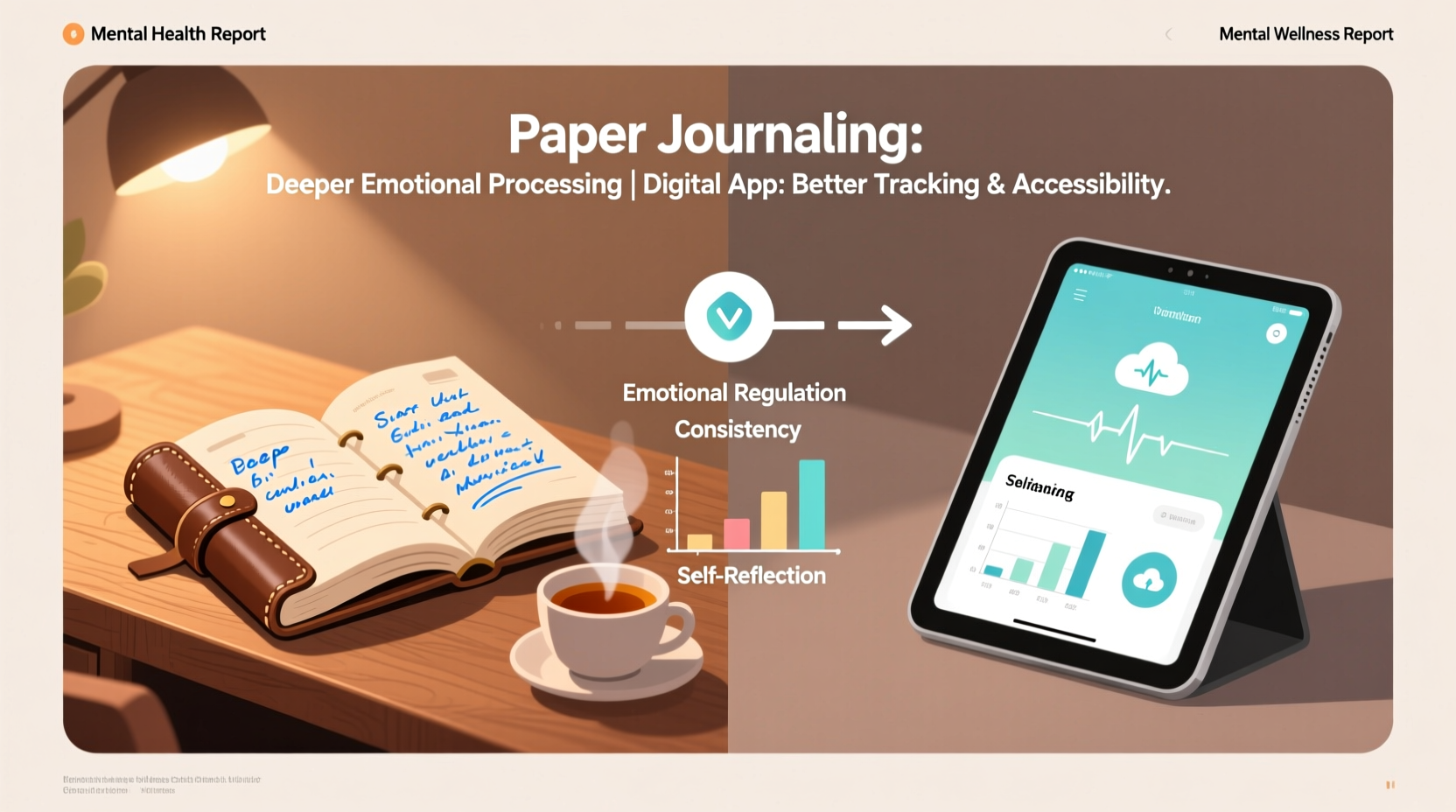
Decades of psychological research support expressive writing as a therapeutic practice. Dr. James Pennebaker, a pioneer in this field, demonstrated that writing about emotionally challenging experiences for just 15–20 minutes over several days leads to measurable improvements in mood, immune function, and even academic performance. The act of translating internal chaos into structured language helps regulate emotion, reduce rumination, and foster self-awareness.
When individuals journal consistently, they engage multiple brain regions associated with executive function, memory consolidation, and emotional processing. Writing activates the prefrontal cortex—responsible for rational thinking—while dampening activity in the amygdala, which governs fear and stress responses. This neurological shift promotes emotional regulation, making it easier to cope with trauma, grief, or daily stressors.
But does the medium affect these outcomes? Emerging studies suggest that how we write—not just what we write—can influence the depth of reflection, retention of insights, and long-term adherence to the habit.
Paper Diaries: The Cognitive and Emotional Advantages of Handwriting
Writing by hand engages the brain differently than typing. Neuroimaging studies show that handwriting stimulates sensorimotor circuits involved in learning and memory. The physical motion of forming letters creates stronger neural connections, enhancing comprehension and recall. In one study published in *Psychological Science*, students who took handwritten notes outperformed those who typed them on conceptual understanding tests—even when both groups reviewed identical material afterward.
This “generation effect” applies to emotional processing as well. When people write by hand, they tend to reflect more deeply, use richer vocabulary, and express greater emotional honesty. Without autocorrect, predictive text, or instant deletion, the slower pace encourages thoughtful phrasing and reduces impulse editing. This deliberateness fosters authenticity—an essential quality in therapeutic journaling.
“Handwriting forces you to slow down, which allows space for insight. You’re not just transcribing thoughts—you’re shaping them.” — Dr. Maria Sullivan, Clinical Psychologist and Author of *Mindful Expression*
Additionally, paper journals offer sensory feedback—the texture of the page, the sound of the pen, the visual progression of filled pages—that reinforces continuity and commitment. There’s also no risk of screen-induced anxiety or digital distractions like notifications pulling attention away from introspection.
Digital Journaling Apps: Accessibility, Features, and Behavioral Support
Digital journaling platforms such as Day One, Journey, and Reflectly have gained popularity due to their convenience and feature-rich interfaces. These apps often include templates, mood tracking, reminders, encryption, cloud backup, photo integration, and voice-to-text capabilities. For many users, especially those managing depression or anxiety, these tools lower the barrier to entry and promote consistency.
One key advantage of digital journaling is accessibility. Users can jot down thoughts anytime—during a commute, after a stressful meeting, or before sleep—without carrying a physical book. Push notifications remind users to write, helping build routine. Some apps analyze word patterns over time to detect shifts in mood, offering data-driven insights that might otherwise go unnoticed.
Moreover, privacy concerns are addressed through end-to-end encryption and biometric locks, making digital journals potentially safer than paper ones left on a desk. For individuals dealing with trauma or sensitive topics, knowing entries are securely stored can increase willingness to be vulnerable in writing.
However, digital journaling comes with trade-offs. Typing is faster but less cognitively engaging. The absence of motor memory may reduce emotional imprinting. And while features enhance functionality, they can also distract from pure reflection—scrolling through themes or formatting entries can become a procrastination tactic rather than a path to insight.
Comparative Analysis: Paper vs Digital Journaling
| Feature | Paper Diary | Digital App |
|---|---|---|
| Cognitive Engagement | High – enhances memory and deep thinking | Moderate – rapid input may bypass reflection |
| Emotional Depth | Greater – encourages vulnerability and honesty | Variable – depends on user discipline |
| Convenience & Portability | Limited – requires carrying notebook | High – accessible on devices always at hand |
| Privacy & Security | Physical risk – can be seen or lost | Strong – encrypted and password-protected |
| Long-Term Adherence | Depends on personal ritual | Higher – aided by reminders and gamification |
| Search & Retrieval | Manual – time-consuming to locate past entries | Instant – keyword search across months |
| Cost | Low – one-time purchase | Variable – freemium models or subscriptions |
The table reveals a nuanced picture: neither format dominates across all dimensions. Instead, effectiveness depends heavily on individual needs, lifestyle, and psychological goals.
Real-World Example: Two Approaches, One Goal
Consider Sarah, a 34-year-old therapist recovering from burnout. She tried digital journaling first using an app with mood tags and daily prompts. While she appreciated the reminders and ability to attach calming photos, she found herself rushing entries and avoiding deeper topics. “It felt too clinical,” she said. “Like filling out a form.” After switching to a leather-bound notebook, she noticed her entries grew longer, messier, and more honest. “I cried while writing things I hadn’t admitted aloud. That wouldn’t have happened on a screen.”
In contrast, Mark, a 28-year-old software developer with social anxiety, struggled to maintain any journaling habit until he discovered a voice-entry feature in a mobile app. “Speaking my thoughts felt safer than writing them,” he explained. “And having encrypted storage meant I didn’t worry about someone finding my device.” Over six months, his app-generated mood charts helped him identify triggers linked to work deadlines, prompting him to adjust his schedule proactively.
These cases illustrate that personal comfort and context determine success more than the tool itself.
Step-by-Step Guide: Choosing the Right Journaling Method for Your Mental Health
- Assess your primary goal: Are you seeking emotional release, symptom tracking, mindfulness, or creative exploration? Deep emotional processing favors paper; structured monitoring leans toward digital.
- Evaluate your lifestyle: Frequent travelers or tech-reliant professionals may benefit from app-based access. Those craving analog simplicity may prefer paper.
- Test both formats: Commit to each for two weeks. Use the same prompt (e.g., “What am I feeling right now?”) and compare emotional resonance and ease of use.
- Consider hybrid options: Some people write raw reflections by hand, then transcribe key insights digitally for safekeeping and analysis.
- Monitor consistency: Track how often you actually journal over a month. The most effective method is the one you stick with.
Actionable Checklist: Optimize Your Journaling Practice
- ☑ Set a consistent time and place for journaling (e.g., morning coffee or bedtime)
- ☑ Use open-ended prompts like “What do I need to let go of today?” or “Where did I feel joy this week?”
- ☑ Avoid judgment—there’s no “right” way to journal; honesty matters most
- ☑ Review past entries monthly to spot patterns in mood or behavior
- ☑ Secure your journal—lock your app or store your notebook privately
- ☑ Experiment with structure: try bullet points, stream-of-consciousness, or gratitude lists
Frequently Asked Questions
Is one method better for reducing anxiety?
Both can help, but differently. Paper journaling excels at facilitating deep emotional processing, which can alleviate chronic anxiety rooted in unresolved feelings. Digital apps are better suited for immediate symptom logging and identifying situational triggers through data trends.
Can I switch between paper and digital?
Absolutely. Many people use both depending on context—jotting quick thoughts on their phone during the day and doing deeper reflective writing at home in a notebook. Just ensure continuity by occasionally transferring key insights if needed.
How private are digital journaling apps?
Top-tier apps like Day One and Journey offer military-grade encryption and local storage options. However, free apps may collect metadata or display ads. Always review privacy policies and avoid entering highly sensitive information unless full encryption is confirmed.
Expert Consensus: It’s About Intention, Not Medium
“The best journal is the one you’ll actually use. Tools matter less than the intention behind them. If an app reminds you to reflect daily, it’s valuable. If a blank page invites truth, it’s transformative.” — Dr. Lena Torres, Cognitive Behavioral Therapist
Experts agree that regularity and authenticity outweigh technical superiority. A beautifully designed app won’t help if unused. A handmade journal collects dust if perceived as a chore. What counts is showing up—with whatever tool makes that possible—and writing with courage.
Final Thoughts: Building a Sustainable Journaling Habit
The debate between paper diaries and digital apps isn’t about declaring a winner—it’s about matching the method to the mind. For some, the tactile intimacy of handwriting unlocks emotional doors. For others, the seamless integration of digital tools sustains momentum where willpower falters.
Ultimately, journaling for mental health works best when it feels natural, safe, and sustainable. Whether ink meets paper or fingers meet screen, the core value lies in creating space for self-dialogue—a rare commodity in our hyperconnected world.




 浙公网安备
33010002000092号
浙公网安备
33010002000092号 浙B2-20120091-4
Comments
No comments yet. Why don't you start the discussion?