
For centuries, journaling has been a trusted tool for reflection, emotional regulation, and cognitive clarity. In recent decades, the rise of smartphones and productivity apps has shifted how many people document their thoughts—replacing pen and paper with keyboards and voice-to-text. But as mental health becomes a growing priority, a critical question emerges: which form of journaling—on paper or through a digital app—is more effective for achieving true mental clarity?
Mental clarity refers to a state of mind where thoughts are focused, organized, and free from mental clutter. It allows for better decision-making, reduced anxiety, and improved self-awareness. Journaling supports this by externalizing thoughts, identifying patterns, and creating space between emotion and reaction. Yet the medium in which we journal can significantly influence its impact.
The Cognitive Benefits of Writing by Hand
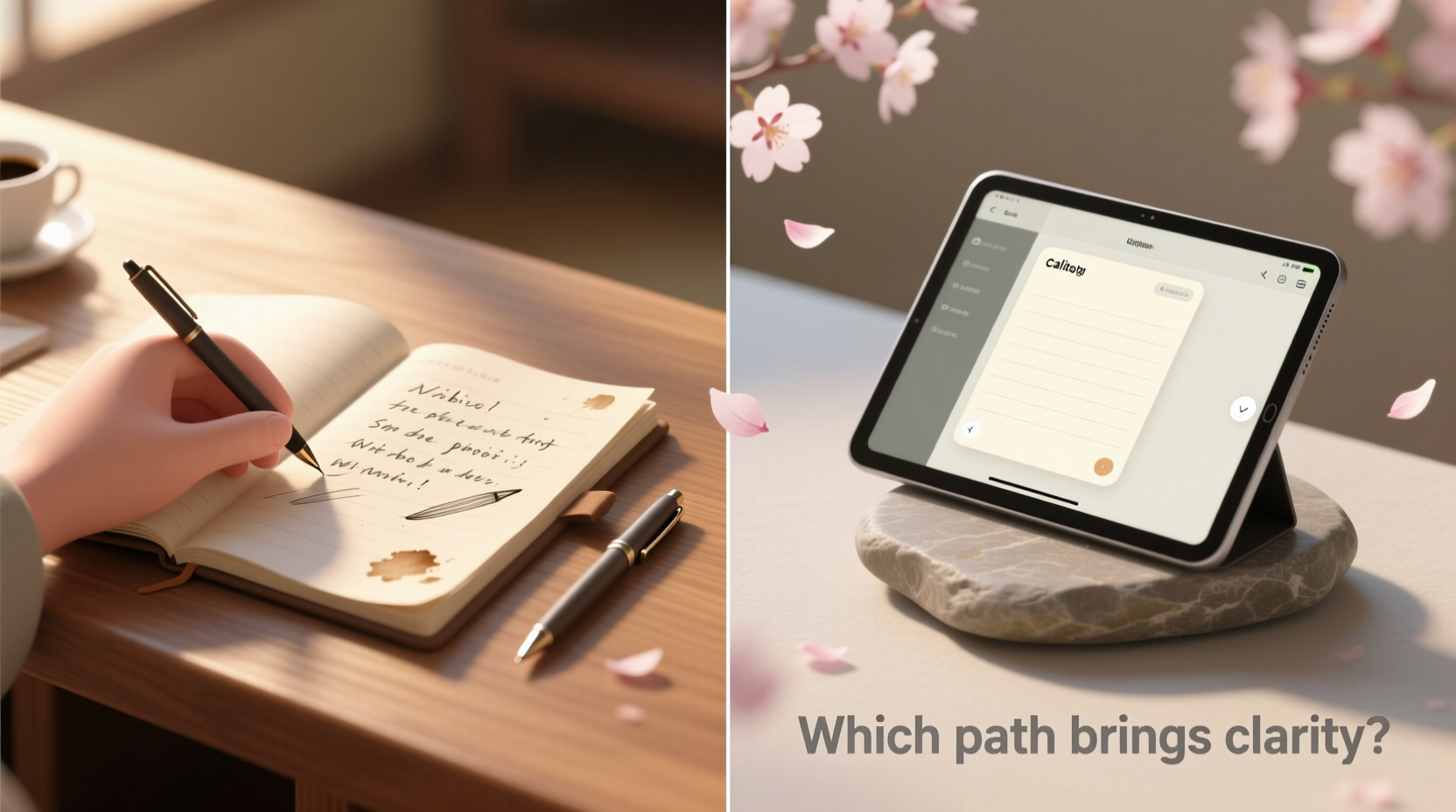
Neuroscience research consistently shows that writing by hand engages the brain differently than typing. When you write with a pen, your brain activates regions associated with language, memory, and executive function more deeply than during keyboard input. This is due in part to the slower, deliberate nature of handwriting, which forces cognitive engagement and meaning-making.
A 2014 study published in *Psychological Science* found that students who took notes by hand demonstrated better conceptual understanding and retention than those who typed. The same principle applies to journaling: the physical act of forming letters strengthens neural pathways linked to comprehension and introspection.
Writing on paper also reduces distractions. Unlike digital devices, a notebook doesn’t ping with notifications or tempt you to switch tabs. This uninterrupted focus fosters deeper reflection, making it easier to untangle complex emotions or identify recurring thought patterns.
Digital Journaling: Speed, Searchability, and Structure
Digital journaling apps like Day One, Journey, or Notion offer compelling advantages, especially for users seeking efficiency and organization. Typing is faster than handwriting, allowing users to capture thoughts quickly before they fade. This speed can be crucial during moments of high stress or inspiration when ideas flood in rapidly.
Search functionality is another major benefit. Need to revisit what you wrote about work anxiety three months ago? A simple keyword search retrieves entries instantly—something impossible with a physical notebook unless meticulously indexed.
Many digital journals also support multimedia integration. You can attach photos, voice memos, GPS location, or even biometric data from wearables. For some, this enriched context deepens self-understanding. For example, pairing a mood log with sleep data might reveal patterns invisible through text alone.
However, these conveniences come at a cost. The very features that make digital tools efficient—notifications, internet access, multitasking capabilities—also make them prone to distraction. Opening a journaling app on your phone often means being one swipe away from social media, emails, or games. This undermines the mindfulness essential to mental clarity.
Comparing Paper and Digital: A Feature-by-Feature Breakdown
| Feature | Paper Journal | Digital App |
|---|---|---|
| Cognitive Engagement | High – activates motor memory and deeper processing | Moderate – faster but less reflective |
| Speed of Entry | Slower – limited by handwriting speed | Faster – typing allows rapid capture |
| Distraction Risk | Very low – no alerts or pop-ups | High – device-dependent interruptions |
| Search & Organization | Low – manual indexing required | High – instant search and tagging |
| Portability & Backup | Portable but vulnerable to loss/damage | Cloud-synced, secure, accessible across devices |
| Privacy & Security | Physically secure if kept private | Depends on encryption; potential for data breaches |
| Multimedia Support | None (unless pasting items) | Full support (photos, audio, video) |
Real-World Impact: A Mini Case Study
Sarah, a 34-year-old project manager, struggled with racing thoughts and decision fatigue. She began journaling to gain clarity but initially used her iPad with a note-taking app. While she appreciated the ability to search past entries, she noticed she often opened Instagram after logging her thoughts—defeating the purpose.
After two months of inconsistent results, Sarah switched to a leather-bound notebook and committed to writing each morning with coffee. Within three weeks, she reported feeling “more grounded” and able to identify recurring stress triggers—something she hadn’t noticed digitally. “There’s something about the silence of paper,” she said. “It feels like I’m having a real conversation with myself.”
Her experience reflects a broader trend: while digital tools excel in logistics, analog methods often win in emotional depth and presence.
“Handwriting creates a feedback loop between mind and body that typing cannot replicate. It slows us down in the best way—making room for insight.” — Dr. Naomi Klein, Cognitive Psychologist, University of Toronto
Optimizing Your Journaling Practice: A Step-by-Step Guide
Whether you choose paper or digital, the key to mental clarity lies in consistency and intentionality. Follow this six-step process to build an effective journaling habit:
- Define Your Purpose: Are you journaling to reduce anxiety, track moods, solve problems, or explore creativity? Clarity of intent shapes your method.
- Choose Your Medium: Based on your lifestyle, select paper or digital. Frequent travelers may prefer cloud-backed apps; those seeking mindfulness may lean toward analog.
- Set a Fixed Time: Morning pages or bedtime reflections work best for most. Attach journaling to an existing habit (e.g., after brushing teeth).
- Use Prompts for Depth: Instead of “What happened today?” ask, “What emotion dominated my day, and why?” or “What thought kept returning?”
- Review Weekly: Scan entries weekly to spot patterns. On paper, use sticky notes; in apps, tag entries by theme (e.g., #stress, #gratitude).
- Adjust as Needed: If your chosen method isn’t yielding clarity, experiment. Try hybrid approaches—sketching on paper, then summarizing digitally.
Hybrid Approaches: Best of Both Worlds?
Some individuals find balance by combining both methods. For instance, they might draft raw, emotional entries by hand to maximize cognitive engagement, then transfer key insights into a digital format for tracking and analysis.
This dual approach leverages the reflective power of handwriting and the organizational strength of technology. Tools like scanning apps (e.g., Adobe Scan or Microsoft Lens) allow users to digitize handwritten pages, preserving authenticity while enabling backup and search.
Another hybrid model involves using voice-to-text sparingly: speaking thoughts aloud when overwhelmed, then editing them later in a quiet setting. This can be especially helpful for those with physical limitations or dysgraphia.
The goal isn’t purity of method but effectiveness. As long as the process leads to greater self-awareness and mental clarity, the medium is secondary.
Common Pitfalls to Avoid
- Over-relying on aesthetics: Beautiful notebooks or color-coded digital themes can become a distraction. Focus on content, not presentation.
- Perfectionism: Waiting for the “right” moment or writing “correctly” kills consistency. Mental clarity comes from honesty, not eloquence.
- Using journaling as rumination: Repeating negative thoughts without reflection reinforces loops. Always aim to end with a question, insight, or action step.
- Neglecting privacy: Whether digital or physical, ensure your journal is stored securely. Fear of exposure inhibits truthfulness.
Checklist: Building a Clarity-Focused Journaling Habit
- ✅ Choose a medium (paper, digital, or hybrid) aligned with your goals
- ✅ Set a consistent time and place for journaling
- ✅ Start with a simple prompt to overcome blank-page anxiety
- ✅ Limit session length (5–15 minutes) to maintain sustainability
- ✅ Review entries weekly to identify emotional or behavioral patterns
- ✅ Protect your journal’s privacy to encourage full honesty
- ✅ Adjust method if mental clarity isn’t improving after 3–4 weeks
Frequently Asked Questions
Can digital journaling ever be as effective as paper for mental clarity?
Yes—but only if you minimize distractions. Use distraction-free writing modes, disable notifications, and consider dedicated e-ink devices like reMarkable or Kindle. These mimic paper’s simplicity while offering digital benefits.
Is there a risk of losing insights with paper journals?
Potentially. Physical journals can be lost, damaged, or become disorganized over time. To mitigate this, periodically summarize key insights in a digital doc or scan important pages. Treat the paper journal as your primary thinking space, and the digital copy as an archive.
How long should I stick with one method before switching?
Give any method at least 21 days of consistent use before evaluating. Habits take time to yield results, and initial discomfort doesn’t mean ineffectiveness. If after a month you feel no greater clarity, reassess your approach.
Conclusion: Clarity Begins Where Distraction Ends
The choice between journaling on paper and using a digital app isn’t about technological superiority—it’s about psychological suitability. For most people seeking mental clarity, the slower, tactile, and distraction-free nature of paper offers a deeper pathway to insight. However, digital tools provide unmatched convenience, searchability, and scalability, making them ideal for analytical thinkers or those managing complex emotional data over time.
The most effective journaling practice is the one you sustain. Whether you fill Moleskines or sync encrypted cloud entries, the act of externalizing your inner world creates space for clarity to emerge. Start where you are. Use what works. Refine as you grow.




 浙公网安备
33010002000092号
浙公网安备
33010002000092号 浙B2-20120091-4
Comments
No comments yet. Why don't you start the discussion?