
Journaling has long been a trusted tool for self-reflection, emotional regulation, and mental clarity. In today’s digital age, people face a choice: reach for a notebook and pen or open a journaling app on their phone. While both methods offer benefits, a growing body of research suggests that handwriting may have a unique advantage when it comes to processing emotions deeply and effectively. The tactile experience of writing by hand engages the brain differently than typing, influencing how we reflect, remember, and regulate feelings.
This isn’t just about nostalgia for pen and paper. It’s about understanding how our tools shape our thinking. Whether you're managing stress, working through grief, or simply trying to understand your daily moods, the medium you choose can affect the depth of your insights. Let’s explore the cognitive, emotional, and practical differences between analog and digital journaling—and whether putting pen to paper really leads to deeper emotional processing.
The Cognitive Science Behind Handwriting and Emotion
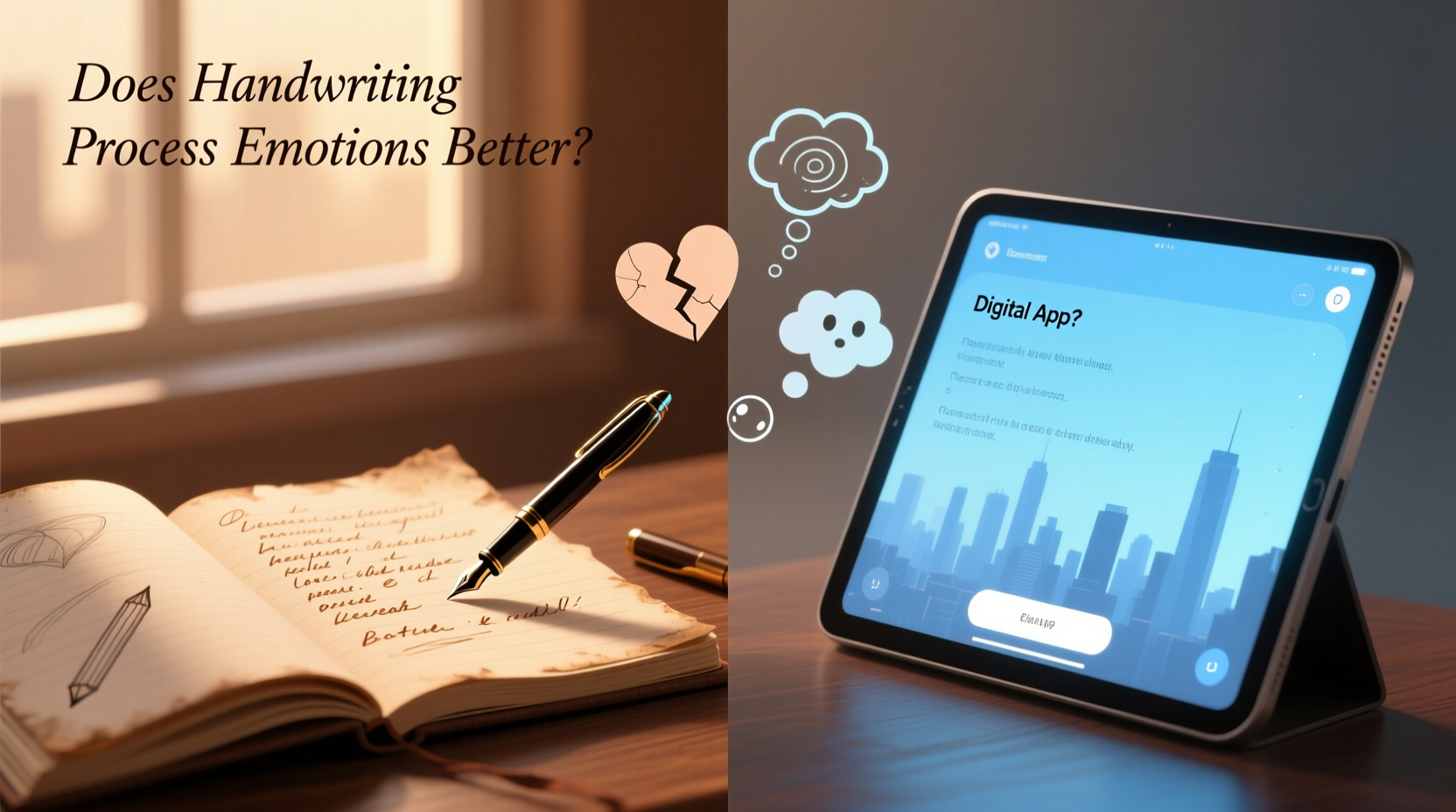
When you write by hand, your brain activates a complex network involving motor control, memory, and sensory feedback. Unlike typing, which is largely mechanical and fast, handwriting requires slower, deliberate movements that engage multiple regions of the brain simultaneously. Studies using fMRI scans show that forming letters by hand stimulates areas associated with language, memory, and emotion regulation—particularly the prefrontal cortex and limbic system.
Dr. Virginia Berninger, a cognitive scientist at the University of Washington, found that students who wrote essays by hand produced more words and demonstrated greater conceptual coherence than those who typed. Her research also showed increased neural activity in regions linked to idea generation and emotional integration during handwritten tasks. This suggests that handwriting doesn’t just record thoughts—it helps shape them.
“Writing by hand creates a deeper connection between thought and expression. It forces a kind of cognitive slowness that fosters reflection.” — Dr. Anne Trubek, author of *The History and Future of Handwriting*
This “cognitive slowness” is key. Typing allows rapid input, often matching the speed of thought. But this speed can bypass deeper processing. Handwriting, by contrast, introduces a natural delay. That pause gives the mind time to reframe, reconsider, and connect emotions to experiences in a more nuanced way.
Emotional Processing: Depth Over Speed
Processing emotions isn’t just about venting; it’s about making sense of feelings, identifying patterns, and gaining insight. Psychologists refer to this as “meaning-making,” a crucial step in healing from stress, trauma, or daily emotional friction.
In a landmark study by Dr. James Pennebaker, participants who wrote about traumatic experiences for 15–20 minutes over three to four days showed improved immune function, reduced anxiety, and better mood regulation. Notably, the most significant benefits occurred when writing was done consistently and introspectively—not just listing events, but exploring their emotional significance.
Follow-up studies revealed that those who wrote by hand reported higher levels of emotional insight compared to typists. Researchers speculate this is due to the embodied nature of handwriting. The physical act—pressure on the pen, texture of the paper, rhythm of strokes—creates a somatic anchor for memory and emotion. This multisensory engagement strengthens the emotional resonance of what’s written.
Paper vs. Digital: A Practical Comparison
While the science favors handwriting for emotional depth, digital journaling offers undeniable convenience. Let’s break down the trade-offs across key dimensions:
| Factor | Paper Journaling | Digital Journaling |
|---|---|---|
| Emotional Depth | High – encourages reflection, slows thought, enhances memory encoding | Moderate – faster input may reduce introspection |
| Convenience | Low – requires carrying materials, no search function | High – accessible anywhere, searchable, syncs across devices |
| Privacy & Security | High – physical control, no hacking risk (if locked) | Variable – depends on app encryption and device security |
| Longevity & Backup | Risk of loss/damage – no automatic backup | High – cloud storage, easy duplication |
| Creativity & Flexibility | High – space for doodles, underlining, marginalia | Moderate – limited by interface design |
| Speed & Volume | Slower – average 20–30 words per minute | Faster – 40–60+ words per minute |
The table shows a clear pattern: paper wins on emotional engagement and creative freedom, while digital excels in accessibility and organization. For users prioritizing emotional processing—especially during therapy, grief, or major life transitions—handwriting appears superior. However, for tracking moods, logging daily habits, or capturing fleeting ideas, digital tools are often more sustainable.
A Real Example: Sarah’s Journey Through Grief
Sarah, a 34-year-old teacher, began journaling after losing her father unexpectedly. At first, she used a popular journaling app, typing entries late at night. She found it easy to log facts—“Dad called today. We talked about the garden.”—but struggled to express her sadness. After two weeks, she felt stuck.
On a friend’s suggestion, she switched to a small Moleskine notebook. She committed to writing by hand each evening, even if only for five minutes. Within days, something shifted. “I started writing things I didn’t know I felt,” she said. “Like guilt for not visiting more, or anger at the hospital staff. The pen made me slow down. I’d pause, reread, underline a word. It felt like I was talking to myself, not just recording.”
Over time, Sarah noticed recurring themes—love, regret, longing. She began drawing small sketches next to entries: a rose, his favorite hat. These visual cues triggered deeper memories. Six months later, she still uses the same notebook occasionally, flipping back to earlier pages. “It’s not just words,” she explained. “It’s proof I lived through it.”
Sarah’s experience reflects a broader truth: emotional healing often requires more than information management. It needs presence, patience, and personal symbolism—qualities handwriting naturally supports.
How to Choose the Right Method for Your Needs
There’s no one-size-fits-all answer. The best journaling method depends on your goals, lifestyle, and emotional state. Below is a checklist to help you decide—or blend both approaches effectively.
Journaling Decision Checklist
- Are you exploring deep emotions (grief, anxiety, trauma)? → Lean toward paper
- Do you need to capture ideas quickly throughout the day? → Digital may be better
- Is privacy a major concern? → Paper offers more control
- Do you want to search past entries easily? → Digital wins
- Are you using journaling for therapy or self-discovery? → Prioritize handwriting
- Do you struggle with consistency? → Try a digital app with reminders
- Do you enjoy tactile experiences (writing, sketching, coloring)? → Paper enhances satisfaction
Many people find success with a hybrid approach: using a paper journal for reflective, emotional writing and a digital app for habit tracking, gratitude logs, or quick notes. For example, you might write a nightly emotional review by hand, then use an app to log your mood on a scale each morning.
Step-by-Step Guide to Deep Emotional Journaling
If you’re ready to explore emotional processing through handwriting, follow this structured approach:
- Choose your tools: Select a notebook and pen that feel comfortable. Avoid overly large journals—smaller ones feel less intimidating.
- Set the environment: Find a quiet space with minimal distractions. Consider lighting a candle or playing soft instrumental music.
- Begin with grounding: Take three slow breaths. Place your hand on the page. Notice the texture.
- Write a prompt: Start with “Today, I feel…” or “What I’m not saying is…” to bypass surface-level thoughts.
- Write without stopping: Set a timer for 10–15 minutes. Keep the pen moving, even if you repeat phrases.
- Engage the senses: Describe not just emotions, but where you feel them in your body. “My chest feels tight,” or “My jaw is clenched.”
- Re-read and reflect: After writing, read aloud quietly. Underline key phrases. Ask: What surprised me?
- Close intentionally: End with one sentence of self-compassion: “I honor what I’m feeling,” or “This is part of my journey.”
This ritual builds emotional literacy over time. You’ll begin to notice patterns—how certain people, events, or times of day affect your inner state. More importantly, you’ll develop a compassionate relationship with your emotions, rather than suppressing or fearing them.
Frequently Asked Questions
Can digital journaling ever be as effective as handwriting for emotional processing?
For some users, yes—especially when digital tools include voice-to-text, handwriting input (via stylus), or guided prompts that encourage reflection. However, pure typing lacks the motor-sensory feedback that makes handwriting uniquely effective for deep processing. If using digital, try slowing down, minimizing distractions, and avoiding auto-correct to mimic the reflective pace of handwriting.
Is there a risk of becoming too emotionally absorbed when journaling by hand?
Yes, especially for individuals with depression or PTSD. Writing about trauma can temporarily increase distress before leading to relief. It’s important to balance emotional exploration with grounding techniques. If journaling consistently worsens your mood, consider doing it in therapy or switching to brief, structured entries (e.g., “One thing I felt today: ___. One thing I need: ___”).
How often should I journal to see emotional benefits?
Research suggests 15–20 minutes, 3–4 times per week is sufficient to gain measurable benefits. Daily journaling can be helpful, but consistency matters more than frequency. Even short entries, when done regularly, build self-awareness over time.
Conclusion: Write With Intention, Regardless of Medium
The question isn’t whether paper is universally better than digital, but whether your journaling practice aligns with your emotional goals. If you seek clarity, healing, or deeper self-understanding, handwriting offers a powerful advantage. Its slower pace, sensory richness, and cognitive engagement create the ideal conditions for emotional processing. Yet digital tools remain invaluable for organization, accessibility, and habit formation.
The most effective journalers aren’t loyal to a format—they’re committed to honesty. Whether ink on paper or text on screen, the act of writing transforms chaos into coherence. It turns fleeting feelings into lasting insight. So pick up the pen if it calls to you. Or open the app if that’s what fits your life. Just start. The page—physical or digital—waits not for perfection, but for your truth.




 浙公网安备
33010002000092号
浙公网安备
33010002000092号 浙B2-20120091-4
Comments
No comments yet. Why don't you start the discussion?