
In an age of constant notifications, overflowing inboxes, and relentless mental chatter, the need to declutter the mind has never been more urgent. Two of the most widely recommended practices for achieving mental clarity are journaling and meditation. Both have deep roots in psychological and spiritual traditions and are backed by modern science. Yet, they work in fundamentally different ways. One invites expression through words; the other cultivates silence through awareness. So, which is better for clearing mental clutter? The answer isn’t straightforward—it depends on your personality, goals, and current state of mind.
Understanding Mental Clutter
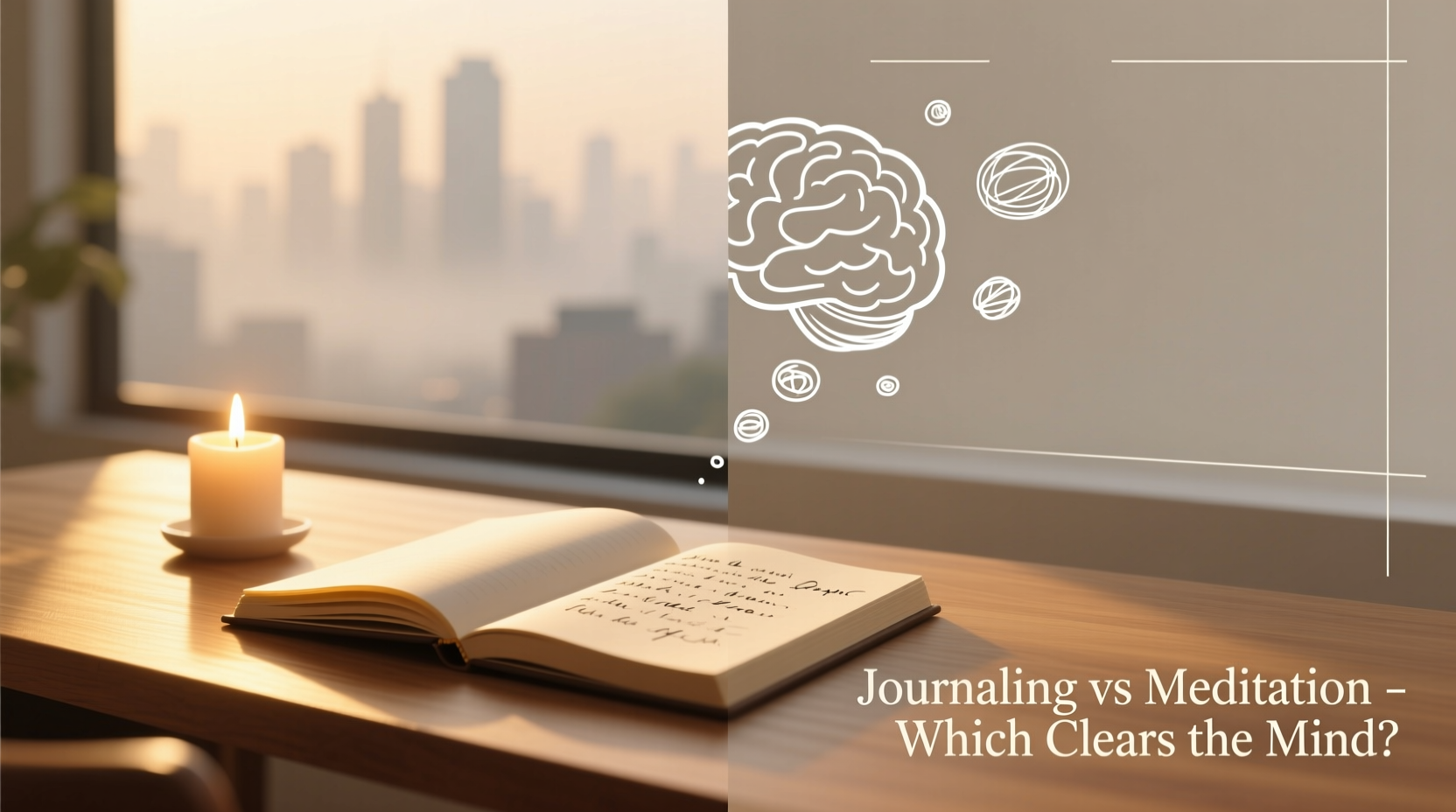
Mental clutter refers to the accumulation of unprocessed thoughts, unresolved emotions, repetitive worries, and fragmented ideas that occupy cognitive space without contributing to clarity or peace. It manifests as brain fog, decision fatigue, anxiety, or difficulty focusing. Unlike physical clutter, mental clutter is invisible but just as disruptive. It doesn't vanish on its own. Intentional practices are required to sort, release, or reframe these internal disturbances.
Both journaling and meditation serve as tools to manage this buildup—but through different mechanisms. Journaling externalizes thoughts by putting them into language, while meditation teaches detachment from thought itself. Understanding this distinction is key to choosing the right practice—or combining both effectively.
How Journaling Clears the Mind
Journaling is an active process of writing down thoughts, feelings, and experiences. It functions like a mental dump, allowing the brain to offload information it’s holding onto unnecessarily. When thoughts remain trapped in the mind, they tend to loop and amplify. Writing them down interrupts this cycle.
Research supports the cognitive benefits of expressive writing. A study published in the Journal of Experimental Psychology found that participants who wrote about their thoughts for 15–20 minutes daily experienced improved working memory and reduced intrusive thinking. The act of structuring thoughts into sentences forces the brain to organize chaos, making problems feel more manageable.
Different forms of journaling serve distinct purposes:
- Stream-of-consciousness journaling: Write continuously without editing or filtering. Ideal for releasing emotional tension.
- Gratitude journaling: Focuses on positive experiences, shifting attention away from rumination.
- Problem-solving journaling: Breaks down challenges into actionable steps, reducing overwhelm.
- Morning pages (from Julia Cameron’s “The Artist’s Way”): Three pages of longhand writing upon waking to clear mental debris before the day begins.
The Cognitive Benefits of Writing
Writing engages the prefrontal cortex, the brain region responsible for executive function. This engagement helps regulate emotions and improve self-awareness. By naming emotions (“I feel anxious about my presentation”), you reduce their intensity—a phenomenon known as “affect labeling.” Journaling also creates distance between you and your thoughts. Once something is written, it becomes an object you can observe, rather than a force consuming you.
“Writing is nature’s antidepressant. It allows us to confront our inner world with honesty and structure.” — Dr. James Pennebaker, psychologist and pioneer of expressive writing research
How Meditation Clears the Mind
Meditation, in contrast, is not about capturing thoughts but observing them without reaction. The goal isn’t to eliminate thoughts—because that’s impossible—but to change your relationship with them. Through mindfulness, you learn to see thoughts as passing events in the mind, like clouds drifting across the sky.
Neuroscientific studies show that regular meditation reduces activity in the default mode network (DMN), the brain system associated with mind-wandering and self-referential thinking—the very source of much mental clutter. Over time, meditators report greater mental spaciousness, reduced reactivity, and improved focus.
Common meditation styles include:
- Mindfulness meditation: Focus on breath or bodily sensations, gently returning attention when the mind wanders.
- Loving-kindness (metta) meditation: Cultivates compassion, which can soften the harsh inner critic contributing to mental noise.
- Body scan meditation: Directs awareness through the body, grounding attention in physical sensation rather than thought.
- Open monitoring meditation: Observes all experiences—thoughts, sounds, emotions—without attachment.
Unlike journaling, meditation does not require analysis or narrative. It operates on the principle that awareness alone can dissolve mental congestion. You don’t need to understand why a thought arises—you simply notice it and let it pass.
The Neuroscience of Stillness
A 2011 study from Harvard Medical School found that just eight weeks of mindfulness meditation increased gray matter density in brain regions linked to learning, memory, and emotional regulation. Participants also reported lower stress levels and fewer distracting thoughts. These changes suggest that meditation doesn’t just provide temporary relief—it reshapes the brain’s response to mental clutter over time.
Journaling vs Meditation: A Comparative Analysis
To determine which practice is more effective for decluttering, consider how each handles common sources of mental noise.
| Aspect | Journaling | Meditation |
|---|---|---|
| Best for | Processing emotions, solving problems, organizing thoughts | Reducing reactivity, increasing presence, quieting mental chatter |
| Mechanism | Externalization through language | Detachment through observation |
| Time required | 10–30 minutes (can be longer) | 5–20 minutes (scalable) |
| Skill development | Writing fluency, self-reflection | Attention control, emotional regulation |
| Immediate effect | Relief through release (\"I got it out\") | Calm through stillness (\"I am not my thoughts\") |
| Long-term benefit | Improved self-understanding, emotional processing | Reduced baseline anxiety, enhanced focus |
| Barriers to entry | Requires willingness to write honestly | Challenging for those with racing thoughts |
When Journaling Works Better
Journaling excels when your mind is overloaded with specific concerns—work deadlines, relationship conflicts, or decisions requiring reflection. If your mental clutter feels like a tangled web of \"what ifs\" and \"should haves,\" writing helps disentangle it. It’s particularly useful during periods of transition, grief, or creative blocks.
When Meditation Works Better
Meditation shines when the mind is caught in loops of anxiety or rumination without a clear cause. If your thoughts feel like background static—persistent but vague—meditation trains you to stop engaging with them. It’s ideal for cultivating a baseline of calm, especially in high-stress environments.
Real-World Example: Sarah’s Journey to Mental Clarity
Sarah, a 34-year-old project manager, struggled with chronic mental fatigue. Her days were filled with meetings, emails, and endless to-do lists. At night, her mind would replay conversations and anticipate tomorrow’s challenges. She tried meditation using a popular app but found herself frustrated—her thoughts wouldn’t stop. After five minutes, she’d give up, feeling like a failure.
A therapist suggested she start with journaling instead. Each evening, Sarah spent 15 minutes writing freely about her day—what stressed her, what went well, what lingered in her mind. Within a week, she noticed less nighttime rumination. The simple act of writing gave her a sense of closure.
After two months, she returned to meditation. This time, it felt different. With fewer unresolved thoughts swirling, she could sit quietly for 10 minutes without agitation. Journaling had cleared the surface; meditation deepened the calm beneath.
Sarah now uses both: journaling in the morning to plan and reflect, meditation at lunch to reset. Together, they form a complementary system for mental hygiene.
Step-by-Step Guide: Building a Dual Practice
You don’t have to choose one over the other. Many people benefit from integrating both journaling and meditation into a cohesive routine. Here’s how to build a balanced approach:
- Assess your current mental state: Are you overwhelmed with specific thoughts (choose journaling) or general anxiety (try meditation)?
- Start small: Begin with 5 minutes of meditation or one page of journaling per day.
- Pair practices strategically: Journal before meditating to release mental load, or meditate before journaling to access clearer insights.
- Use journaling to track meditation progress: Note how you feel before and after sessions to identify patterns.
- Adjust weekly: If journaling feels burdensome, switch to voice notes. If meditation feels frustrating, return to writing until your mind settles.
Sample Daily Routine
- 7:00 AM – Morning Pages: 10 minutes of stream-of-consciousness writing.
- 12:30 PM – Mindful Breathing: 7-minute seated meditation after lunch.
- 8:00 PM – Gratitude Journal: List three positive moments from the day.
Frequently Asked Questions
Can journaling replace meditation?
No, not entirely. While journaling helps process thoughts, it doesn’t train attention or cultivate non-reactivity the way meditation does. They serve different but complementary roles. Some find journaling too mentally active to produce deep calm, which is where meditation excels.
Is one better for anxiety?
It depends on the type of anxiety. For situational or thought-based anxiety (e.g., worrying about a job interview), journaling can help organize fears and develop coping strategies. For generalized anxiety or chronic overthinking, meditation builds resilience by changing your relationship to anxious thoughts. Combining both often yields the best results.
How long before I see results?
Many people notice subtle shifts within a week—fewer obsessive thoughts, better sleep, or improved focus. Significant changes typically emerge after 4–6 weeks of consistent practice. Like physical exercise, mental training requires repetition to build lasting capacity.
Final Thoughts: Choose Integration, Not Competition
The question of whether journaling or meditation is better for decluttering a busy mind misses a deeper truth: they are not rivals but allies. Journaling brings order to the content of the mind; meditation expands the space around it. One clears the forest floor of debris; the other widens the clearing.
Some days, you’ll need the precision of words to untangle a problem. Other days, you’ll crave the silence of meditation to simply be. The most effective mental hygiene routines honor both needs. Start with whichever feels more accessible, then gradually incorporate the other. Over time, you’ll develop a personalized toolkit for navigating mental clutter with grace and resilience.




 浙公网安备
33010002000092号
浙公网安备
33010002000092号 浙B2-20120091-4
Comments
No comments yet. Why don't you start the discussion?