
For centuries, the act of reading has been synonymous with turning pages—paper rustling between fingers, ink forming stories under natural light. But in the last two decades, digital reading has reshaped how we consume literature. The Amazon Kindle Paperwhite, with its glare-free display, adjustable lighting, and library-in-your-pocket convenience, has become one of the most popular e-readers on the market. Yet many readers still wonder: does reading on a screen diminish the richness of the literary experience?
The answer isn’t binary. It depends on what you value in reading—convenience, sensory engagement, cognitive retention, or emotional immersion. This article explores the tangible and intangible differences between the Kindle Paperwhite and physical books, examining how each affects your attention, memory, and enjoyment.
Sensory Experience: Touch, Smell, and Presence
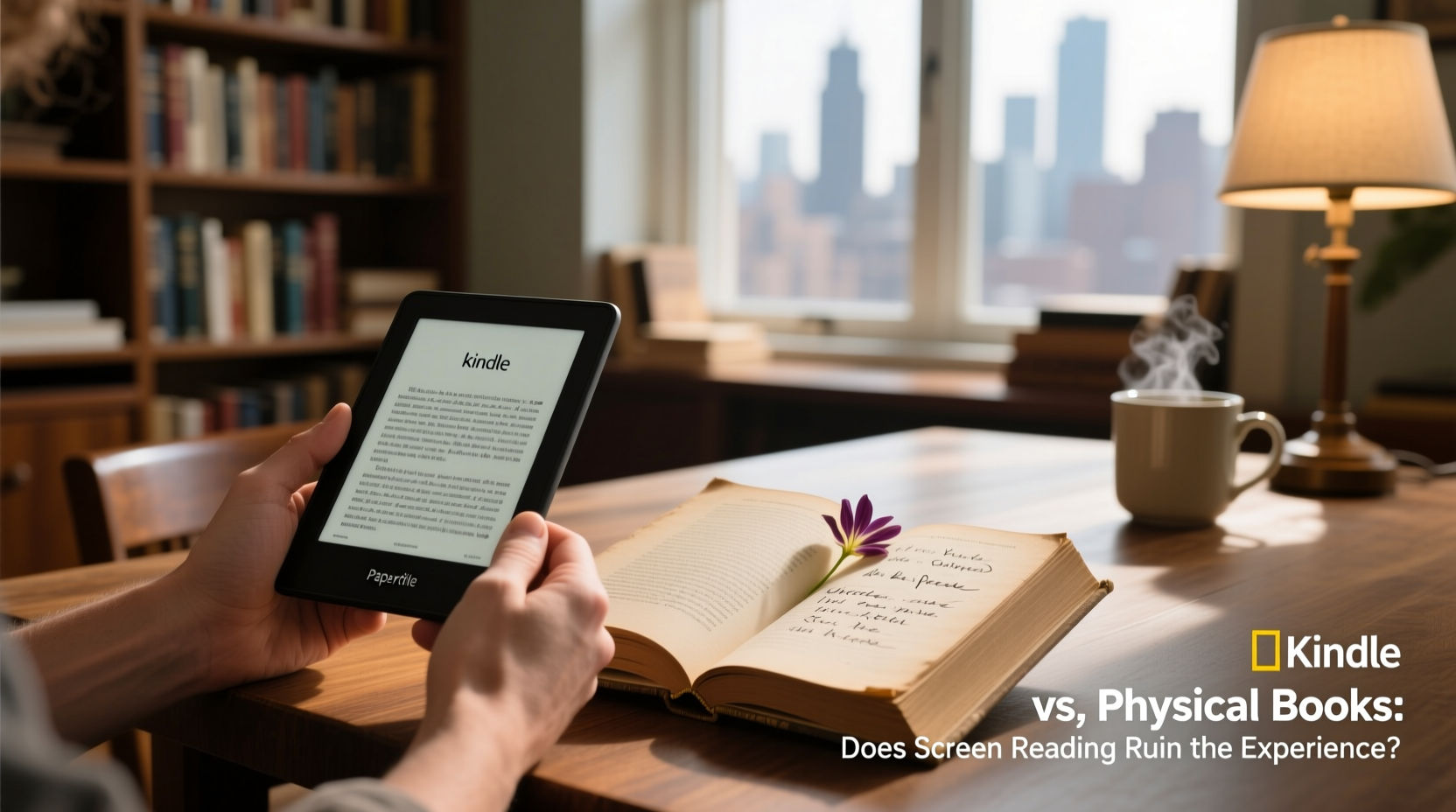
Physical books engage multiple senses. The weight of a hardcover in your hands, the texture of matte versus glossy paper, the faint scent of aged pages—all contribute to a tactile narrative that extends beyond words. Psychologists refer to this as “material memory,” where physical cues help anchor information and emotion. A 2018 study from the University of Copenhagen found that participants who read a short story in print were more likely to recall plot details and report deeper emotional involvement than those who read it digitally.
In contrast, the Kindle Paperwhite is intentionally minimalist. Its smooth, lightweight design prioritizes portability over sensory depth. While it mimics paper with an anti-glare E Ink display and page-turn buttons, it lacks the variability of real books—the creak of a spine, the dog-ear of a favorite passage, or the visual progress of a growing stack of finished chapters.
Still, the Paperwhite compensates with thoughtful design. Its front-lit screen allows reading in darkness without disturbing others, and the high-resolution display reduces eye strain significantly compared to tablets or phones. For nighttime readers or travelers, this can enhance comfort rather than detract from it.
Cognitive Impact: Focus, Retention, and Comprehension
One of the most debated aspects of digital reading is its effect on concentration. Screens are often associated with distraction—notifications, multitasking, and the temptation to switch apps. However, the Kindle Paperwhite is designed to be a single-purpose device. Without social media, email, or web browsers (on basic models), it avoids the fragmentation common to smartphones and tablets.
Research supports that focused digital reading can match print in comprehension when distractions are minimized. A 2020 meta-analysis published in Scientific Studies of Reading concluded that while print slightly edges out digital for long-form retention, the gap closes significantly when readers use distraction-free e-readers like the Paperwhite.
Where digital reading may fall short is spatial memory. Readers often remember where a passage appeared on a page—“near the bottom, left-hand side”—a mental map that aids recall. E-readers disrupt this with uniform scrolling and reflowable text. You don’t “turn” to chapter seven; you tap forward until you arrive.
“The brain treats physical books like landmarks. When you lose the spatial layout, you lose a subtle but powerful cognitive scaffold.” — Dr. Naomi Baron, linguist and author of *How We Read Now*
Practical Advantages: Portability, Accessibility, and Cost
No discussion of the Kindle Paperwhite would be complete without acknowledging its practical strengths. For frequent travelers, students, or avid readers, carrying dozens of books in a 6-inch device is transformative. The Paperwhite’s 300 ppi display renders text sharply, and features like built-in dictionaries, instant highlighting, and cloud syncing make annotation and research seamless.
Accessibility is another major win. Adjustable font sizes, dyslexia-friendly typefaces, and text-to-speech compatibility support readers with visual impairments or learning differences. These tools are rarely available—or affordable—in physical editions.
Financially, e-books are often cheaper than print, especially new releases. Subscriptions like Kindle Unlimited offer access to over a million titles for a monthly fee. Meanwhile, secondhand e-books don’t exist, and digital rights management (DRM) means you don’t truly “own” purchased files—only a license to read them.
| Feature | Kindle Paperwhite | Physical Books |
|---|---|---|
| Portability | Excellent – hundreds of books in one device | Limited by weight and volume |
| Eye Comfort | High – E Ink mimics paper, low blue light | Natural, but dependent on lighting |
| Cost Over Time | Lower per book, subscription options | Higher, especially for hardcovers |
| Durability | Device-dependent; battery degrades | Long-lasting if stored properly |
| Ownership Rights | Licensed access only | Full ownership, resellable |
| Environmental Impact | Lower per-book footprint after ~30 reads | Higher due to paper, ink, shipping |
Emotional Connection: Ritual, Nostalgia, and Identity
Many people collect books not just to read, but to display. Shelves lined with novels signal identity, taste, and intellectual curiosity. A well-worn copy of *Pride and Prejudice* or a first edition of *The Great Gatsby* carries sentimental value that no digital file can replicate.
Reading rituals also differ. Curling up with a paperback on a rainy afternoon feels intimate—a deliberate disconnection from the digital world. In contrast, using a Kindle, even a distraction-free one, can feel like engaging with technology rather than escaping it.
Yet for others, the Paperwhite enhances ritual. Setting a warm backlight at night, syncing progress across devices, or receiving personalized reading goals from the Kindle app adds a layer of intentionality. Some users report reading more consistently because the device fits seamlessly into their daily routines—commuting, waiting rooms, bedtime.
Mini Case Study: Sarah, the Reluctant E-Reader
Sarah, a university professor and lifelong book collector, resisted e-readers for years. She believed screens made reading feel “transactional.” But after a cross-country move, she grew tired of shipping heavy boxes of books. On a friend’s recommendation, she bought a Kindle Paperwhite.
Initially, she missed the smell of paper and the ability to flip back to earlier chapters. But within weeks, she noticed something unexpected: she was reading more. Her commute, once spent scrolling through news feeds, became 30 minutes of uninterrupted fiction. She began exploring genres she’d previously avoided—translated works, indie authors, poetry collections—because they were easy to sample and inexpensive.
Today, Sarah owns both formats. She keeps cherished volumes on her shelves and uses the Paperwhite for discovery and convenience. “It’s not a replacement,” she says. “It’s a different kind of reading relationship.”
How to Choose: A Step-by-Step Guide
Deciding between the Kindle Paperwhite and physical books doesn’t have to be all-or-nothing. Consider your habits, environment, and values. Follow this timeline to make an informed choice:
- Week 1: Audit Your Reading Habits
Track where, when, and how you read. Are you mostly at home? On transit? Do you reread or highlight frequently? - Week 2: Test Both Formats
Read the same book in print and on a Kindle (borrow or use a free sample). Note differences in focus, comfort, and emotional engagement. - Week 3: Evaluate Practical Needs
Ask: Do I travel often? Need large text? Want to save space? Is cost a factor? - Week 4: Define Your Reading Goals
Are you reading for pleasure, study, or professional growth? Deep literary analysis favors print; broad exploration suits digital. - Final Decision: Hybrid Approach?
Many readers now maintain both. Use the Paperwhite for new releases and travel, and keep physical copies for favorites and gifts.
Checklist: Optimizing Your Reading Experience
- ✅ Use blue light filters or warm lighting on the Paperwhite in the evening
- ✅ Take notes manually when reading important texts to boost retention
- ✅ Store physical books away from sunlight and humidity to prevent damage
- ✅ Sync your Kindle with Goodreads to track progress and discover new books
- ✅ Rotate formats seasonally—print in summer, digital during busy periods
- ✅ Visit libraries or bookstores to maintain connection with physical culture
Frequently Asked Questions
Does reading on a Kindle cause eye strain?
No more than reading print under poor lighting. The Kindle Paperwhite uses E Ink technology, which reflects light like paper and emits no direct backlight. Its adjustable warm light further reduces eye fatigue in dark environments. Unlike tablets, it doesn’t emit significant blue light, making it safer for prolonged use.
Can I lend or resell Kindle books?
Generally, no. Most Kindle books are protected by DRM (digital rights management), meaning they’re licensed for personal use only. Some titles allow limited sharing through Amazon’s Family Library, but you cannot resell, donate, or freely distribute purchased e-books as you can with physical copies.
Is the Kindle Paperwhite better for the environment?
It depends on usage. Manufacturing an e-reader has a higher initial environmental cost than producing a single book. However, studies suggest that if you read more than 20–30 books on a device, its per-book carbon footprint drops below that of physical books due to reduced paper, ink, and transportation emissions.
Conclusion: Reclaiming the Joy of Reading—Wherever You Are
The question isn’t whether the Kindle Paperwhite ruins the reading experience, but whether it transforms it in ways that serve your life. For some, the absence of paper, smell, and heft feels like a loss. For others, the freedom to carry a lifetime of literature in their coat pocket is revolutionary.
Reading has never been static. From clay tablets to scrolls, codices to paperbacks, the medium has always evolved. What remains constant is the human desire to connect with stories, ideas, and knowledge. Whether that happens on a screen or a page matters less than the act itself.
If you’ve dismissed e-readers as cold or impersonal, consider giving the Paperwhite a fair trial. If you’ve abandoned print for convenience, revisit a bookstore and rediscover the joy of holding a well-designed volume. The best reading life isn’t defined by format—but by consistency, curiosity, and presence.




 浙公网安备
33010002000092号
浙公网安备
33010002000092号 浙B2-20120091-4
Comments
No comments yet. Why don't you start the discussion?