
In an age where digital convenience reigns, choosing between reading a book on Kindle Unlimited or listening via Audible isn’t just about access—it’s about how we absorb information, retain knowledge, and experience stories. With both platforms offering vast libraries and subscription-based models, the real question becomes: which medium supports better comprehension, memory retention, and overall enjoyment? The answer isn’t one-size-fits-all. It depends on cognitive habits, lifestyle, and even the type of content being consumed.
The Cognitive Science Behind Reading and Listening
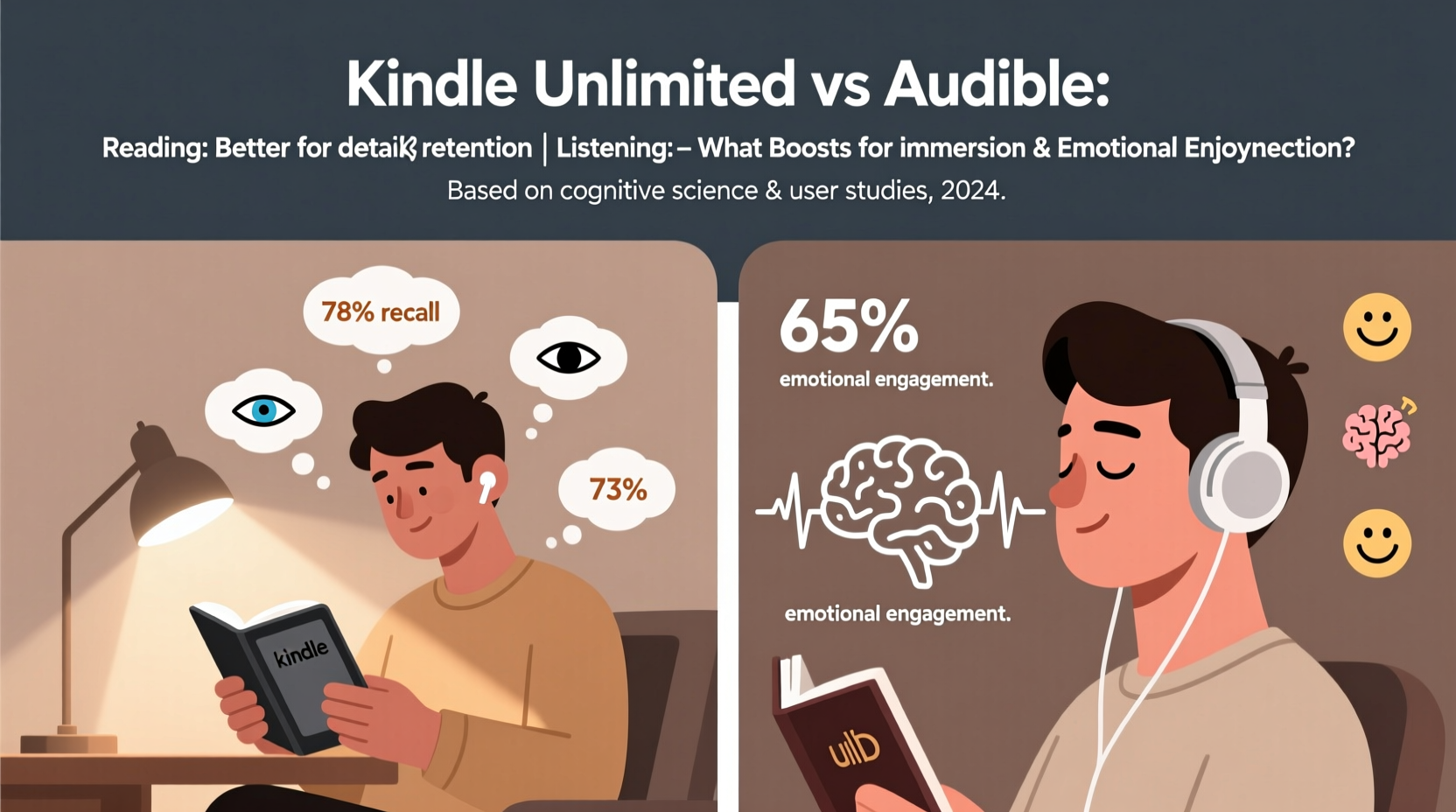
Reading and listening engage different neural pathways, though both ultimately serve the purpose of comprehension. When you read, your brain processes visual symbols—letters and words—and converts them into meaning. This process involves decoding, phonological processing (even in silent reading), and semantic integration. Studies from cognitive psychology suggest that reading promotes deeper encoding because it allows for greater control over pacing, re-reading, and annotation.
Listening, on the other hand, relies on auditory processing. The brain receives spoken language in real time, requiring continuous attention without the ability to pause and reflect as easily. However, audiobooks activate areas associated with imagination and emotional resonance more strongly than text alone. According to Dr. Maryanne Wolf, director of UCLA’s Center for Dyslexia, Diverse Learners, and Social Justice, “Listening can be just as effective as reading for narrative comprehension, but reading often leads to superior retention when critical analysis or detailed recall is required.”
One key factor is working memory. Reading allows readers to slow down, reread complex passages, and visually track progress—advantages that support retention. In contrast, audiobooks demand sustained auditory focus, which can falter during multitasking or fatigue.
“Reading builds stronger mental models. But storytelling through voice can deepen empathy and emotional understanding.” — Dr. Jonathan Gottschall, author of *The Storytelling Animal*
Kindle Unlimited vs Audible: A Feature and Experience Comparison
To understand which platform suits your needs, consider not only the format but also the ecosystem, accessibility, and user experience.
| Feature | Kindle Unlimited | Audible |
|---|---|---|
| Content Library Size | Over 3 million titles (mostly ebooks) | Over 200,000 audiobooks + originals |
| Subscription Cost (Monthly) | $9.99 | $14.95 (1 credit) or $22.95 (2 credits) |
| Offline Access | Yes (on Kindle devices/apps) | Yes (downloadable audio files) |
| Navigation & Search | Full text search, highlighting, notes | Chapter skip only; no word-level navigation |
| Multitasking Compatibility | Limited (requires visual focus) | High (usable while driving, cooking, etc.) |
| Retention Support Tools | Annotations, dictionary lookup, X-Ray | Speed control, bookmarking, Whispersync (with Kindle) |
While Kindle Unlimited offers granular control over the reading experience, Audible excels in convenience and immersion. For learners or professionals studying technical material, the ability to highlight, annotate, and revisit specific sentences gives Kindle a clear edge. But for fiction lovers or commuters, Audible’s hands-free delivery enhances accessibility and daily integration.
Retention: What Research Says About Memory and Comprehension
Multiple studies have compared reading and listening comprehension, especially in educational contexts. A 2016 study published in Psychonomic Bulletin & Review found that participants retained significantly more factual information from text than from audio, particularly when tested immediately after exposure. The researchers attributed this to the \"production effect\"—the act of seeing and mentally articulating words strengthens memory traces.
However, retention isn't solely about raw data recall. Narrative comprehension—the understanding of plot, character motivation, and thematic development—is often comparable across formats. A 2020 study by the University of California, Santa Barbara showed that listeners performed nearly as well as readers in recalling story arcs and emotional turning points, especially when narration was expressive and well-paced.
Another crucial factor is engagement level. Passive listening—while distracted by chores or traffic—leads to lower retention. Active listening, where the listener focuses fully, closes the gap. Similarly, skimming a Kindle book reduces retention just as much as zoning out during an audiobook.
- Best for retention: Reading, especially for nonfiction, academic texts, or learning new concepts.
- Close second: Audiobooks with high-quality narration and active listening habits.
- Lowest retention: Multitasking with either format without focused attention.
Real Example: Sarah’s Study Routine Transformation
Sarah, a graduate student in public health, used to rely on audiobooks during her 45-minute commute to absorb research literature. She found herself constantly rewinding, struggling to remember key statistics or methodological details. After switching to reading PDFs and Kindle versions on her tablet—with note-taking and highlighting—she noticed a dramatic improvement in exam performance and class participation. “I thought I was being efficient with my time,” she said, “but I wasn’t actually learning. Now I listen to audiobooks only for novels or biographies—things I want to feel, not memorize.”
Enjoyment: Subjective Preferences and Emotional Engagement
Enjoyment is deeply personal. Some readers love the tactile sensation of turning virtual pages, the quiet focus of reading before bed, or the satisfaction of underlining a powerful quote. Others find joy in the performative quality of audiobooks—how a skilled narrator brings characters to life with tone, accent, and pacing.
Consider this: hearing Stephen Fry narrate a Harry Potter novel adds layers of humor and warmth that text alone cannot convey. Similarly, Michelle Obama’s narration of *Becoming* amplifies its intimacy and authenticity. These performances transform books into immersive experiences, often increasing emotional connection and long-term impact.
Yet, many readers report greater imaginative freedom when reading. Without a prescribed voice or pace, they construct their own internal theater—assigning voices to characters, visualizing scenes uniquely. This autonomy can heighten personal investment in the story.
Ultimately, enjoyment hinges on context:
- Long drives, workouts, or household chores favor audiobooks.
- Quiet evenings, deep focus sessions, or analytical reading suit Kindle.
- Narrative-driven genres (fiction, memoirs) work well in both formats.
- Technical, dense, or concept-heavy content (science, philosophy, law) benefits from reading.
Maximizing Both Platforms: A Practical Guide
You don’t have to choose one format forever. Many avid consumers use both strategically. Here’s how to get the most out of Kindle Unlimited and Audible together.
Step-by-Step: Build a Balanced Reading-Listening Routine
- Assess your goals: Are you reading to learn, relax, or be entertained? Match the format accordingly.
- Prioritize reading for complex material: Use Kindle Unlimited for textbooks, self-help guides, or articles requiring analysis.
- Choose audiobooks for narrative pleasure: Select highly rated narrations on Audible for fiction, memoirs, or inspirational content.
- Enable Whispersync: Buy or borrow a Kindle version and its audiobook counterpart to switch modes seamlessly.
- Set listening times: Reserve audiobooks for commutes, walks, or chores—avoid passive consumption.
- Take notes digitally: Use Kindle highlights synced to apps like Evernote or Notion for later review.
- Review weekly: Revisit annotations or replay key audiobook sections to reinforce retention.
Checklist: Optimizing Your Digital Book Experience
- ✅ Subscribe to both Kindle Unlimited and Audible if budget allows
- ✅ Use Whispersync to sync progress between reading and listening
- ✅ Adjust audiobook speed (1.2x–1.5x) for faster consumption without losing clarity
- ✅ Enable Kindle vocabulary builder for automatic word tracking
- ✅ Limit multitasking during audiobook sessions to improve focus
- ✅ Download content offline to avoid data usage or connectivity issues
- ✅ Rotate genres and formats monthly to prevent burnout
Frequently Asked Questions
Can you really learn as much from an audiobook as from reading?
For narrative content and general understanding, yes. But for technical subjects requiring detailed recall or critical thinking, reading typically yields better results due to increased control and re-readability.
Is Kindle Unlimited worth it if I mostly listen to books?
Only if you occasionally read or use Whispersync. If you exclusively listen, Audible alone may suffice. However, Kindle Unlimited offers access to magazines, short reads, and indie titles that aren’t always available on Audible.
Does listening to audiobooks count as “real” reading?
Yes. Comprehension and engagement matter more than format. As literacy expert Daniel Willingham states, “If you understand and remember what you hear, you’ve read it—in the functional sense.” The stigma around audiobooks as “cheating” is outdated and unsupported by cognitive science.
Conclusion: Choose Based on Purpose, Not Just Preference
The debate between Kindle Unlimited and Audible isn’t about declaring a winner—it’s about aligning your tools with your goals. Reading generally supports better retention, especially for complex or technical material. Listening enhances enjoyment, accessibility, and emotional depth, particularly with strong narration. The smartest approach is not to pick sides, but to leverage both.
Use Kindle when you need to analyze, annotate, or remember. Turn to Audible when you want to immerse, unwind, or maximize time. And whenever possible, combine them. Let your brain absorb information in the way that suits the moment, the material, and your mood. In doing so, you’re not just consuming books—you’re mastering the art of modern learning.




 浙公网安备
33010002000092号
浙公网安备
33010002000092号 浙B2-20120091-4
Comments
No comments yet. Why don't you start the discussion?