
In a world where minimalism meets functionality, the humble wallet has undergone a quiet revolution. While Western designs have long favored bulkier, feature-rich models with multiple card slots and coin compartments, a different philosophy has emerged from South Korea: sleek, compact, and highly efficient. Korean wallets—often minimalist in construction—have gained global attention for their elegant simplicity and surprising utility. But are they truly more practical for everyday use? To answer that, we need to look beyond aesthetics and examine how each style performs in real-life scenarios.
Design Philosophy: Minimalism vs. Utility
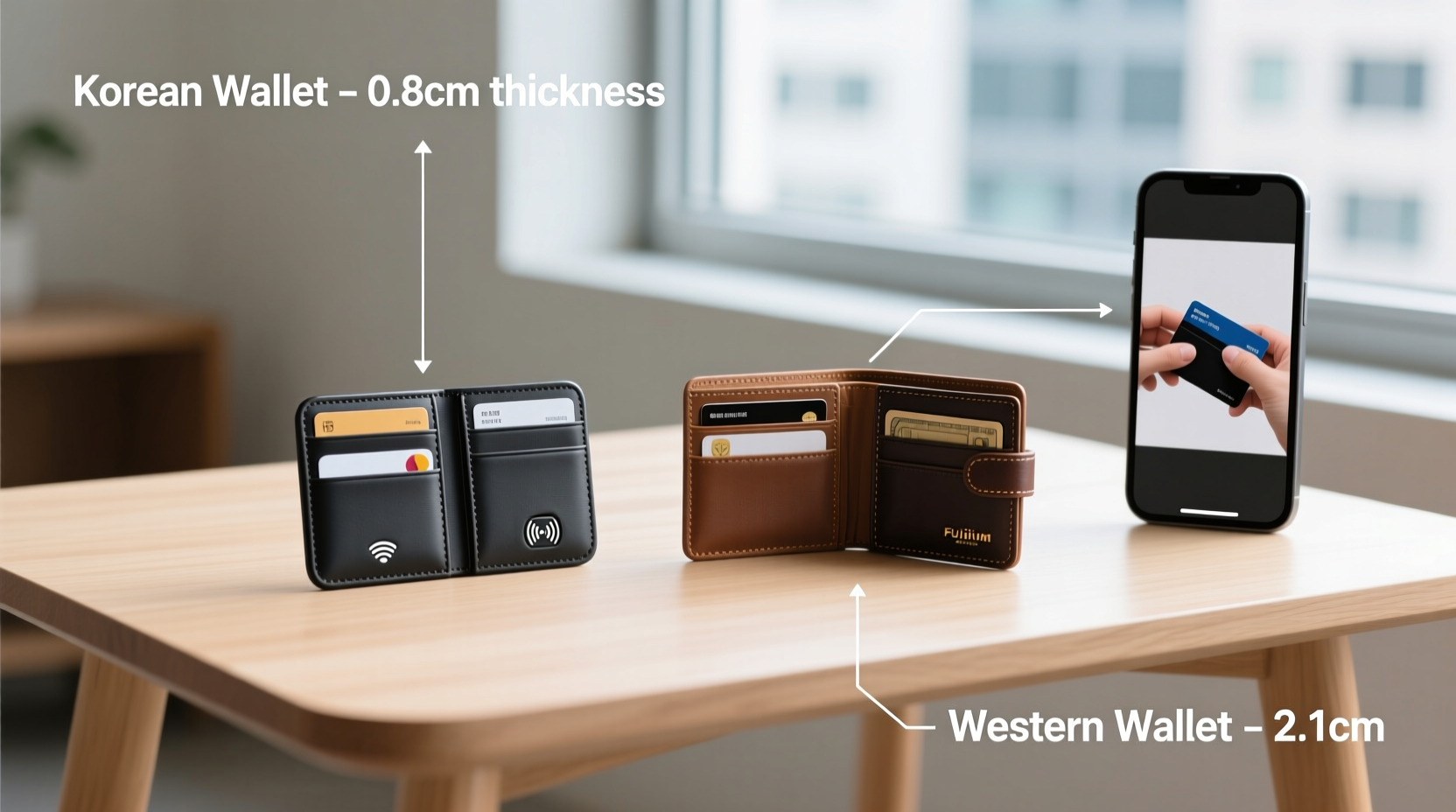
The core difference between Korean and Western wallets lies in their foundational design principles. Western wallets, especially traditional bi-fold or trifold models, are built around maximizing storage. They often include separate sections for cash, coins, IDs, receipts, boarding passes, and even keys. This approach stems from decades of consumer behavior in North America and Europe, where carrying numerous cards, paper money, and physical tickets was standard.
Korean wallets, by contrast, embrace minimalism rooted in urban efficiency. In cities like Seoul, where digital payments dominate and public transit is seamless, there’s less need for bulky accessories. Korean designers prioritize slim profiles, lightweight materials, and smart organization. Many models fit comfortably in front pockets without causing discomfort or \"wallet bulge\"—a common issue with thicker Western counterparts.
“Korean wallet design reflects a culture that values discretion, elegance, and mobility. It’s not about what you carry—it’s about moving through life unencumbered.” — Ji-Hoon Park, Seoul-based product designer
Material and Build Quality
Both Korean and Western wallets use premium materials such as full-grain leather, ballistic nylon, and RFID-blocking fabrics. However, the application differs significantly.
Western brands often emphasize durability through thickness and reinforcement. Zippers, metal clasps, and rigid structures are common, especially in men's wallets. These choices add longevity but also weight and volume. Brands like Bellroy and Fossil incorporate advanced tech features such as quick-access card sliders and hidden passport sleeves, catering to frequent travelers and business professionals.
Korean manufacturers focus on refined craftsmanship with subtlety. Instead of overt branding or hardware, they opt for buttery-soft vegetable-tanned leathers, precision stitching, and internal layouts optimized for 3–6 essential cards and folded bills. The result is a wallet that molds to the user over time while maintaining a low profile. Some high-end Korean labels even offer custom engraving and hand-stitched finishes comparable to luxury watch straps.
Functional Comparison: Real-World Use Cases
To evaluate practicality, consider how each wallet type performs across typical daily activities.
| Use Case | Western Wallet Performance | Korean Wallet Performance |
|---|---|---|
| Daily Commute (Transit Pass + ID) | Good – ample space for transit card and ID | Excellent – many have dedicated quick-scan slots |
| Front Pocket Comfort | Poor – often too thick or rigid | Excellent – designed specifically for front-pocket wear |
| Cash Organization | Excellent – multiple bill compartments | Fair – limited to one folded bill section |
| Card Access Speed | Fair – cards buried in deep slots | Very Good – fan-style pull or side access |
| Digital Payment Readiness | Average – may interfere with NFC/RFID | Excellent – slim enough for tap-to-pay without removal |
The data shows a clear trend: Korean wallets excel in urban, mobile environments where speed and comfort matter most. For users relying heavily on smartphones and contactless payments, these wallets eliminate friction. However, those who still rely on cash or manage multiple loyalty cards may find Western models more accommodating.
Mini Case Study: Life in Seoul vs. New York
Consider two professionals: Min-ji, a graphic designer in Seoul, and David, a sales executive in New York.
Min-ji uses a slim bifold made from water-resistant microfiber. She carries her driver’s license, credit card, transit pass, and a single emergency bill. Her phone handles most transactions via Samsung Pay. Her wallet fits flush in her jeans’ front pocket and never disrupts her stride during subway commutes. On average, she touches her wallet twice per day—once for transit, once for a coffee.
David, meanwhile, uses a full-sized bi-fold with 12 card slots, a coin pouch, and a photo ID window. He carries business cards, gym access, insurance info, and three credit cards for rewards tracking. He accesses his wallet at least eight times daily—in taxis, restaurants, stores, and meetings. His wallet, though functional, creates a noticeable bulge in his back pocket, leading to lower back discomfort after long days.
Neither approach is inherently superior. But when measured against lifestyle needs, Min-ji’s choice aligns perfectly with her environment. David’s wallet serves its purpose but introduces ergonomic trade-offs. For users seeking to simplify, the Korean model offers a compelling alternative.
Step-by-Step Guide: Transitioning to a Korean-Style Wallet
Moving from a traditional wallet to a minimalist Korean design requires intentional downsizing. Follow this process to make the switch smoothly:
- Audit Your Current Contents: Empty your wallet completely. Lay out every item and categorize them by necessity.
- Identify Essentials: Keep only items used daily—typically one ID, one payment card, and optionally a transit pass.
- Digitize What You Can: Store membership cards, coupons, and backups in Apple Wallet or Google Pay.
- Choose the Right Model: Select a Korean-style wallet with quick-access features and a secure closure (e.g., snap button or elastic band).
- Test for Comfort: Wear it in your front pocket for a week. Adjust placement if needed—some prefer hip pockets for better balance.
- Rotate Seasonally: Keep a secondary slim wallet for travel or occasions requiring extra cards.
Checklist: Is a Korean Wallet Right for You?
- ✅ I use contactless payments (Apple Pay, Google Pay) regularly
- ✅ I carry fewer than six cards daily
- ✅ I experience discomfort from back-pocket bulging
- ✅ I value discreet, understated design
- ✅ I live in an urban area with reliable digital infrastructure
If four or more apply, a Korean-style wallet could enhance your daily routine. If you frequently handle cash, collect receipts, or need immediate access to multiple IDs, a hybrid or Western model might remain preferable.
FAQ
Can Korean wallets hold passports or boarding passes?
Most cannot. They are designed for daily essentials, not travel documents. However, some dual-layer models include a slim slip pocket suitable for temporary passes. For air travel, pair your Korean wallet with a separate passport holder.
Do Korean wallets last as long as Western ones?
Yes, provided they’re made from quality materials. Because they undergo less mechanical stress (no zippers, fewer folds), well-crafted Korean wallets often age more gracefully. Regular conditioning of leather ensures longevity.
Are they compatible with RFID protection?
Many are. While not all Korean wallets include built-in RFID blocking, several premium brands integrate thin shielding layers without adding bulk. Look for models explicitly labeled “RFID-safe” if security is a concern.
Conclusion: Practicality Redefined
Practicality isn’t just about capacity—it’s about alignment with lifestyle. Korean wallets aren’t universally better, but they represent a shift toward intentional living. By stripping away excess and focusing on what’s truly needed, they offer a quieter, more comfortable way to navigate modern life. In cities where speed, discretion, and mobility matter, their advantages become undeniable.
The rise of digital finance and mobile IDs means fewer people need to carry everything they own in their back pocket. For those ready to downsize, a Korean-style wallet isn’t just a fashion statement—it’s a tool for greater freedom. Whether you live in Busan, Berlin, or Boston, rethinking your wallet might be the smallest change that makes the biggest difference.




 浙公网安备
33010002000092号
浙公网安备
33010002000092号 浙B2-20120091-4
Comments
No comments yet. Why don't you start the discussion?