
Choosing a second language to learn can be one of the most strategic decisions a professional makes. In today’s interconnected economy, multilingualism isn’t just a resume booster—it’s a competitive advantage. Among the most popular choices, Spanish and French stand out as globally significant languages with deep cultural roots and widespread use in international commerce. But when it comes to real-world business utility, which offers greater return on investment? The answer depends on industry, geography, and long-term career goals. This article breaks down the practical advantages of each, using data, expert insights, and real-world scenarios to guide your decision.
Global Reach and Speaker Base
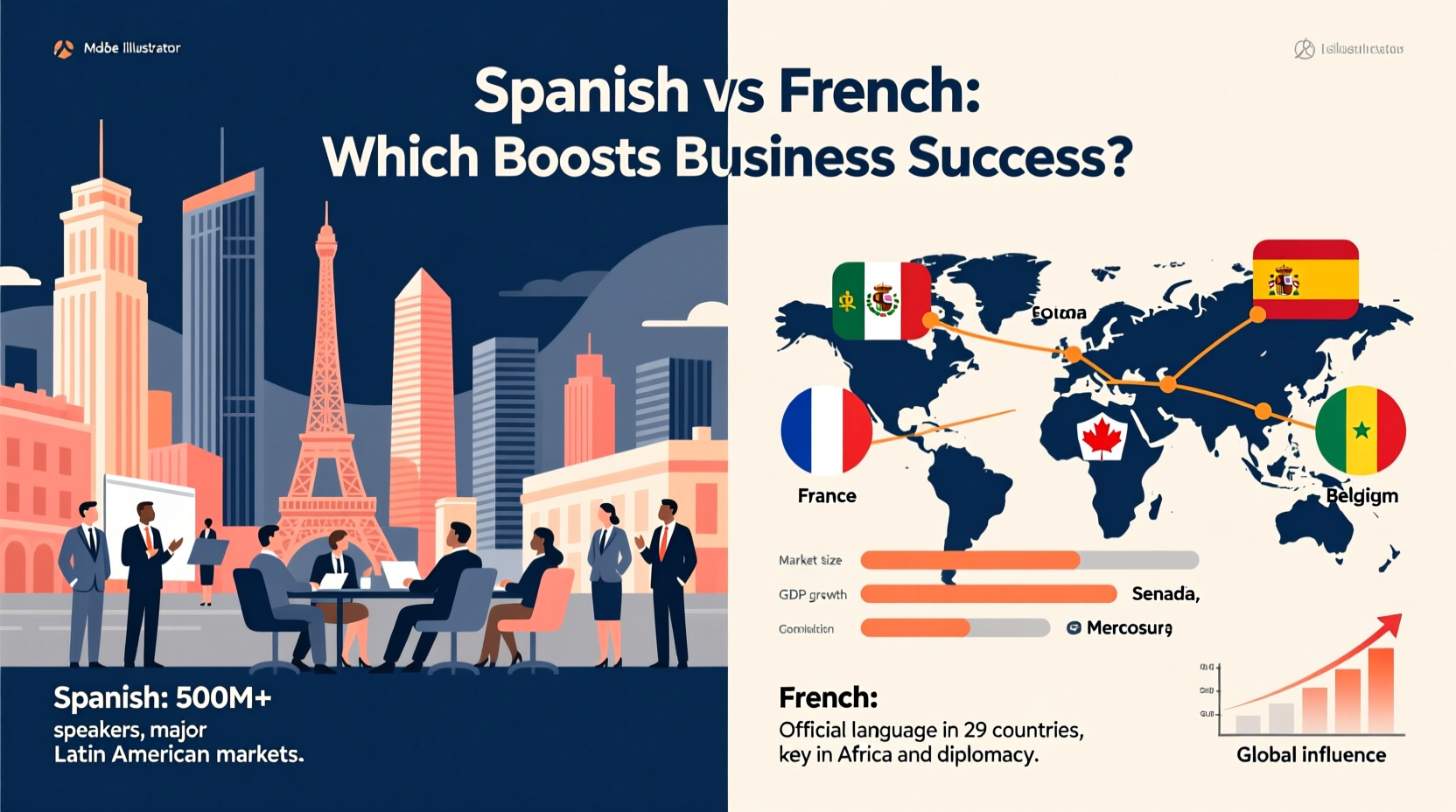
The number of native and non-native speakers is often the first metric considered when evaluating a language’s usefulness. Spanish leads in sheer volume. With over 580 million speakers worldwide—485 million of them native—Spanish ranks as the second most spoken language by native speakers, trailing only Mandarin. It is the official language in 20 countries, including fast-growing economies like Mexico, Colombia, and Argentina.
French, while slightly smaller in total speakers (about 300 million), holds unique geopolitical weight. It is an official language in 29 countries across Europe, Africa, the Caribbean, and the Pacific. Notably, many of these are former French colonies where French remains the language of government, education, and high-level business. As globalization shifts focus toward emerging African markets, French gains strategic importance. By 2050, projections suggest that over 80% of French speakers will reside in sub-Saharan Africa, making it a critical tool for accessing a rapidly expanding consumer base.
Economic Influence and Trade Networks
When assessing business utility, economic output matters. The Spanish-speaking world includes several major economies. Mexico alone has a GDP exceeding $1.7 trillion, making it the second-largest economy in Latin America. Spain, though smaller, is a key player in the European Union and a gateway to Southern Europe. Combined, Spanish-speaking nations contribute roughly $7 trillion annually to global GDP.
French-speaking regions, however, form a different kind of economic bloc. France, with a GDP of over $3 trillion, is the third-largest economy in Europe. But the real strength lies in collective networks. The Organisation internationale de la Francophonie (OIF) includes countries representing about 17% of the UN’s member states and accounts for approximately $2.8 trillion in combined GDP. While this is less than the Spanish-speaking world’s total, the OIF fosters strong intra-regional trade agreements and development partnerships.
Crucially, French dominates in sectors such as luxury goods, aerospace, energy, and infrastructure—industries where high-value contracts are negotiated in French. Meanwhile, Spanish excels in agriculture, mining, telecommunications, and cross-border logistics, especially along North-South supply chains between the U.S. and Latin America.
| Factor | Spanish | French |
|---|---|---|
| Total Speakers | ~580 million | ~300 million |
| Native Speakers | ~485 million | ~80 million |
| Countries Where Official | 20 | 29 |
| Key Economic Regions | Latin America, Spain, U.S. Hispanic market | France, Canada, West/Central Africa |
| Projected Growth Area | Mexico, Colombia, U.S. demographics | Sub-Saharan Africa |
| UN Official Language | Yes | Yes |
Industry-Specific Advantages
No single language dominates all industries equally. The choice between Spanish and French should align with your sector.
In healthcare, education, retail, and customer service within the United States, Spanish is increasingly essential. With over 42 million native Spanish speakers in the U.S.—and millions more bilingual individuals—companies from Walmart to Kaiser Permanente invest heavily in Spanish-language outreach. A manager who can conduct meetings, train staff, or negotiate supplier terms in Spanish has a tangible edge in domestic operations.
Conversely, French opens doors in diplomacy, international organizations, and sustainable development. The European Union, NATO, UNESCO, and the International Olympic Committee all operate extensively in French. Professionals aiming for careers at institutions like the World Bank or the United Nations often find French proficiency expected, not optional. In Africa, French-speaking countries like Côte d'Ivoire and Senegal are emerging hubs for renewable energy and digital innovation, attracting billions in foreign investment.
“Language is not just communication—it’s trust. When you speak to someone in their preferred business language, you signal respect and commitment.” — Dr. Léa Moreau, Senior Advisor at the International Chamber of Commerce
Case Study: Two Executives, Two Strategic Choices
Consider two mid-career professionals facing similar advancement opportunities but choosing different linguistic paths.
Carlos Mendez, a supply chain analyst at a U.S.-based agribusiness, decided to learn Spanish. His company sources coffee and avocados from Guatemala, Peru, and Ecuador. After six months of intensive study, Carlos began leading virtual negotiations with suppliers. Within a year, he was promoted to Regional Procurement Manager, credited with reducing costs by 12% through improved vendor relationships—all conducted in fluent Spanish.
Amina Diallo, a sustainability consultant based in Montreal, chose French. Her firm advised governments on climate resilience projects in francophone Africa. Though she already spoke English and some Arabic, mastering formal French allowed her to draft policy proposals for ministries in Dakar and Yaoundé. She soon became the lead liaison for a $50 million clean water initiative funded by the French Development Agency.
Both succeeded—not because one language was “better,” but because each aligned their learning with actual business needs.
Learning Curve and Accessibility
For English speakers, both Spanish and French are classified as Category I languages by the Foreign Service Institute (FSI), meaning they require approximately 575–600 hours of study to achieve proficiency. However, nuances exist.
Spanish pronunciation is largely phonetic, making it easier for beginners to read aloud accurately. Verb conjugations are extensive but follow consistent patterns. Vocabulary overlaps significantly with English due to shared Latin roots—words like “important,” “nation,” and “university” appear nearly identical.
French pronunciation is more complex, with nasal vowels, silent letters, and subtle liaisons between words. Spelling often diverges from sound, posing challenges for new learners. That said, French grammar shares structural similarities with English legal and academic writing, which can benefit professionals in law, finance, or academia.
Ultimately, motivation plays a larger role than difficulty. Learners immersed in Spanish-dominant communities—through travel, media, or local networking—tend to progress faster. Similarly, those engaging with French podcasts, news outlets like RFI, or expat communities report accelerated fluency.
Actionable Checklist: Choosing the Right Language for Your Career
- ✅ Assess your current and target markets: Do you work with Latin America, Spain, or U.S. Hispanic consumers? Spanish likely offers higher ROI.
- ✅ Evaluate your industry: Are you in international development, diplomacy, or luxury goods? French may be more relevant.
- ✅ Research job postings in your field: How often do employers list Spanish or French as a preferred skill?
- ✅ Consider geographic mobility: Are you open to relocating to Africa, Canada, or Europe? French could enhance opportunities.
- ✅ Audit your existing network: Who do you communicate with regularly? Align language choice with relationship-building potential.
- ✅ Test both languages: Take introductory courses in each and gauge personal affinity and progress speed.
Long-Term Strategic Value
Looking beyond immediate utility, consider future trends. Demographics favor Spanish in the short to medium term. The U.S. Census Bureau projects that by 2045, one in three Americans will be of Hispanic origin. Companies ignoring this shift risk losing market share.
Yet French offers long-term strategic value through Africa’s economic ascent. Nigeria may dominate headlines, but French-speaking countries like Ghana, Rwanda, and Côte d’Ivoire are achieving double-digit growth in fintech and green energy. France’s continued investment in its African partnerships—despite political tensions—means French will remain a language of influence for decades.
Moreover, multilingual professionals rarely stop at one additional language. Starting with Spanish provides a foundation for learning Portuguese or Italian; beginning with French eases the path into Arabic or other Romance languages. The cognitive benefits of bilingualism compound over time, improving memory, decision-making, and cultural intelligence.
Frequently Asked Questions
Is Spanish more useful than French in the U.S.?
Yes, for most domestic business contexts. Spanish is the second most spoken language in the U.S., widely used in healthcare, retail, construction, and public services. Bilingual employees are in high demand across sectors serving diverse populations.
Can I succeed in international business without learning either?
You can, but you’ll face limitations. English remains the lingua franca of global commerce, yet local language skills build deeper trust, unlock informal networks, and give you an edge in negotiations. In emerging markets, few decision-makers rely solely on English.
Which language has more prestige in corporate settings?
Historically, French carried more prestige, especially in diplomacy and luxury industries. Today, Spanish is gaining ground due to economic clout and demographic trends. Prestige is increasingly tied to relevance—speaking the language of your client base is what truly commands respect.
Conclusion: Make the Choice That Moves Markets
The debate over Spanish versus French for business isn’t about declaring a winner—it’s about matching language skills to opportunity. Spanish offers broader reach, stronger ties to growing consumer markets, and undeniable utility in the Americas. French delivers access to influential institutions, African growth corridors, and high-stakes sectors like energy and international policy.
Your best move? Align your language choice with your career trajectory. If you’re in tech sales targeting Brazil, learn Spanish. If you’re in environmental consulting eyeing projects in Francophone Africa, prioritize French. And if possible, aim to learn both over time—because in global business, every language you master multiplies your impact.




 浙公网安备
33010002000092号
浙公网安备
33010002000092号 浙B2-20120091-4
Comments
No comments yet. Why don't you start the discussion?