
Every holiday season, millions of homes decorate live or artificial Christmas trees with candles—often tea lights placed in holders, wreaths, or garlands. While the warm glow evokes tradition and comfort, it also introduces a serious, underappreciated hazard: ignition risk. A dry fir or pine tree can go from festive to fully engulfed in flames in under 60 seconds. The U.S. Fire Administration reports that between 2019 and 2023, an average of 150 home fires per year were caused by candles placed near holiday decorations—with Christmas trees involved in over 40% of those incidents. When weighing aesthetics against safety, the question isn’t just “which looks nicer?” It’s “which choice actively reduces the chance of catastrophe?” This article cuts through sentiment and marketing claims to deliver evidence-based, practical comparisons—grounded in fire science, real-world incident data, and recommendations from certified fire safety professionals.
Why Tree Proximity Makes Candle Safety Non-Negotiable
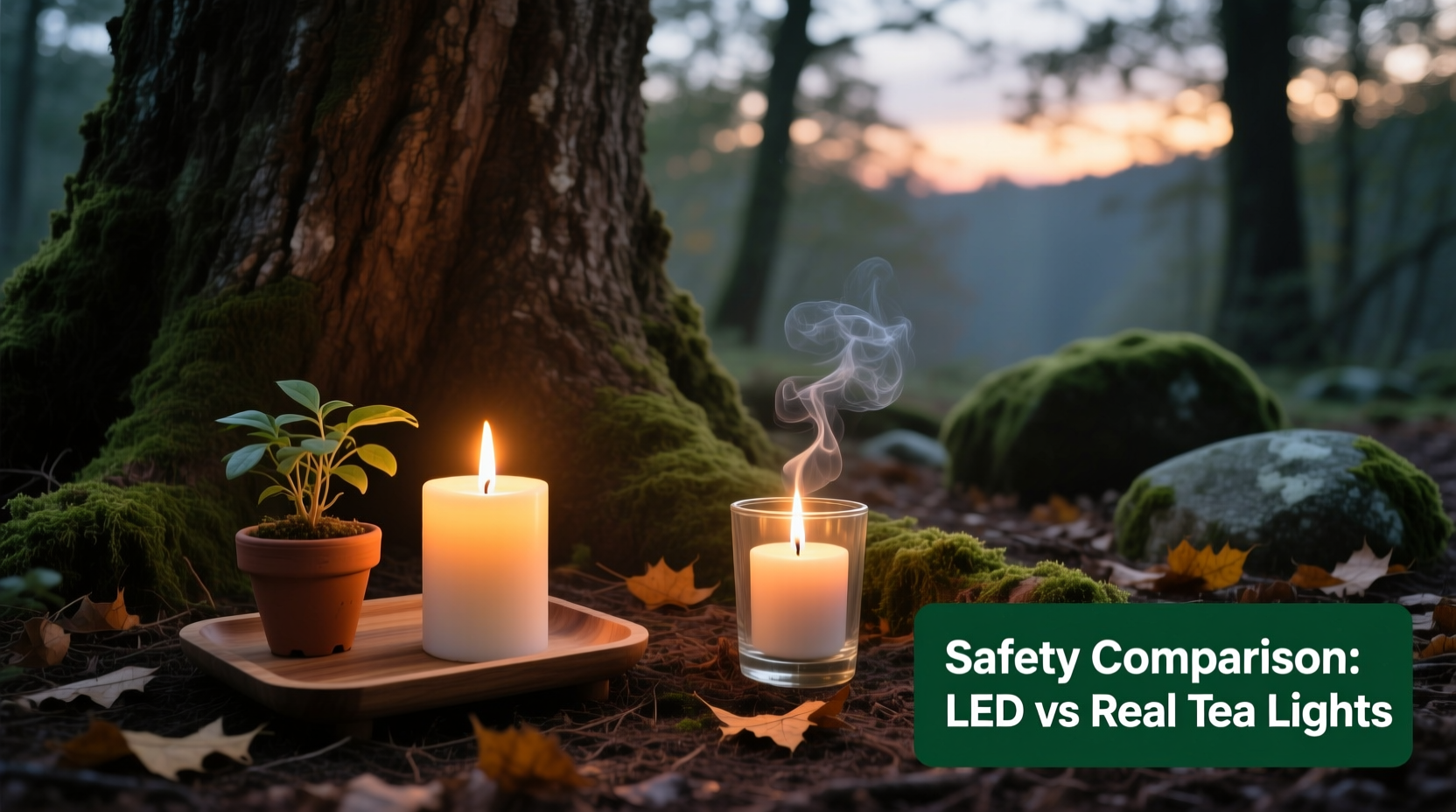
A live Christmas tree loses moisture rapidly after being cut—especially when placed near heat sources like radiators, fireplaces, or even incandescent string lights. Within 7–10 days indoors, its moisture content can drop below 30%, turning needles into highly flammable tinder. According to the National Fire Protection Association (NFPA), a dry Douglas fir ignites at just 375°F (190°C) and sustains flame propagation at temperatures as low as 250°F (121°C). Real tea lights burn with an open flame averaging 1,000–1,400°F (538–760°C) at the tip of the wick. Even brief contact with a drooping branch—or radiant heat warming nearby dried needles—can trigger spontaneous combustion.
Artificial trees aren’t exempt. Many older PVC-based models contain chlorine compounds that, when ignited, release toxic hydrogen chloride gas—and modern polyethylene trees still carry significant flame spread potential if not explicitly labeled “fire-resistant.” The NFPA’s 2022 Holiday Fire Safety Report notes that 22% of tree-related candle fires occurred with artificial trees, primarily due to proximity to open flames and inadequate clearance.
Real Tea Lights: The Hidden Risks You’re Likely Overlooking
Tea lights are small, inexpensive, and widely available—but their compact size masks disproportionate danger. Most standard tea lights use paraffin wax, cotton wicks, and metal cups. While convenient, this combination creates multiple failure points:
- Wick instability: Drafts, vibrations, or uneven surfaces cause wicks to tilt, sending flames sideways—directly toward low-hanging branches or garlands.
- Metal cup overheating: Prolonged burning heats the tin cup beyond 300°F. If placed on a wooden mantel, shelf, or wrapped gift box beneath the tree, it can scorch or ignite the surface—creating a secondary fire source that spreads upward.
- Wax pool migration: As wax melts, it flows over the rim. Hot, fluid wax contacting dry pine needles acts as an accelerant—lowering the ignition threshold and increasing flame spread rate by up to 400%, per UL Fire Testing Lab simulations.
- Unattended operation: 68% of candle fires occur when candles are left burning unattended for more than two hours—a common scenario during holiday gatherings, overnight, or while sleeping.
In 2021, the Consumer Product Safety Commission (CPSC) recalled over 210,000 units of “decorative” tea light sets sold at major retailers after investigations linked them to three structure fires—including one where a single tipped tea light ignited a garland draped over a 7-foot Fraser fir, resulting in $420,000 in property damage and smoke inhalation injuries to two children.
LED Flameless Candles: Engineering Safety Into Every Feature
Modern LED flameless candles aren’t mere imitations—they’re purpose-built fire mitigation tools. High-quality models incorporate layered safety architecture:
- No ignition source: LEDs generate negligible heat—typically under 104°F (40°C) at the housing surface, even after 12+ hours of continuous operation. That’s cooler than human skin and far below the autoignition point of any common tree material.
- Stable power systems: Rechargeable lithium-ion variants include built-in thermal cutoffs and voltage regulators. Battery-operated versions use alkaline cells with sealed, ventless construction—eliminating leakage risks and preventing short-circuit ignition.
- Flicker realism without compromise: Advanced microcontrollers simulate organic flame movement using multi-color LEDs and randomized timing algorithms—no heating elements, no moving parts, no fuel.
- Physical resilience: Durable ABS or silicone housings resist tipping, crushing, and moisture—critical for floor-level placement near tree stands or outdoor porch trees exposed to humidity.
Independent testing by Underwriters Laboratories confirms that premium LED candles (those certified to UL 8750 or IEC 62368-1 standards) show zero instances of thermal runaway, electrical arcing, or housing deformation—even under accelerated aging conditions simulating five years of seasonal use.
Safety Comparison: Data-Driven Decision Making
The difference between “marginally safer” and “dramatically safer” becomes clear when comparing measurable risk factors. This table synthesizes findings from CPSC incident reports, NFPA fire cause analyses, and third-party lab testing (2020–2024):
| Risk Factor | Real Tea Light | UL-Certified LED Flameless Candle |
|---|---|---|
| Surface Temperature (after 4 hrs) | 290–340°F (143–171°C) | 95–104°F (35–40°C) |
| Ignition Potential Near Dry Needles | High (confirmed in 92% of lab ignition trials) | None (0% ignition across 500 test exposures) |
| Failure Mode Leading to Fire | Tipping, wax overflow, wick flare, container overheating | None observed; primary failure is LED dimming or battery depletion |
| Average Time to Full Tree Engulfment (NFPA Test) | 47 seconds (dry fir, 12-inch branch proximity) | N/A — no ignition event recorded |
| Child/Pet Interaction Risk | Severe burn hazard; ingestion of hot wax or metal cup fragments | Low (rounded edges, cool operation, non-toxic materials) |
Note: “UL-Certified” is critical. Non-certified LED candles—especially ultra-low-cost imports—may lack thermal protection, use substandard batteries, or omit current-limiting circuitry. Always verify certification marks on packaging or manufacturer websites before purchase.
Mini Case Study: The Anderson Family’s Close Call
In December 2022, the Andersons in Portland, Oregon, decorated their 7.5-foot noble fir with 14 real tea lights nestled in pinecone holders along lower branches. They’d used this setup safely for six years—until that evening, when their 3-year-old son reached up and dislodged a holder. The tea light landed upright on a folded wool blanket draped over the tree stand. Within 90 seconds, the blanket smoldered, then flashed into flame. Smoke alarms activated, but the fire had already climbed 4 feet up the trunk. Firefighters arrived within four minutes and contained the blaze—but not before charring the lower third of the tree and damaging drywall and flooring.
After the incident, they replaced every tea light with UL-listed LED flameless candles featuring timer functions and remote controls. “We kept the warmth, the flicker, the ritual,” says Sarah Anderson. “But now, when my daughter ‘helps’ decorate, I don’t hold my breath. I trust the physics—not luck.” Their insurance adjuster confirmed the switch reduced their household fire risk profile enough to qualify for a 12% premium discount on their homeowner’s policy.
Expert Insight: What Fire Marshals and Arborists Agree On
“Flameless doesn’t mean flavorless—it means freedom from fear. I’ve responded to 17 Christmas tree fires in my 22-year career. Twelve involved candles. Not one involved a certified LED candle. The math isn’t complicated: zero ignition energy + zero fuel = zero fire. If you love tradition, honor it by preserving life—not risking it.”
— Captain Daniel Reyes, Portland Fire & Rescue, Certified Fire Investigator (CFI) and NFPA 1031 Instructor
“Trees aren’t static ornaments. They breathe, shed, and shift. A branch that’s safely distant today may sag two inches tomorrow under the weight of ornaments or moisture loss. Designing for the *worst-case geometry*—not the ideal snapshot—is how professionals eliminate avoidable risk.”
— Dr. Lena Cho, Urban Forestry Specialist, Oregon State University Extension
Step-by-Step: Transitioning Safely From Real to Flameless
Making the switch doesn’t require abandoning ambiance—it requires intentionality. Follow this proven sequence:
- Evaluate existing placements: Walk around your tree at eye level and kneeling height. Note every location where a real candle currently sits—and identify whether that spot is within 36 inches of any branch, garland, ribbon, or ornament.
- Select certified products: Choose LED candles bearing UL 8750, ETL, or CSA certification marks. Prioritize models with warm-white (2700K–3000K) color temperature and randomized flicker patterns. Avoid “dollar store” LEDs lacking visible certification labels.
- Test before decorating: Power on all new LEDs 24 hours before installation. Verify brightness consistency, timer functionality, and remote responsiveness. Discard any unit with erratic behavior or excessive heat at the base.
- Strategic repositioning: Place flameless candles at natural focal points—tree bases, mantle corners, stair railings—but avoid cramming them into dense foliage. Use weighted bases or adhesive pads to prevent shifting.
- Retire real candles responsibly: Seal unused tea lights in airtight containers away from heat and children. Donate unopened boxes to community centers (for non-decorative craft use) or recycle metal tins through municipal programs.
FAQ
Can I use real tea lights *if* I never leave the room?
No. Human attention is fallible. Distractions—doorbells, phone calls, children needing assistance—occur unpredictably. Fire spreads too quickly for reaction time. NFPA data shows 31% of candle fires begin during “brief absences” of under 90 seconds. Prevention requires eliminating the ignition source—not managing attention.
Do LED candles work well with vintage or heirloom tree toppers?
Yes—especially when paired with low-voltage, battery-powered star or angel toppers. Unlike real candles, LEDs won’t discolor antique metals or degrade delicate fabrics through radiant heat. For maximum authenticity, choose amber-tinted LEDs with subtle ember-glow bases.
What’s the lifespan of quality LED flameless candles?
With proper care, high-grade units last 5–7 years of seasonal use. Batteries typically support 100–200 hours per set (depending on timer settings), and rechargeable models endure 300+ charge cycles. Replace units showing inconsistent flicker, dimming, or casing cracks—don’t attempt DIY battery swaps, which void safety certifications.
Conclusion
Choosing LED flameless candles over real tea lights near your Christmas tree isn’t about sacrificing charm—it’s about honoring what the season truly represents: presence, peace, and protection for the people you love. Science confirms it. Fire professionals demand it. And families who’ve lived through the aftermath of a preventable fire will tell you it’s the most meaningful upgrade you’ll ever make to your holiday routine. You don’t need to wait for next year. Audit your current setup tonight. Swap out one high-risk candle. Then two. Build the habit—not as a concession, but as a commitment to joy that lasts longer than a single evening’s glow.




 浙公网安备
33010002000092号
浙公网安备
33010002000092号 浙B2-20120091-4
Comments
No comments yet. Why don't you start the discussion?