
When it comes to holiday lighting or year-round ambiance enhancement, window displays play a pivotal role in shaping the visual character of a home. Two popular options—LED icicle lights and curtain lights—are often used interchangeably, but they differ significantly in structure, effect, and aesthetic impact. The key distinction lies in how each influences depth perception and light diffusion across a window surface. Understanding these differences helps homeowners make informed decisions that align with their design goals, whether aiming for a soft glow or a dramatic cascade.
Depth and diffusion are not just technical terms; they directly affect mood, space perception, and seasonal charm. A well-lit window can transform a flat facade into a layered, inviting display. This article explores the structural and optical properties of both lighting types, compares their performance in real-world settings, and provides actionable guidance for achieving superior illumination.
Understanding Depth and Light Diffusion in Window Lighting
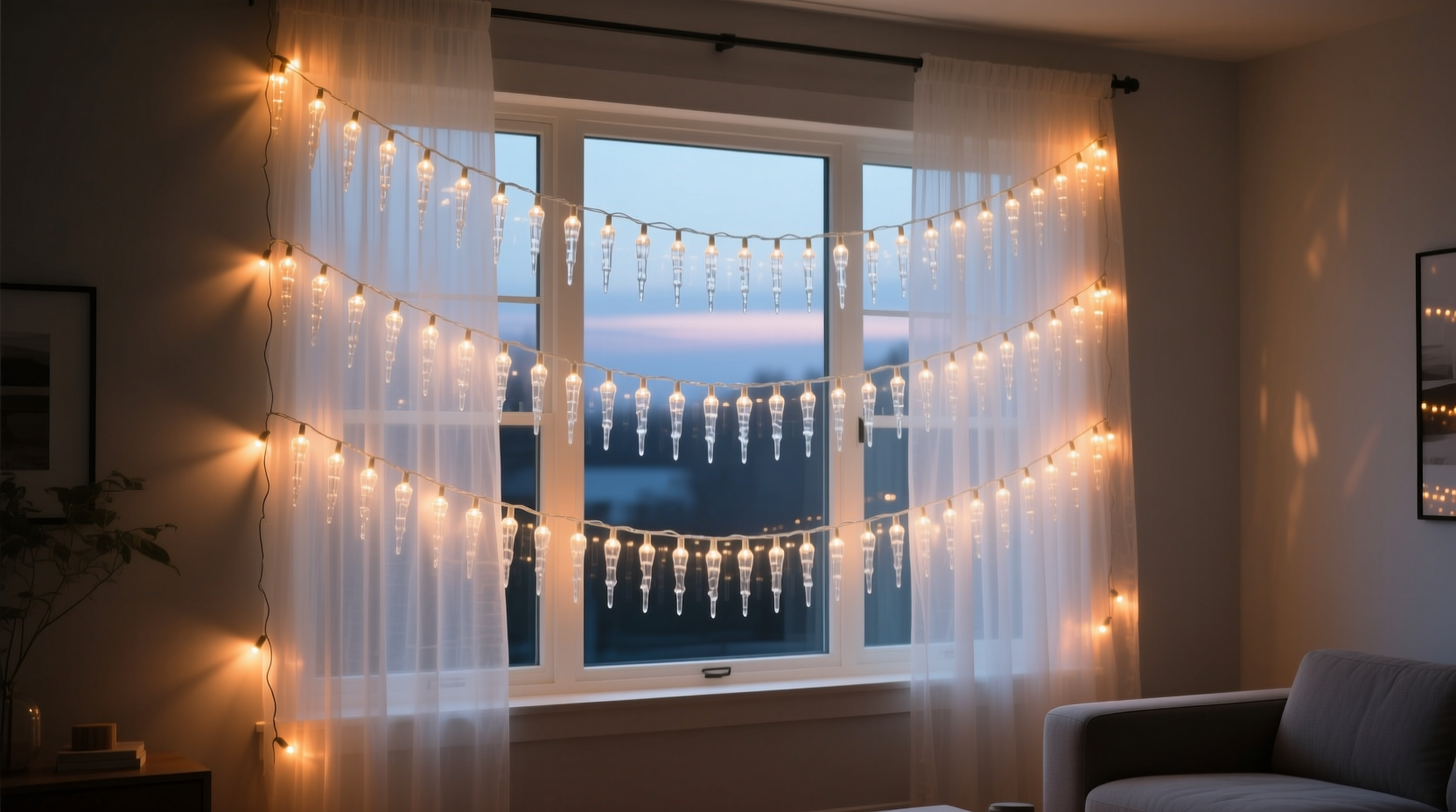
Before comparing specific products, it's essential to define what \"depth\" and \"light diffusion\" mean in the context of decorative lighting.
Depth refers to the illusion of three-dimensionality created by lighting. A display with high depth appears to recede into space rather than sitting flush against the glass. It gives the impression of volume, shadow, and layering—critical for making a window feel dynamic rather than flat.
Light diffusion, on the other hand, describes how evenly and softly light spreads across an area. Poorly diffused lights create harsh hotspots and dark gaps, while effective diffusion produces a uniform, gentle radiance that enhances rather than overwhelms.
In window applications, these qualities depend on several factors: bulb spacing, wire configuration, length of drop, density of LEDs, and angle of emission. Both icicle and curtain lights manipulate these variables differently, leading to distinct outcomes.
LED Icicle Lights: Structure and Visual Impact
LED icicle lights mimic the appearance of melting ice formations hanging from eaves. They consist of a horizontal top strand with multiple vertical drops of varying lengths—typically staggered between 12 to 36 inches. These drops are usually spaced 3 to 6 inches apart along the main wire.
The staggered drop design is crucial. Because the strands hang at different lengths, they catch light at varied depths relative to the window plane. When viewed from the street or indoors, this variation introduces shadows and parallax, enhancing the perception of depth. As wind or slight movement occurs, the subtle sway of individual strands adds kinetic depth, further breaking up flatness.
However, diffusion remains a challenge. Most icicle sets use point-source LEDs—small, bright bulbs concentrated at intervals. While energy-efficient, these tend to create visible bright spots along each drop, especially when seen up close. Between the bulbs, darkness persists unless additional ambient lighting fills the gaps.
Another limitation is directional focus. Icicle lights primarily emit downward and outward, meaning much of the light escapes past the sides of the window rather than illuminating the glass or interior space. This makes them excellent for exterior curb appeal but less effective for indoor ambiance.
“While icicle lights excel at simulating natural winter phenomena, their lighting pattern is inherently directional and fragmented—ideal for drama, not uniformity.” — Marcus Lin, Architectural Lighting Designer
Curtain Lights: Design Advantages for Depth and Diffusion
Curtain lights, also known as net lights or mesh lights, feature a grid-like arrangement where vertical strands of LEDs are evenly spaced—often 6 inches apart—and extend straight down from a single horizontal header. Unlike icicles, all strands are typically the same length, forming a flat, rectangular plane resembling a glowing curtain.
Despite appearing flatter in structure, curtain lights often produce greater perceived depth due to their high-density coverage and consistent diffusion. With more LEDs per square foot (commonly 50–100 bulbs over a 6' x 4' panel), the light output becomes less about individual points and more about collective glow. This saturation minimizes shadows and evens out brightness, resulting in a luminous field that appears to float in front of the window.
Because the entire surface emits light uniformly, reflections on glass become softer and more immersive. From the outside, this creates a “lit-from-within” effect, suggesting warmth and interior life. Indoors, the even spread reduces glare and eye strain, making curtain lights suitable for living rooms, bedrooms, or cafes seeking cozy atmospheres.
Moreover, modern curtain lights often incorporate diffuser sleeves or frosted bulbs that scatter light laterally. This lateral dispersion increases interaction with surrounding surfaces—walls, frames, drapes—bouncing photons back into the viewer’s field of vision and reinforcing spatial depth through indirect illumination.
Comparative Analysis: Key Differences in Performance
| Feature | LED Icicle Lights | Curtain Lights |
|---|---|---|
| Bulb Density | Low to moderate (bulbs every 4–6\") | High (bulbs every 3–6\" across dense grid) |
| Depth Perception | Moderate (from staggered lengths) | High (from uniform glow and reflection) |
| Light Diffusion | Poor to fair (hotspots common) | Excellent (even spread, minimal gaps) |
| Installation Fit | Best for wide eaves and tall windows | Ideal for standard to large windows |
| Indoor Ambiance | Limited (focused outward) | Strong (soft, enveloping glow) |
| Wind Resistance | Poor (strands tangle easily) | Good (connected grid resists tangling) |
This comparison reveals a clear trade-off: icicle lights prioritize realism and festive tradition, while curtain lights emphasize optical quality and atmospheric immersion. If the goal is deeper perceived depth and superior diffusion, curtain lights hold a measurable advantage.
Real-World Application: A Side-by-Side Case Study
In a recent seasonal installation in Portland, Oregon, two adjacent homes on the same block used identical white LED technology but different configurations—one installed premium icicle lights, the other opted for commercial-grade curtain panels.
Home A chose 24-foot dual-row icicle strings with 36-inch max drop, mounted under the eave above a double-hung window. From the sidewalk, the display looked festive and traditional, with noticeable sparkle and movement. However, during still nights, the lack of diffusion became apparent: individual bulbs stood out like stars against black velvet, and the space between strands remained visually disconnected.
Home B used a 6' x 4' warm-white curtain light panel clipped directly to the window frame. No eave mounting was needed. At dusk, the entire window transformed into a glowing canvas. Neighbors reported feeling a stronger sense of warmth emanating from this house. Photographs confirmed higher luminance consistency and reduced contrast ratios.
A local lighting consultant measured lux levels at five points across both facades. The icicle setup showed variance from 12 to 87 lux (a 7x difference), indicating uneven distribution. The curtain light averaged 68–74 lux across all points—a mere 8% fluctuation. Despite using fewer total LEDs (80 vs. 120), the curtain system delivered smoother, deeper illumination.
Step-by-Step Guide to Maximizing Depth and Diffusion
To achieve optimal visual results regardless of your chosen type, follow this sequence:
- Measure Your Window Area: Note width and height. For curtain lights, match or slightly exceed dimensions. For icicles, ensure drops extend below the sill for depth effect.
- Select the Right Color Temperature: Warm white (2700K–3000K) enhances coziness and improves diffusion perception. Cool white may appear brighter but feels harsher.
- Check Bulb Spacing and Density: Aim for no more than 6 inches between LEDs. Higher density = better diffusion.
- Install with Offset Clearance: Mount lights 2–6 inches away from the glass using clips or brackets. This allows light to wrap around edges, increasing depth.
- Add Background Contrast: Hang dark fabric or place furniture behind the window. A dark backdrop makes the light appear brighter and more dimensional.
- Test at Dusk and Night: Observe how light interacts with surroundings. Adjust positioning if hotspots or gaps are visible.
- Consider Layering: Combine curtain lights with sheer curtains or blinds. The fabric acts as a secondary diffuser, softening the glow.
Checklist: Choosing Between Icicle and Curtain Lights
- ☐ Do you want a traditional, festive look? → Choose icicle lights.
- ☐ Is smooth, even lighting your priority? → Choose curtain lights.
- ☐ Are you lighting from inside for indoor ambiance? → curtain lights perform better.
- ☐ Do you have high eaves or rooflines? → icicle lights take advantage of vertical space.
- ☐ Is wind exposure a concern? → curtain lights resist tangling.
- ☐ Do you prefer easy storage and setup? → curtain panels unfold like nets and require fewer anchor points.
- ☐ Are you using the lights year-round? → curtain lights blend better with modern decor.
Frequently Asked Questions
Can I use icicle lights indoors for a curtain-like effect?
Technically yes, but results are suboptimal. Icicle lights have irregular drops and wider spacing, so they don’t cover windows uniformly. You’ll see gaps and inconsistent brightness. For indoor window lighting, dedicated curtain lights deliver far better diffusion and coverage.
Do curtain lights work on bay or angled windows?
Yes, but flexibility matters. Look for models with flexible wiring or modular sections. Some advanced designs allow bending at corners without damaging circuits. Measure carefully and consider custom-cut panels for non-rectangular spaces.
Which uses more electricity—icicle or curtain lights?
It depends on LED count and wattage, not type. However, curtain lights often have higher bulb density, so a full-panel unit might consume slightly more power. That said, most modern LED versions use under 10 watts per 50-light strand, making both highly efficient compared to incandescent alternatives.
Final Recommendation: Prioritize Diffusion for Lasting Impact
While LED icicle lights remain a nostalgic favorite—especially during winter holidays—their limitations in diffusion and depth consistency make them less ideal for sophisticated or ambient-focused displays. Curtain lights, with their engineered uniformity, superior spread, and enhanced reflective properties, consistently outperform in creating a deep, immersive glow.
This doesn’t mean abandoning icicle lights altogether. They serve a purpose in architectural accenting, particularly on rooftops or porches where movement and dimensionality come from height and sway. But for window-specific installations where light quality, comfort, and visual richness matter most, curtain lights are the superior choice.
The shift toward experiential lighting—where mood and atmosphere outweigh mere brightness—is reshaping consumer preferences. As homes become sanctuaries of comfort and style, the demand for seamless, deeply diffused illumination will continue to grow. In that evolution, curtain lights aren’t just functional; they’re foundational.




 浙公网安备
33010002000092号
浙公网安备
33010002000092号 浙B2-20120091-4
Comments
No comments yet. Why don't you start the discussion?