
As winter approaches, homeowners and decorators alike turn to outdoor lighting to evoke the magic of a snowy season—even in regions where snow is rare. Among the most popular choices are LED icicle lights and rope lights. Both offer energy efficiency, durability, and a range of color options, but when it comes to creating the illusion of natural snowfall, one may outshine the other. This article explores the visual characteristics, design structure, and real-world performance of each type to determine which delivers a more authentic snow-mimicking effect.
Understanding the Visual Language of Snowfall
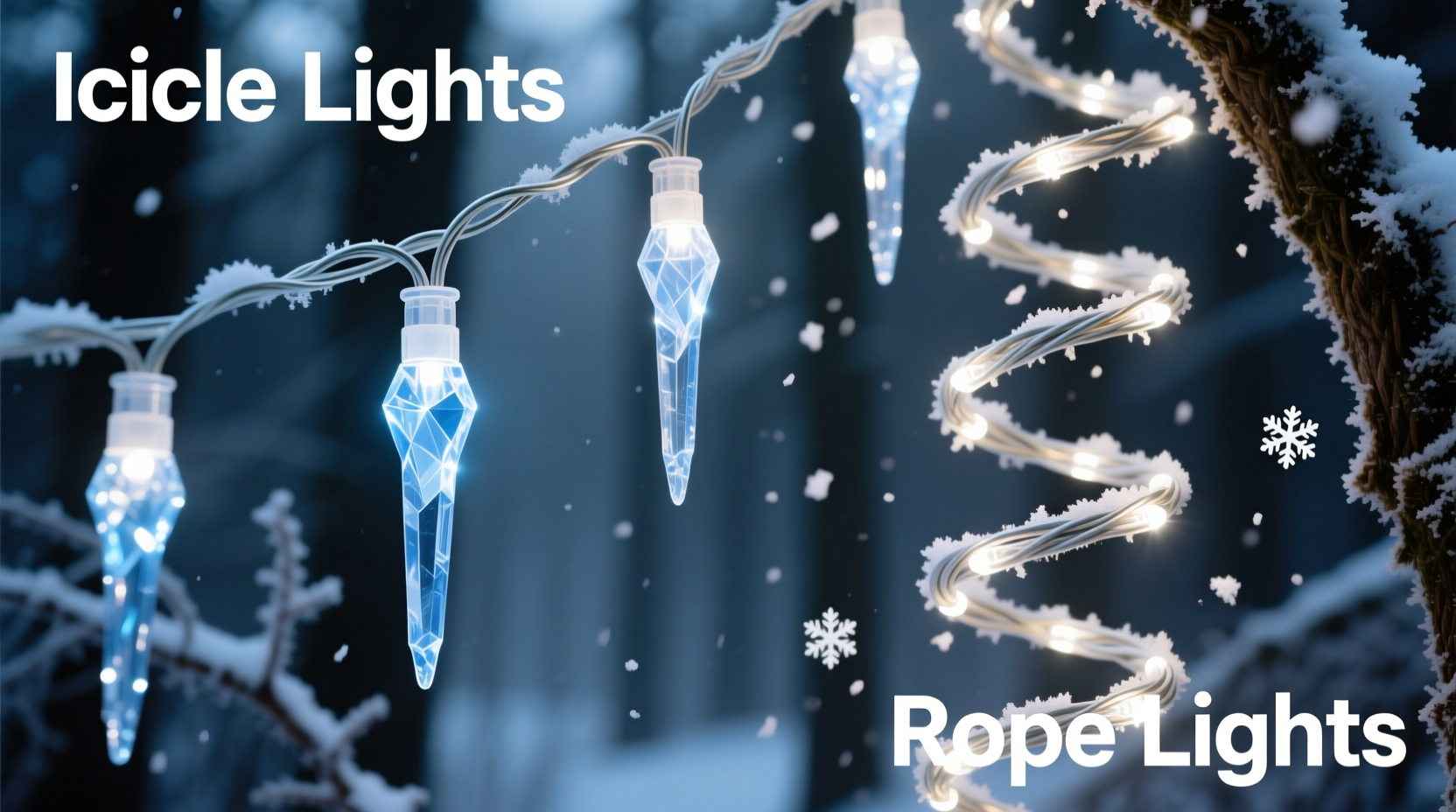
To assess which lighting style better mimics snowfall, it’s essential to understand what we’re trying to replicate. Natural snowfall isn’t uniform. It has depth, randomness, and variation in density. Icicles form at irregular intervals along rooflines, with differing lengths and slight bends due to melting and refreezing. The way light reflects off frozen water droplets creates subtle glimmers—fleeting highlights rather than constant brightness.
A successful artificial snowfall illusion must capture these nuances: uneven spacing, vertical drops, and intermittent sparkle. Static, evenly spaced illumination won’t fool the eye. Instead, the goal is dynamic realism—something that feels organic, not engineered.
“Lighting that imitates nature must embrace imperfection. Perfect symmetry kills authenticity.” — Daniel Reeves, Landscape Lighting Designer with 20+ years in seasonal installations
Design & Structure: How Each Light Type Works
At first glance, both LED icicle lights and rope lights appear similar—flexible strings of small bulbs designed for outdoor use. But their construction leads to vastly different visual outcomes.
LED Icicle Lights: Simulating Nature’s Drips
True to their name, LED icicle lights are built to resemble actual icicles hanging from eaves. They consist of a horizontal top strand with vertical “drops” extending downward at set intervals. These drops vary in length (commonly between 6” and 36”) and often include staggered tips to enhance randomness. Many modern versions feature dual-function LEDs that alternate or twinkle, simulating the shimmer of sunlight on ice.
The key advantage lies in their three-dimensional profile. When installed along a roofline, they create depth and shadow play, especially at dusk. Wind causes gentle swaying, further enhancing the illusion of real ice formations.
Rope Lights: Uniform Glow vs. Natural Variation
Rope lights, by contrast, are continuous tubes of plastic or silicone encasing a strand of LEDs. They emit a consistent glow along their entire length, with no vertical extensions. Typically round or semi-round in cross-section, they’re flexible and weather-resistant, making them ideal for outlining windows, railings, or arches.
While newer models include diffused lenses to soften the light, rope lights lack the dimensional drop effect crucial to mimicking hanging ice. Their smooth, uninterrupted appearance reads more like neon signage than winter frost. Even when bent into curves or zigzags, they fail to suggest individual icicles.
Visual Comparison: Realism Under Real Conditions
To evaluate which product better replicates snowfall, consider how each performs in common viewing scenarios.
| Feature | LED Icicle Lights | Rope Lights |
|---|---|---|
| Vertical Dimension | High – multiple drop lengths create depth | Low – flat, linear profile |
| Shadow Play | Strong – cast shadows mimic ice formations | Minimal – even diffusion reduces contrast |
| Natural Movement | Moderate – individual strands sway independently | Low – rigid tube resists wind motion |
| Installation Flexibility | Rooflines, gutters, porches | Outlines, curves, borders |
| Snowfall Illusion Accuracy | High – closely resembles actual icicles | Low – appears artificial, not wintry |
The table makes clear that while rope lights excel in uniformity and ease of shaping, they fall short in mimicking the chaotic elegance of real snowmelt forming icicles. Icicle lights, despite being less versatile in layout, deliver superior realism through structural mimicry.
Case Study: Suburban Home Transformation in Portland, OR
In December 2023, homeowner Lisa Tran in Portland, Oregon—a city known for drizzle but rarely heavy snow—wanted to create a cozy, snowy cabin aesthetic for her Craftsman-style home. She tested two approaches across adjacent sections of her front porch roofline.
On the left side, she installed 20-foot strands of commercial-grade LED icicle lights with mixed drop lengths (ranging from 9” to 24”). On the right, she used 20 feet of 12mm diameter rope lights in cool white, mounted flush under the eave.
Neighbors and passersby were asked informally which side looked more like a snow-covered home. Of 37 respondents, 31 said the icicle-lit side appeared “like it had just snowed,” citing the “dripping effect” and “sparkle.” Only two mentioned the rope lights as “pretty,” but added they “looked more like a diner sign.”
After two weeks, Lisa replaced the rope lights with a second set of icicle strands. “I wanted people to feel like they’d stepped into a winter postcard,” she said. “The rope lights just didn’t sell the story.”
Step-by-Step Guide to Installing Realistic Icicle Lighting
Even the best product needs proper installation to achieve its full potential. Follow this sequence for optimal snowfall mimicry:
- Measure your roofline – Focus on eaves, gutters, and porch overhangs where real icicles would form.
- Choose variable-length icicle strands – Avoid uniform drops; mix lengths within a single run for randomness.
- Space strands unevenly – Install clusters closer together in some areas, sparser in others, like natural ice buildup.
- Angle the base slightly forward – Tilt the top wire so drops hang freely and catch side light.
- Add subtle movement – Use clips that allow slight sway; avoid tight mounting.
- Select the right color temperature – Opt for 5000K–6500K (daylight white) to mimic sunlight on snow, not warm white.
- Incorporate dimming or twinkling modes – Set to “twinkle” or “fade” rather than steady-on for dynamic sparkle.
- Test at twilight – View from street level and neighboring angles to adjust positioning before finalizing.
When Rope Lights Are the Better Choice
Despite their limitations in mimicking snowfall, rope lights have legitimate uses in winter décor. They shine—literally—in applications where continuity matters more than realism.
- Archways and doorframes: Rope lights can trace elegant curves, framing entrances with a festive border.
- Handrails and stair edges: Their durability and even glow enhance safety while adding ambiance.
- Indoor mantle displays: Wrapped around garlands, they provide soft, ambient light without overpowering.
- Color-themed displays: Multicolor rope lights work well in playful, non-realistic setups like holiday trains or reindeer scenes.
In these cases, the goal isn’t to deceive the eye into seeing snow, but to create a joyful, illuminated environment. Rope lights fulfill that role effectively.
Expert Recommendations for Maximum Realism
Industry professionals agree that achieving a convincing snowfall illusion requires attention to detail beyond bulb choice.
“The secret isn’t just the light—it’s the shadow. You need negative space, variation, and a little unpredictability.” — Maya Lin, Seasonal Lighting Consultant for Urban Outdoors Co.
Lin recommends layering lighting techniques: using icicle lights for primary snow mimicry, then adding pin-spot uplights in shrubs with blue filters to emulate snow cover on the ground. She also advises against over-lighting—too many strands destroy the delicate balance of realism.
Another pro tip: install some icicle strands with slight gaps between drops, leaving empty spaces where “icicles” might have melted. This subtle imperfection increases believability.
Frequently Asked Questions
Can rope lights be modified to look like icicles?
Not effectively. While DIY attempts exist—such as attaching faux icicle molds or cutting tubes into segments—the results are often clunky and unsafe. The uniform internal wiring prevents true drop variation, and exposed cuts risk moisture damage. Purpose-built icicle lights remain the superior option.
Do LED icicle lights consume more energy than rope lights?
No. In fact, modern LED icicle lights are highly efficient, typically using 4–8 watts per strand. Rope lights of similar length may use slightly less due to fewer LEDs, but the difference is negligible. Both are far more efficient than older incandescent options.
Are icicle lights safe in wet, snowy climates?
Yes, if rated for outdoor use (look for UL certification and IP44 or higher). Ensure connections are elevated and sealed with waterproof caps. Avoid placing plugs directly on snow-covered ground to prevent water ingress.
Checklist: Choosing the Right Lights for Snowfall Realism
- ☑ Prioritize LED icicle lights with variable drop lengths
- ☑ Select cool white (5000K–6500K), not warm white
- ☑ Choose strands with independent twinkle or fade modes
- ☑ Verify outdoor rating (UL-listed, waterproof)
- ☑ Plan for uneven spacing and natural-looking clusters
- ☑ Avoid overcrowding—leave gaps for realism
- ☑ Pair with ground-level blue accent lighting
- ☑ Test visibility and effect at dusk and night
Conclusion: Embracing the Illusion of Winter
When the goal is to recreate the quiet beauty of a snow-laden evening, LED icicle lights are the clear winner over rope lights. Their three-dimensional design, varied drop lengths, and ability to catch light and shadow make them uniquely capable of mimicking real icicles formed by winter’s touch. Rope lights, while useful for outlines and decorative borders, lack the depth and randomness needed for true snowfall realism.
The difference lies not just in technology, but in perception. Humans are finely tuned to recognize patterns—or the absence of them. Artificial perfection signals “decoration”; subtle irregularity whispers “nature.” By choosing lighting that embraces variation, you invite viewers into a moment of suspended disbelief, where a suburban porch can briefly become a snowy retreat.




 浙公网安备
33010002000092号
浙公网安备
33010002000092号 浙B2-20120091-4
Comments
No comments yet. Why don't you start the discussion?