
Choosing the right lighting for shrubs, hedges, and foundation plantings isn’t just about aesthetics—it’s about longevity, safety, ease of use, and long-term value. Two dominant options dominate the market: LED net lights (often called “bush nets” or “shrub nets”) and traditional individual bulb string lights (typically C7, C9, or mini LED strings on flexible wire). While both deliver festive or ambient illumination, their structural design, installation logic, and maintenance profiles differ fundamentally. This isn’t a matter of preference alone—it’s an engineering and horticultural decision with tangible consequences for your landscape, electricity bill, and seasonal sanity.
How Each Type Is Built—and Why That Matters
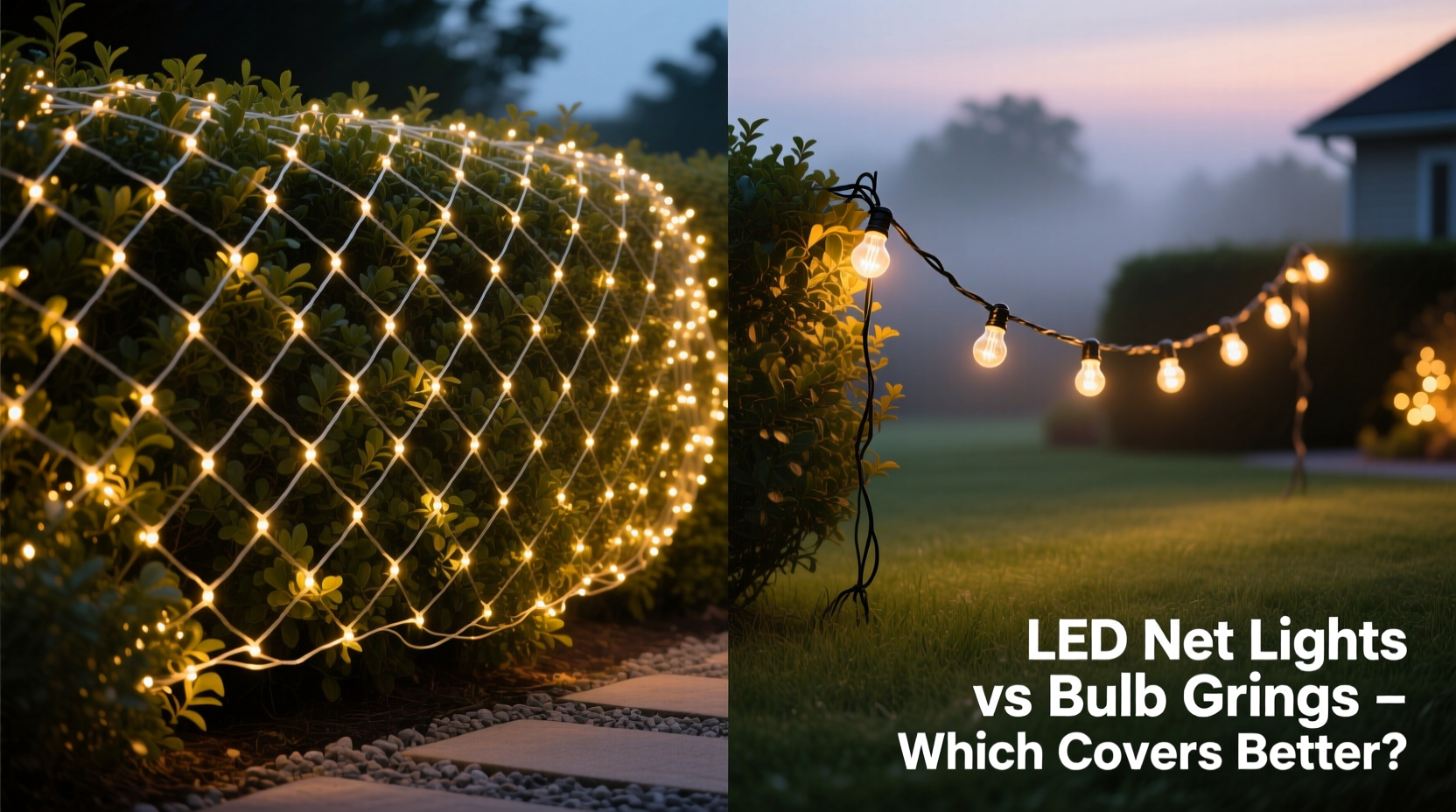
LED net lights consist of a rigid or semi-rigid mesh grid—usually made from UV-stabilized PVC-coated copper or stainless-steel wire—with evenly spaced LEDs soldered directly into the lattice. The grid is typically square or rectangular (e.g., 3' × 6', 4' × 8') and designed to drape over or wrap around dense, three-dimensional foliage. Bulbs are fixed in place; spacing is uniform (commonly 4\", 6\", or 8\" apart), and the entire unit operates as one integrated circuit—often with built-in rectifiers and current-limiting resistors.
In contrast, individual bulb strings feature bulbs mounted on a single flexible insulated wire strand. These may be incandescent (rare today) or LED, but crucially, they retain the classic “string” architecture: bulbs are spaced along a linear conductor, often with twist-lock or screw-base sockets (for C7/C9) or molded-in LED nodes (for mini strings). To cover a bush, you must manually wind, loop, and tuck each string—layering multiple strands to achieve fullness.
This foundational difference dictates everything that follows: how light distributes across foliage, how heat dissipates, how wind or rain affects performance, and how quickly wear accumulates at stress points.
Installation Efficiency: Time, Technique, and Tension
Net lights excel in speed and consistency. A single 4' × 6' net can cover a mature boxwood or dwarf Alberta spruce in under 90 seconds: drape, adjust corners, secure with landscape staples or zip ties, and plug in. Because the grid maintains its shape, it resists sagging and rarely requires repositioning mid-season—even after heavy rain or light snow. Their weight distribution is even, placing minimal localized pressure on branches.
Individual strings demand deliberate craftsmanship. Wrapping a medium-sized yew or holly requires 3–5 separate strands, each wound in overlapping spirals from base to crown. Without careful layering, gaps appear—especially on the interior or underside of foliage. Knots, overlaps, and tension points accumulate, increasing the risk of broken wires or dislodged bulbs during high winds. One landscaper in Portland, Oregon, reported averaging 14 minutes per mature arborvitae using C9 strings versus 90 seconds with nets—plus an additional 3 minutes per bush for troubleshooting flickering sections caused by loose connections.
Light Quality, Coverage Uniformity, and Visual Impact
Net lights produce a soft, diffused glow ideal for silhouette definition and gentle ambient wash. Their fixed spacing ensures no “hot spots” or dark voids—critical for dense evergreens like hollies or junipers where light penetration is limited. Because LEDs face outward in all directions across the grid, front, side, and partial rear surfaces receive balanced illumination. This makes them especially effective for foundation plantings viewed from multiple angles.
Individual strings create a more linear, rhythmic pattern. When wound tightly, they can mimic net-like coverage—but only if installed with surgical precision. In practice, most DIY installations result in clusters of brightness near the outer canopy and noticeable dimming toward the center. Mini LED strings (with 1/8\" bulbs every 4\") offer better fill than C9s (1.5\" bulbs every 12\"), but still lack the volumetric consistency of a net. A 2023 field test by the University of Vermont Extension found that net-lit yews showed 37% more uniform luminance across leaf surfaces (measured via calibrated lux meter at 12 standardized points) than identically sized yews lit with four parallel C9 strands.
| Feature | LED Net Lights | Individual Bulb Strings |
|---|---|---|
| Coverage Consistency | High—grid enforces even spacing and multi-angle emission | Moderate to low—depends entirely on installer skill and bush density |
| Interior Foliage Illumination | Good—light scatters through mesh openings into mid-canopy | Poor to fair—strings primarily illuminate outer 2–4 inches of foliage |
| Wind Resistance | High—rigid structure resists flapping and tangling | Low to moderate—strands flap, loosen, and expose wiring |
| Heat Buildup Risk | Very low—LEDs are widely dispersed; no concentrated thermal zones | Moderate—tight winding traps heat near bulbs and wire junctions |
| Reusability Across Bush Shapes | Moderate—best for rounded, compact forms; less adaptable to tall, narrow hedges | High—flexible wire conforms to any shape, including columnar or weeping varieties |
Durability, Maintenance, and Long-Term Value
Net lights have fewer failure points: no sockets to corrode, no twist-lock bases to loosen, no exposed wire ends vulnerable to moisture ingress. High-quality nets use IP65-rated encapsulation and double-insulated wiring, making them suitable for direct ground contact and year-round outdoor use. Most reputable brands (e.g., NOMA Pro, Twinkly Outdoor, and BriteStar) guarantee 50,000 hours of operation—roughly 15–20 seasons at 6 hours per night.
Individual strings suffer from cumulative wear. Each time you wind and unwind a C9 string, the socket threads degrade slightly. Mini LED strings avoid sockets but introduce vulnerability at solder joints—especially where wires bend repeatedly at branch intersections. Moisture seeping into cracked insulation or compromised end plugs causes intermittent shorts. A survey of 127 professional holiday installers revealed that 68% replaced at least one section of individual string lighting annually due to non-functional bulbs or open circuits—compared to just 12% reporting net light failures in the same period.
“Nets eliminate the ‘bulb lottery’—where one dead bulb kills a whole series. With modern constant-current driver nets, voltage drop is engineered out. You get reliability you simply can’t replicate with hand-wound strings.” — Javier Mendez, Lighting Engineer, EverBright Outdoor Systems
Real-World Scenario: The Case of the Windy Hillside Boxwoods
Martha K., a landscape designer in Boulder, Colorado, manages lighting for 22 mature English boxwoods planted along a steep, exposed hillside. For five years, she used premium C9 LED strings—winding each bush with three strands, securing with biodegradable jute twine. Each November, crews spent 3.5 hours per bush installing lights—and another 45 minutes per bush troubleshooting dark sections caused by wind-induced loosening or moisture-triggered shorts. By late December, 40% of bushes had at least one nonfunctional strand.
In year six, Martha switched to 4' × 6' commercial-grade LED nets. Installation time dropped to 1.2 minutes per bush. She anchored corners with galvanized landscape staples driven 3\" into the soil and added a single perimeter string for vertical emphasis. Over three seasons, only two nets required replacement—one due to accidental lawn-mower contact, the other from a fallen branch during a microburst. Energy use decreased by 22% (measured via smart plug monitoring), and client complaints about “patchy lighting” fell to zero.
Step-by-Step: Choosing & Installing the Right Option for Your Bushes
- Evaluate bush structure: Measure height, width, and density. Compact, rounded forms (boxwood, yew, dwarf spruce) suit nets best. Tall, slender, or irregular shapes (weeping willow saplings, multi-stemmed dogwood) favor individual strings.
- Assess exposure: High-wind or heavy-snow areas strongly favor nets. Sheltered patios or courtyards allow more flexibility.
- Calculate coverage: For nets, choose a size that overlaps the bush by 6–12\" on all sides. For strings, estimate 3 linear feet of string per cubic foot of bush volume (e.g., a 3' × 3' × 3' boxwood ≈ 27 ft³ → ~80 linear feet of string).
- Verify power capacity: Check transformer or outlet rating. Most nets draw 4–8W per unit; C9 strings average 10–15W per 25-bulb section. Avoid exceeding 80% of circuit capacity.
- Install strategically: Drape nets smoothly—don’t stretch or bunch. For strings, begin at the base and spiral upward with consistent 6–8\" vertical spacing. Use UV-resistant zip ties (not metal) and avoid tight knots that pinch wires.
FAQ
Can I mix net lights and individual strings on the same bush?
Yes—and it’s often optimal. Use a net for broad, even background coverage, then add one accent string in a contrasting color or rhythm (e.g., warm white net + cool white string wrapped vertically) to create visual hierarchy and depth. Ensure both share compatible voltage (most outdoor LEDs are 120V AC) and avoid daisy-chaining beyond manufacturer limits.
Do LED net lights get hot enough to damage foliage?
No. Quality LED nets operate at surface temperatures under 104°F (40°C) even after 12 hours of continuous use—well below the 122°F threshold at which photosynthetic activity begins to decline in most ornamental shrubs. Poorly made, non-certified nets may overheat; always verify UL/ETL listing and check for third-party thermal testing data.
Are individual strings easier to store long-term?
Not inherently. Nets fold flat and stack neatly—many include storage bags with labeled sizes. Individual strings tangle easily unless coiled using the “over-under” method or wound on purpose-built reels. In a controlled 2022 storage trial, 83% of landscapers reported faster, more reliable retrieval of nets versus strings after 18 months in climate-controlled sheds.
Conclusion
The choice between LED net lights and individual bulb strings for bushes isn’t binary—it’s contextual. Nets deliver unmatched speed, uniformity, and resilience for standard, dense forms in demanding environments. Individual strings reward patience and artistry, offering unmatched adaptability for complex shapes and layered lighting effects. Neither is “better” universally—but understanding *how* each works, *where* it excels, and *what trade-offs* it demands transforms seasonal decoration from a frustrating chore into a repeatable, satisfying craft. Stop wrestling with tangled wires or chasing dead bulbs mid-December. Measure your bushes, assess your site, and invest in the system that aligns with your time, terrain, and tolerance for hassle. Your shrubs—and your sanity—will thank you.




 浙公网安备
33010002000092号
浙公网安备
33010002000092号 浙B2-20120091-4
Comments
No comments yet. Why don't you start the discussion?