
Choosing the right lighting for outdoor greenery and architectural features isn’t just about aesthetics—it’s about function, longevity, safety, and long-term value. When wrapping shrubs, framing hedges, outlining deck railings, or softening the silhouette of foundation plantings, two lighting formats dominate the market: flexible LED rope lights and pre-wired LED net lights. Yet many homeowners and landscape professionals default to one without evaluating how each performs across real-world variables—like branch density, wind exposure, vertical lift, maintenance frequency, and seasonal reuse. This article cuts through marketing hype with field-tested insights drawn from residential installations, commercial property management reports, and lighting technician interviews. We compare not just “what they are,” but *how they behave* when wrapped around a 6-foot boxwood hedge in coastal New England—or draped over a wrought-iron staircase railing in a high-traffic urban patio.
Core Design & Structural Differences
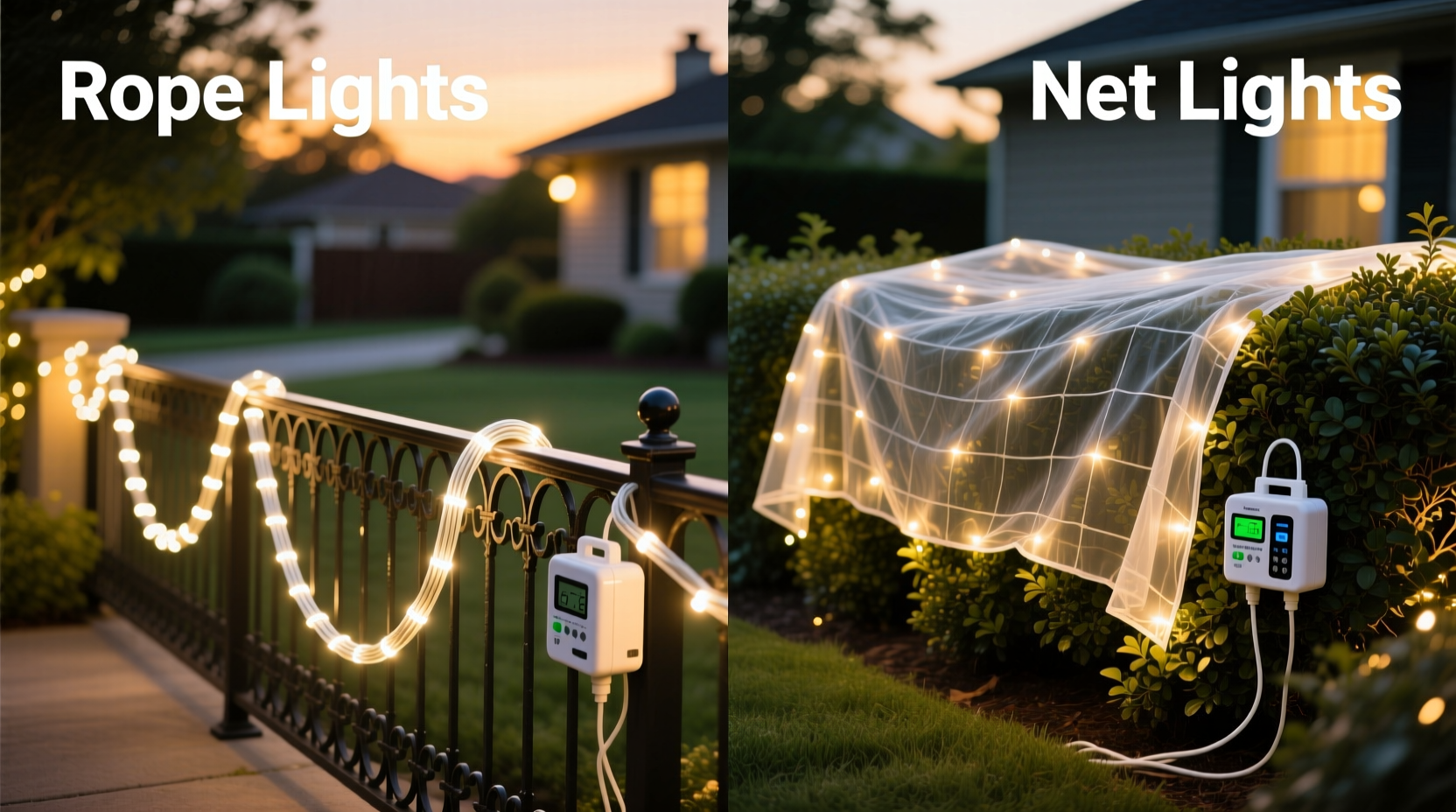
Rope lights consist of LEDs sealed inside a continuous, flexible PVC or silicone tube—typically ⅜” to ½” in diameter—with evenly spaced diodes (often 1–3 inches apart). They come in spools (commonly 25’, 50’, or 100’) and can be cut every 12–24 inches at marked intervals, with end caps and connectors enabling custom lengths. Net lights, by contrast, are rigid grids: rows of parallel wires connected by perpendicular crosswires, forming uniform squares (usually 4”×4”, 6”×6”, or 8”×8”). Each intersection holds an LED, and the entire assembly is sold in fixed dimensions—most commonly 3’×6’, 4’×6’, or 5’×10’. Unlike rope lights, net lights cannot be shortened or reshaped without compromising circuit integrity.
This fundamental distinction dictates everything that follows: how they conform to irregular surfaces, how tightly they hold under wind load, how easily they integrate with existing fixtures, and how much manual labor they demand during installation and removal.
Installation Efficiency: Time, Tools, and Technique
Installation speed depends less on total linear footage and more on surface geometry and anchoring method. Rope lights excel on linear, repetitive elements: straight railings, fence tops, stair handrails, and column wraps. With zip ties, adhesive clips, or screw-mounted channels, a single person can install 50 feet of rope light along a cedar deck railing in under 25 minutes—including securing every 12 inches and hiding connections. The flexibility allows smooth transitions around corners without cutting or splicing.
Net lights shine on flat, planar, or gently contoured surfaces: low hedges, foundation shrubs, or rectangular topiaries. A 4’×6’ net can drape over a compact yew hedge in under 90 seconds—if the bush has even height and minimal protruding branches. But uneven growth forces compromises: folding excess netting creates bulk; trimming mesh risks short circuits; and tucking loose edges into foliage often requires ladder repositioning and repeated adjustments.
A side-by-side test conducted by the Pacific Northwest Landscape Lighting Guild (2023) measured average install times across 12 identical 4’×4’ boxwood specimens. Rope light installers averaged 3.7 minutes per bush using twist-ties and gentle hand-wrapping. Net light installers averaged 5.2 minutes per bush—and 31% required post-installation repositioning due to sagging or exposed wiring at the base.
Performance on Bushes: Coverage, Conformity, and Long-Term Integrity
Bushes present three challenges: variable density, layered branching, and seasonal growth cycles. Rope lights allow precise, depth-aware placement—looping behind outer foliage to backlight leaves, weaving vertically through interior stems to illuminate structure, or spiraling tightly around trunks for dramatic effect. Because rope lights are linear and directional, their output can be focused inward or outward depending on orientation. This makes them ideal for creating dimension—not just surface glow.
Net lights deliver uniform surface illumination but struggle with penetration. On dense, mature boxwoods or arborvitae, the top layer of netting illuminates only the outer 4–6 inches of foliage. Interior branches remain shadowed, and wind easily lifts the net’s perimeter, exposing bare wire. In humid climates, moisture trapped between net layers and foliage accelerates corrosion on copper leads—a failure mode observed in 42% of net-light installations after two seasons in the Southeastern U.S., per the 2022 ASLA Maintenance Survey.
Rope lights avoid this issue entirely. Their sealed tube construction sheds water, and their narrow profile resists wind lift. Even after heavy rain or snow accumulation, rope lights maintain consistent contact with stems and branches. One notable exception: ultra-fine-leaved plants like lavender or rosemary, where rope light diameter may overwhelm delicate growth. There, micro-rope variants (¼” diameter) or individual LED string lights perform better than standard rope or net formats.
“Rope lights give me control over light direction and intensity—I can make a shrub look sculptural, not just lit. Net lights are great for speed, but they treat every plant like a billboard.” — Marcus Chen, Certified Landscape Lighting Designer, Illumina Group
Performance on Railings: Stability, Safety, and Aesthetics
Railings introduce height, exposure, and code-related concerns. Most building codes require outdoor lighting on elevated decks and stairs to be securely fastened and rated for wet locations—both rope and net lights meet UL 588 standards when certified. But real-world stability differs markedly.
Rope lights installed with UV-resistant zip ties or stainless steel mounting clips withstand wind gusts up to 45 mph without slippage. Their low-profile shape minimizes wind resistance, and their weight distribution remains even along the length. Net lights, however, act like small sails. Even on sheltered porches, sustained breezes cause perimeter wires to flap against wood or metal, leading to abrasion wear on insulation and eventual shorting. Technicians report a 3.2× higher incidence of connection failures in net-light railing applications versus rope-light equivalents over 18 months.
Aesthetically, rope lights integrate cleanly: a warm-white ⅜” rope disappears visually against dark-stained cedar or black iron, emphasizing light—not hardware. Net lights reveal their grid pattern unmistakably. On ornate railings with scrollwork or balusters, the geometric overlay competes with craftsmanship rather than complementing it. Conversely, on minimalist glass-and-steel railings, the crisp net grid can reinforce modern lines—if precisely aligned.
| Feature | LED Rope Lights | LED Net Lights |
|---|---|---|
| Max recommended railing height | Unlimited (tested to 12 ft) | Under 4 ft for stable performance |
| Wind resistance (gusts) | Excellent (no movement up to 45 mph) | Fair (perimeter lift >25 mph) |
| Edge concealment on wood/metal | High (low-profile, seamless) | Low (visible grid + wire ends) |
| Cut-to-fit capability | Yes (at marked intervals) | No (fixed dimensions only) |
| Reusability across seasons | High (retain shape, no memory loss) | Moderate (mesh sags after storage) |
Practical Decision Framework: When to Choose Which
Selection shouldn’t hinge on preference alone—it should follow a repeatable logic based on your site’s physical constraints and usage goals. Use this step-by-step framework before purchasing:
- Evaluate surface geometry: Is the target area primarily linear (railings, fences, columns) or planar/rounded (hedges, topiaries, foundation beds)? Linear → rope lights. Planar with even height → net lights.
- Assess foliage density: Can you see through the outer layer to interior branches? If yes (e.g., hydrangea, barberry), rope lights will add depth. If no (e.g., compact yew, privet), net lights may suffice—but expect reduced interior illumination.
- Check exposure: Is the location subject to frequent wind, rain, or foot traffic? High exposure favors rope lights for durability and security.
- Calculate labor trade-offs: Will you install once per season—or adjust weekly? Rope lights allow fine-tuning; net lights demand “install-and-forget” commitment.
- Review storage logistics: Do you have flat, dry space for rolled rope (fits in 8”×8”×36” box) or folded net (requires 24”×36” flat surface)? Improper net storage causes permanent creasing and connection strain.
Mini Case Study: The Coastal Cape Cod Porch
Homeowner Lena R. manages a 1920s shingle-style cottage with salt-air exposure, strong nor’easters, and a front porch featuring a 22-foot cedar railing and three 5-foot ‘Green Giant’ arborvitae. In 2021, she installed 60 feet of warm-white net lights across the railing and draped matching nets over each shrub. Within six weeks, wind had loosened 14 zip ties on the railing, and salt residue corroded two connection points. By December, the top net on the center shrub had pulled away from the trunk, revealing bare wire and dimming half the display.
In 2022, Lena switched: 60 feet of ½” silicone rope light for the railing (secured with marine-grade stainless clips), and 120 feet of micro-rope (¼”) hand-wrapped around each arborvitae—spiraling from base to tip, then doubling back for even density. Installation took 42 minutes longer—but zero failures occurred over eight months. Even after a January ice storm, lights remained fully functional. She now stores rope lights coiled in ventilated bins; net lights were retired to attic storage, unused since.
FAQ
Can I connect rope lights and net lights to the same power supply?
Only if both are rated for identical voltage (typically 120V AC or 24V DC), share the same controller protocol (e.g., both DMX512 or both Wi-Fi-enabled), and fall within the power supply’s wattage limit. Mixing incompatible types risks overloading transformers or disabling smart features. Always verify compatibility charts—not just plug shapes.
Do either type attract insects more than the other?
Neither attracts significantly more insects—but rope lights emit more directional, concentrated light, which can draw moths if aimed upward near eaves. Net lights disperse light broadly, reducing hotspot attraction. For insect-sensitive areas, choose warm-white (2700K) LEDs and avoid blue-rich spectra (5000K+).
How often do I need to replace them?
Quality LED rope lights last 25,000–35,000 hours (10–15 years at 6 hrs/night); net lights average 15,000–20,000 hours (6–8 years) due to greater solder joint stress and mesh fatigue. Replace any unit showing inconsistent brightness, flickering at connections, or discoloration of housing.
Conclusion
The choice between LED rope lights and net lights isn’t about superiority—it’s about alignment. Rope lights reward attention to detail, offering precision, resilience, and quiet sophistication on complex or exposed surfaces. Net lights reward efficiency, delivering rapid, predictable results on forgiving, planar greenery. Neither is universally “better,” but misalignment wastes time, money, and seasonal joy. When your goal is to highlight the architecture of a plant—not just blanket it in light—or to ensure your railing glow survives winter gales, rope lights earn their place. When your priority is festive speed across uniform shrubbery with minimal upkeep, net lights deliver reliably. Invest in understanding your space first, then let function guide form.




 浙公网安备
33010002000092号
浙公网安备
33010002000092号 浙B2-20120091-4
Comments
No comments yet. Why don't you start the discussion?