
When it comes to enhancing outdoor spaces, staircases, or balcony railings with decorative lighting, two popular options stand out: LED rope lights and LED net lights. Both offer energy efficiency, durability, and aesthetic appeal, but their performance in delivering even, hotspot-free illumination on railings can vary significantly. Choosing the wrong type may result in uneven brightness, visible gaps, or distracting clusters of light—exactly what most homeowners want to avoid. This guide breaks down the structural, functional, and visual differences between these two lighting types, helping you make an informed decision based on real-world application and design precision.
Understanding the Core Differences
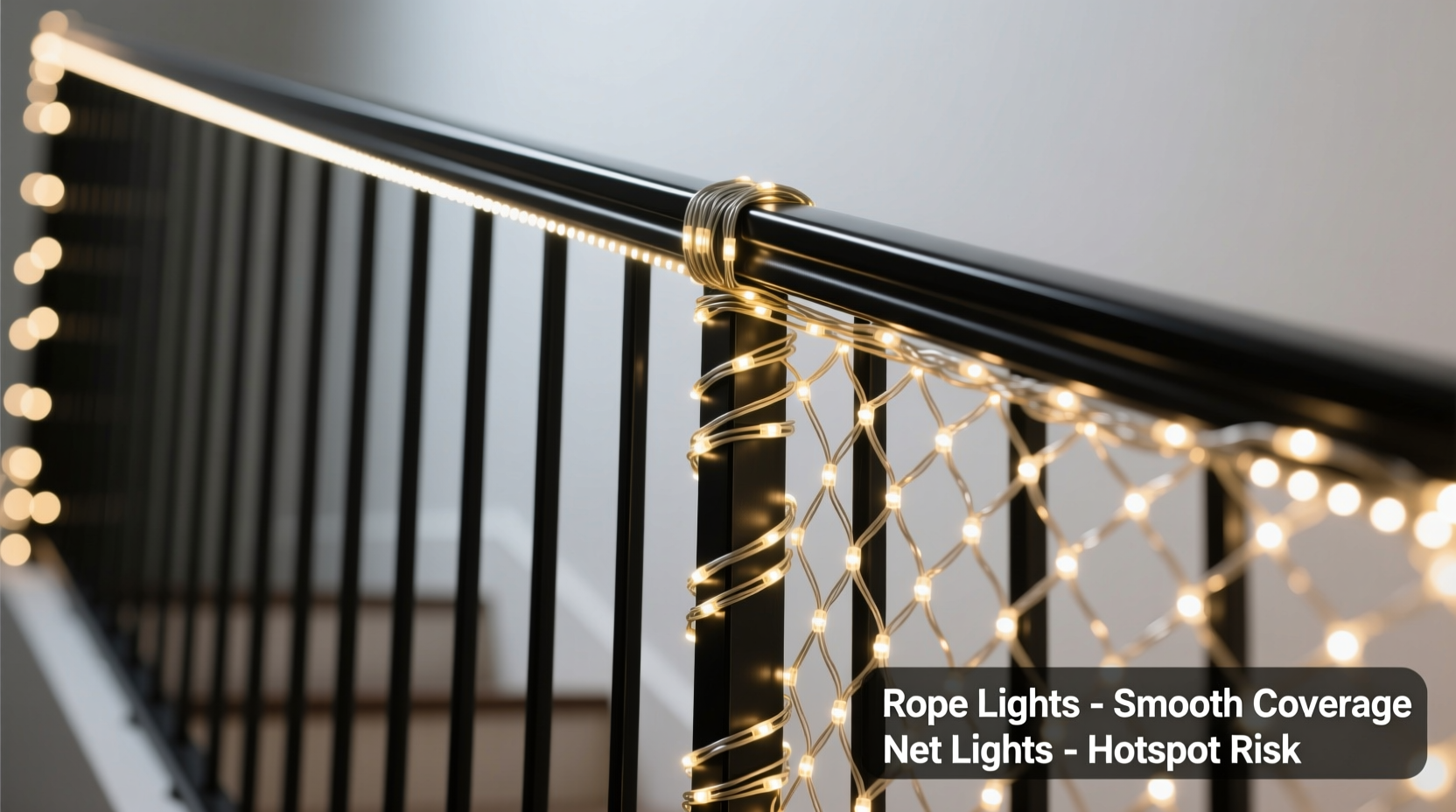
Before assessing which option provides cleaner coverage on railings, it’s essential to understand how each system is constructed and where they are typically used.
LED rope lights consist of small LEDs embedded inside a flexible, cylindrical PVC or silicone tube. The LEDs are usually spaced at regular intervals—commonly every 1 inch, 2 inches, or 4 inches—depending on the model. The entire strand is encased in a continuous sheath, giving it a smooth, \"rope-like\" appearance. These are often used for outlining shapes, wrapping columns, or tracing architectural features due to their flexibility and linear continuity.
LED net lights, on the other hand, are designed like a grid—typically arranged in a square or rectangular mesh pattern with bulbs protruding vertically from horizontal wires. They resemble fishing nets embedded with lights and are primarily intended for draping over bushes, fences, or flat surfaces. While some versions come in narrow strips suitable for railings, they are not inherently built for tight contouring.
The fundamental difference lies in form factor and directional output. Rope lights emit light radially (360 degrees around the tube), while net lights project primarily outward from the plane of the net, creating forward-facing illumination with less diffusion to the sides.
Visual Performance: Hotspots and Coverage Uniformity
One of the main concerns when decorating railings is avoiding “hotspots”—areas where light appears overly bright due to clustered bulbs or poor spacing. These create visual distractions and undermine the elegant, ambient effect most people seek.
Rope lights, especially those with closely spaced LEDs (e.g., 1-inch spacing), distribute light more evenly along the length of the railing. Because the LEDs are housed within a translucent tube, the material diffuses the individual points of light, blending them into a smoother glow. Higher-end models use frosted or milky silicone jackets that further soften the emission, minimizing the visibility of each bulb.
Net lights, by contrast, tend to emphasize individual bulbs. Even if spaced tightly, the lack of a surrounding diffuser means each LED remains distinct. When wrapped around a railing, this leads to pronounced dots of light rather than a continuous band. On curved sections, the rigid wire grid resists bending, causing sections to lift away from the surface or sit unevenly—resulting in inconsistent projection angles and shadowed areas.
“From a lighting designer’s perspective, uniformity is king. Rope lights offer superior integration on linear structures like railings because they behave more like a luminous line than a series of discrete sources.” — Marcus Tran, Architectural Lighting Consultant
Comparison Table: Rope Lights vs Net Lights for Railing Use
| Feature | LED Rope Lights | LED Net Lights |
|---|---|---|
| Light Diffusion | High – tube material blends individual LEDs | Low – bulbs remain visibly distinct |
| Flexibility on Curves | Excellent – conforms to tight bends | Poor – stiff grid resists shaping |
| Coverage Pattern | Continuous linear glow | Discrete dot pattern |
| Installation Ease on Railings | Simple – wraps smoothly, secures easily | Challenging – requires trimming, risks sagging |
| Hotspot Risk | Low – especially with frosted tubing | High – individual bulbs create glare zones |
| Best Use Case | Railings, banisters, deck edges | Bushes, flat walls, overhead draping |
Step-by-Step Guide to Installing Rope Lights on Railings
For optimal results with LED rope lights, follow this professional-grade installation sequence:
- Measure the Railing Length: Use a flexible tape measure to determine total linear footage, including curves and turns. Add 10% extra for overlap and anchoring.
- Select the Right Spacing: Choose a rope light with 1-inch or 2-inch LED spacing. Closer spacing reduces visibility of individual points and enhances continuity.
- Test Before Mounting: Plug in the full strand to verify all LEDs function and check color consistency across multiple sections.
- Clean the Surface: Wipe down the railing with isopropyl alcohol to remove dust and grease, ensuring adhesive clips or mounts adhere properly.
- Use Proper Fasteners: Install UV-resistant plastic clips or zip ties every 6–8 inches. Avoid metal staples or nails that can damage the housing.
- Wrap Smoothly: Begin at one end and wrap the rope light snugly around the top rail, maintaining consistent tension. For balusters, run the cord vertically down each post if desired for a framed look.
- Conceal Wiring: Route the power cord along less visible areas (underside of rail or near support beams) and use cable management sleeves if exposed.
- Secure the End Cap: Seal the cut end (if trimmed) with a waterproof cap to prevent moisture ingress and short circuits.
Real-World Example: Balcony Makeover in Seattle
A homeowner in Seattle’s Capitol Hill neighborhood wanted to illuminate a wrought-iron spiral staircase leading to her rooftop deck. Initially drawn to net lights for their festive appearance, she purchased a 6x12-foot green-light version intending to wrap the railing.
During installation, she struggled to conform the rigid net structure to the helical shape. Sections popped away from the rail, creating floating clusters of light. From below, the effect resembled scattered fireflies rather than a cohesive glow. Worse, the upward-facing sockets caused glare when viewed from the deck above.
She returned the net lights and replaced them with 12 feet of 1-inch-spaced, warm white LED rope lights in a frosted silicone jacket. Using plastic mounting clips, she wrapped the railing in a single continuous loop. The result was a seamless ribbon of soft light that enhanced the curve of the staircase without drawing attention to itself. Neighbors commented on the “expensive-looking” finish, unaware it was achieved with under $50 in materials.
This case illustrates how matching product design to architectural context dramatically improves outcome—even when both products fall under the broad category of decorative LEDs.
Checklist: Choosing the Right Lights for Railing Wraps
- ☐ Prioritize rope lights over net lights for railings and banisters
- ☐ Select a diffused or frosted outer jacket to minimize LED visibility
- ☐ Ensure LED spacing is no more than 2 inches for smooth coverage
- ☐ Confirm the product is rated for outdoor use (IP65 or higher)
- ☐ Check compatibility with dimmers or controllers if desired
- ☐ Verify availability of end caps and mounting accessories
- ☐ Test curvature fit on tight bends before full installation
- ☐ Plan for discreet power access—avoid extension cords crossing walkways
Frequently Asked Questions
Can I cut and reconnect LED rope lights?
Yes, most LED rope lights can be cut at designated cut marks (usually every 1–2 feet). However, reconnection requires compatible waterproof connectors or soldering. Never splice beyond the manufacturer’s specifications, as this can void warranties or cause electrical issues.
Are net lights ever suitable for railings?
In limited cases, narrow “strip-style” net lights (e.g., 6 inches wide with vertical strings) can work on straight, flat-top railings. However, they still risk uneven spacing and poor adhesion on curved sections. For anything beyond basic rectilinear designs, rope lights remain the superior choice.
Do rope lights last longer than net lights?
Lifespan depends more on build quality than form factor. High-quality versions of both can last 30,000–50,000 hours. However, rope lights often have better environmental sealing, making them more durable in wet or high-UV conditions—common near outdoor railings.
Expert Recommendations and Final Considerations
While both LED rope lights and net lights have their place in exterior décor, their suitability depends heavily on the surface geometry and desired lighting effect. Railings demand a solution that follows contours, emits uniformly, and integrates visually without calling attention to hardware.
Interior designers and landscape architects consistently favor rope lights for railing applications. Their ability to mimic continuous light lines aligns with modern aesthetic principles—where subtlety and cohesion matter more than sheer sparkle. As one lighting contractor put it: “You should notice the ambiance, not the bulbs.”
Moreover, advancements in LED technology have narrowed the cost gap. Today’s premium rope lights offer excellent value, with improved color rendering, wider voltage ranges, and smart controls—including app-based scheduling and color tuning for RGB variants.
“The best lighting disappears. It doesn’t shout; it supports. On railings, that means vanishing into the architecture—and only revealing itself as a gentle glow.” — Lena Park, Residential Lighting Designer
Conclusion: Make the Smart Choice for Lasting Elegance
When wrapping railings, achieving clean, hotspot-free coverage isn't just about brightness—it's about distribution, diffusion, and design intelligence. LED rope lights outperform net lights in every critical category: flexibility, uniformity, ease of installation, and visual refinement. While net lights excel in specific applications like tree canopies or wall backdrops, they simply aren’t engineered for the dimensional complexity of railings.
By choosing the right tool for the job, you ensure a polished result that elevates your space year after year. Invest in quality rope lights, install them thoughtfully, and enjoy a lighting solution that blends seamlessly into your environment—illuminating not just the railing, but the experience of being there.




 浙公网安备
33010002000092号
浙公网安备
33010002000092号 浙B2-20120091-4
Comments
No comments yet. Why don't you start the discussion?