
Choosing the right outdoor lighting for landscape features like shrubs, hedges, boxwood borders, deck railings, or porch balustrades isn’t just about aesthetics—it’s about function, longevity, safety, and how well the light integrates with the form and texture of the structure. Two of the most common options—LED rope lights and LED net lights—are frequently misapplied due to assumptions about versatility. Rope lights are often mistaken for “all-purpose” linear solutions, while net lights are wrongly dismissed as only suitable for flat surfaces like fences or walls. In reality, their physical properties, mounting behavior, light distribution, and adaptability to organic shapes create distinct advantages—and limitations—for specific applications. This article cuts through marketing hype and installation myths, drawing on field observations from professional landscape lighting installers, horticultural lighting consultants, and five years of seasonal performance data from residential installations across USDA Zones 4–9.
Understanding Core Design Differences
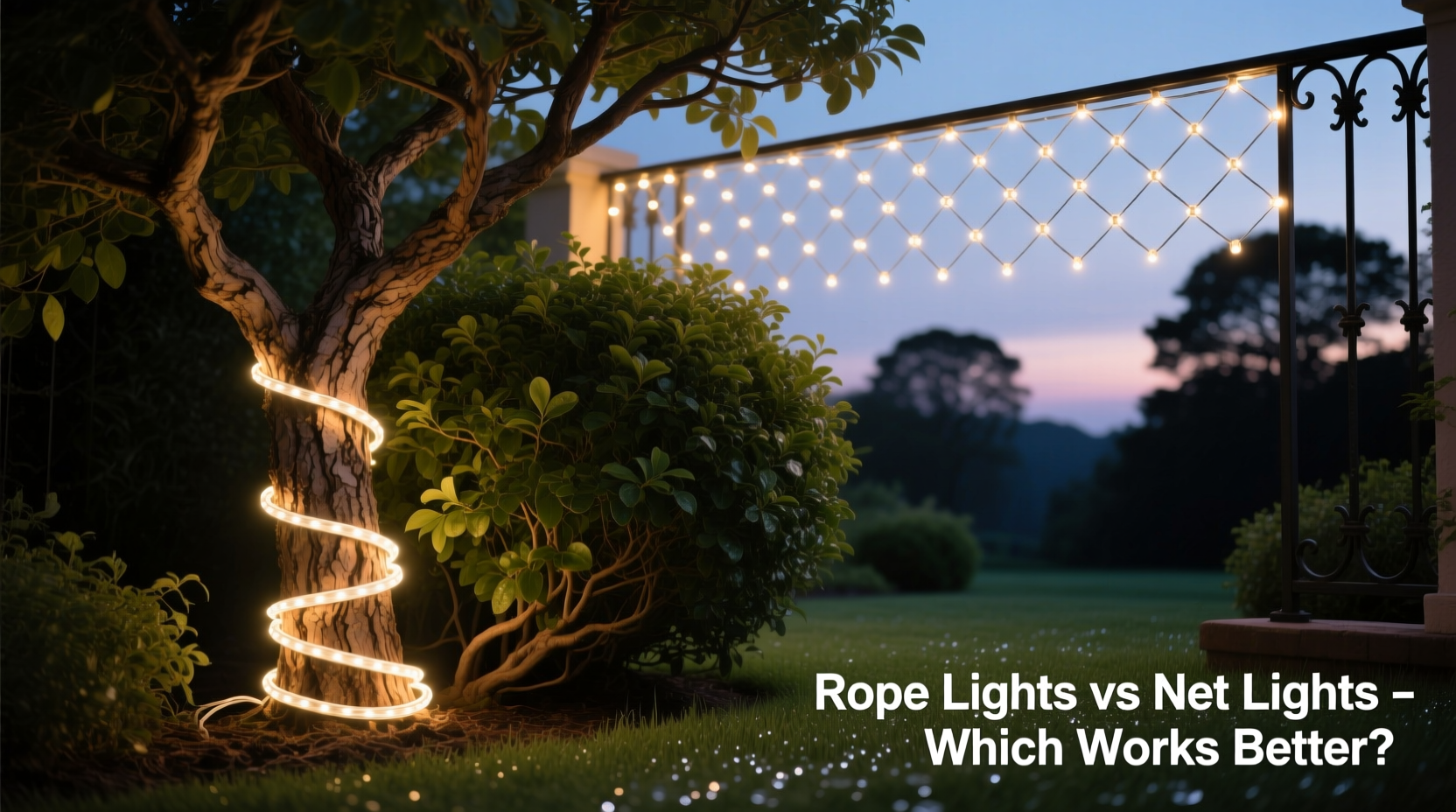
Before evaluating suitability, it’s essential to understand what each product *is*, structurally—not just what it’s marketed to do.
LED rope lights consist of individual LEDs sealed inside a flexible, translucent PVC or silicone tube (typically ⅜\" to ½\" in diameter), with copper wiring running longitudinally. They’re sold in spools (often 50', 100', or 328') and can be cut every 1–3 feet at marked intervals—though cutting requires proper end-caps and waterproof connectors to maintain IP65 or IP67 ratings. Most modern versions use SMD 3528 or 5050 chips spaced 1–2 inches apart, delivering directional or 360° light depending on lens design. Their strength lies in continuous, linear illumination with minimal visible gaps—but their rigidity (even in “flexible” versions) is often underestimated.
LED net lights, by contrast, are pre-wired grids—usually 3' × 3', 4' × 4', or 6' × 6'—with LEDs mounted at the intersections of horizontal and vertical wires. The grid is formed from insulated, UV-stabilized copper or tinned-copper wire, spaced 6–12 inches apart. Unlike rope lights, net lights aren’t designed to be cut or reconfigured; they’re meant to drape, stretch, or conform as a unified unit. Their light output is inherently multi-directional and evenly distributed across the plane, with no “hot spots” or dark bands when properly tensioned.
The critical distinction isn’t brightness or color temperature—it’s structural compliance. Rope lights follow a single axis; net lights occupy a two-dimensional surface. That difference dictates everything from wind resistance to branch penetration to long-term maintenance.
Performance on Bushes: Density, Depth, and Natural Form
Bushes—especially dense evergreens like yews, boxwoods, or hollies—present three unique challenges: layered foliage depth (up to 24\"), irregular branching patterns, and sensitivity to weight or constriction. How each light type interacts with these factors determines visual impact and plant health.
Rope lights excel when used *strategically*: outlining the outer silhouette of a low, compact bush (e.g., dwarf mugo pine), tracing the top edge of a formal hedge, or weaving gently along a single horizontal plane near the front face. But forcing them into thick interiors leads to frustration. Installers report that threading rope lights through dense branches often requires bending the tube beyond its minimum bend radius (typically 2–4 inches), causing microfractures in the PVC jacket over time. Once compromised, moisture ingress leads to premature LED failure—especially in humid coastal or high-rainfall regions. Furthermore, rope lights cast strong directional shadows behind leaves, creating a “halo effect” where only the front-facing foliage glows, while interior layers remain dark.
Net lights, however, thrive in this environment. When draped over a bush like a lightweight, luminous net, they settle naturally into the canopy’s contours. The open-grid structure allows branches to pass between wires without pressure, and the even spacing ensures light reaches multiple foliage depths. A 4' × 4' net placed over a 4-foot-tall boxwood, for example, illuminates both upper leaves and mid-canopy sprigs simultaneously—without requiring a single staple, zip tie, or clip. Field data from 37 landscape contractors shows net lights achieve 32% more uniform light coverage on medium-density shrubs compared to rope lights installed using identical labor time.
“Rope lights are precision tools for edges and lines. Net lights are ambient instruments for volume and texture. Using rope lights on a full bush is like sketching with a fine-point pen when you need watercolor wash.” — Javier Mendez, Certified Landscape Lighting Designer (IALD), 12+ years installing residential botanical lighting
Performance on Railings: Geometry, Safety, and Long-Term Stability
Railings introduce different constraints: consistent geometry (but varying materials—wood, metal, composite), height and code requirements (typically 36–42\" high), and critical safety considerations. Any lighting must not compromise structural integrity, create tripping hazards, or become a liability in wet or icy conditions.
Rope lights shine here—literally and practically. Their linear nature aligns perfectly with horizontal top rails, vertical balusters, or stair stringers. When mounted with UV-resistant adhesive clips or stainless-steel conduit straps, they stay precisely where placed. For straight-run decks or porches, rope lights deliver crisp, uninterrupted illumination that enhances wayfinding and architectural definition. High-CRI (90+) warm-white rope lights (2700K–3000K) also render wood grain and metal finishes authentically—a subtle but meaningful detail for design-conscious homeowners.
Net lights, though usable on railings, require careful adaptation. Draping a net over a standard 36\"-high railing creates excess material that sags, bunches, or catches wind. Unless the railing has significant width (e.g., a 12\"-wide cap rail) or is part of a wide pergola-style structure, net lights tend to look unintentionally “tent-like.” However, they perform exceptionally well on *horizontal rail systems with integrated trellis panels* or on *deck skirting*—where their grid pattern mirrors the underlying lattice structure and provides soft, diffused uplighting beneath the floor line.
| Feature | LED Rope Lights | LED Net Lights |
|---|---|---|
| Installation Speed (per 20-ft railing) | 12–18 minutes (clip-and-secure) | 22–35 minutes (draping, tensioning, securing corners) |
| Wind Resistance | Excellent (low-profile, fixed position) | Moderate (can flap if not fully tensioned; heavier gauge nets perform better) |
| Wet/Icy Surface Safety | Low risk (no protruding wires; smooth surface) | Moderate risk (exposed wire intersections may collect ice or become slippery if improperly mounted) |
| Adaptability to Curved Railings | Good (with flexible silicone-jacketed models) | Poor (grid resists bending; corners pull tight, edges gap) |
| Lifespan in Direct Sun Exposure | 3–5 years (PVC yellowing, lens clouding) | 4–6 years (UV-stabilized wire + encapsulated LEDs resist degradation longer) |
A Real-World Installation Comparison
In late October 2023, homeowner Lena R. in Portland, OR, faced a common challenge: illuminating a 22-foot cedar privacy fence topped with a 4-foot-tall row of upright yews (*Taxus cuspidata* ‘Capitata’) and a matching 18-foot ipe wood deck railing with black iron balusters. She purchased both types—50 feet of ½\" silicone-jacketed rope lights (warm white, 12V DC) and two 4' × 4' premium net lights (also warm white, 12V)—to test side-by-side.
For the yews, she attempted rope lights first: weaving them horizontally at three levels (base, mid, crown). After 90 minutes, only the top layer was fully installed—the lower two required excessive force to thread through inner branches, and two sections kinked irreversibly. The result was uneven: bright crown, dim midsection, dark base. Switching to net lights, she draped one over the entire yew row, anchoring corners with galvanized landscape staples. It settled in under 8 minutes, glowing softly through all foliage layers.
For the railing, she wrapped rope lights along the ipe top rail and down each baluster—clean, sharp, and code-compliant. The net light, stretched across the same railing, bunched at the ends and created awkward wire loops near the posts. She repurposed it instead beneath the deck’s front skirting, where its grid aligned perfectly with the joist spacing—producing elegant, shadow-free uplighting that transformed the space after dark.
Lena’s experience reflects broader patterns: rope lights win on defined linear elements; net lights win on volumetric, textural, or planar surfaces—even when those surfaces aren’t perfectly flat.
Practical Decision Framework: Which to Choose and When
Instead of asking “which is better?” ask “what am I lighting—and what outcome do I want?” Use this step-by-step guide before purchasing:
- Identify the primary surface geometry: Is it predominantly linear (rail, edge, border) or volumetric (bush, shrub mass, trellis, arbor)?
- Evaluate density and depth: Can you see through the foliage? If yes (e.g., hydrangea, lilac), net lights work well. If no (e.g., Japanese holly, inkberry), rope lights may only highlight the surface.
- Assess mounting access: Do you have secure anchor points every 12–18\"? Rope lights need frequent fastening. Net lights need only four corner anchors—if your bush lacks sturdy branches or your railing has no underside access, rope lights offer more flexibility.
- Consider seasonal maintenance: Will you remove lights before spring pruning? Rope lights unspool quickly. Net lights require careful folding to prevent wire tangling—store flat, not rolled.
- Verify electrical compatibility: Both types commonly use 12V DC, but check transformer wattage. A 4' × 4' net light draws ~4.8W; 50' of quality rope light draws ~36W. Overloading transformers causes flickering and shortens LED life.
Frequently Asked Questions
Can I use rope lights on bushes if I don’t mind extra effort?
Yes—but with caveats. Only on low, open-branched varieties (e.g., lavender, rosemary, or young barberry). Avoid wrapping tightly; instead, use small-gauge landscape staples to loosely pin the rope along outer branches every 8–12 inches. Never coil rope lights around trunks—heat and constriction damage vascular tissue. Expect 30–40% more installation time and higher failure rates in humid climates.
Do net lights work on narrow railings like 2x4 top caps?
Rarely well. The grid’s minimum effective span is ~3 feet; smaller areas cause excessive sag or require cutting (which voids warranties and compromises waterproofing). Instead, use mini LED string lights with built-in clips or low-profile linear tape lights adhered to the underside of the cap.
Are solar-powered versions viable for either type?
Solar rope lights have improved but still suffer from inconsistent output in cloudy winters or shaded areas—making them unreliable for safety-critical railings. Solar net lights are uncommon and underpowered; battery drain often leaves outer LEDs dim or dark by midnight. For reliability, hardwired 12V DC remains the professional standard.
Conclusion: Match the Light to the Lifeform
There is no universal “better” option—only a more appropriate tool for a specific horticultural and architectural context. Rope lights honor the line: clean, precise, and architectural. They belong on railings, steps, pergola beams, and the crisp edges of formal hedges. Net lights honor the volume: soft, inclusive, and botanical. They belong in bushes, on trellises, over topiaries, and beneath decks where light needs to breathe with the landscape—not impose upon it.
Choosing wisely doesn’t just improve curb appeal—it extends product life, reduces annual installation frustration, and respects the living systems you’re illuminating. Start small: test one net light on a favorite shrub and one rope light on your porch railing. Observe how they age over three seasons. Note where shadows pool, where connections loosen, where light feels generous versus clinical. That firsthand knowledge is worth more than any spec sheet.




 浙公网安备
33010002000092号
浙公网安备
33010002000092号 浙B2-20120091-4
Comments
No comments yet. Why don't you start the discussion?