
When it comes to holiday lighting or year-round architectural enhancement, window outlines are a favorite choice for homeowners and designers alike. A well-lit window frame draws attention to the structure of a home, adds depth at night, and elevates curb appeal. Two popular lighting options—LED rope lights and pixel lights—are frequently compared for this application. But when precision, sharp corners, and smooth curves matter most, one clearly outperforms the other.
The difference lies not just in brightness or color range, but in control, spacing, and physical flexibility. While both types use LED technology, their construction and capabilities vary significantly. Choosing the wrong type can result in uneven illumination, visible gaps, or jagged turns that undermine the clean look you're trying to achieve.
Understanding LED Rope Lights
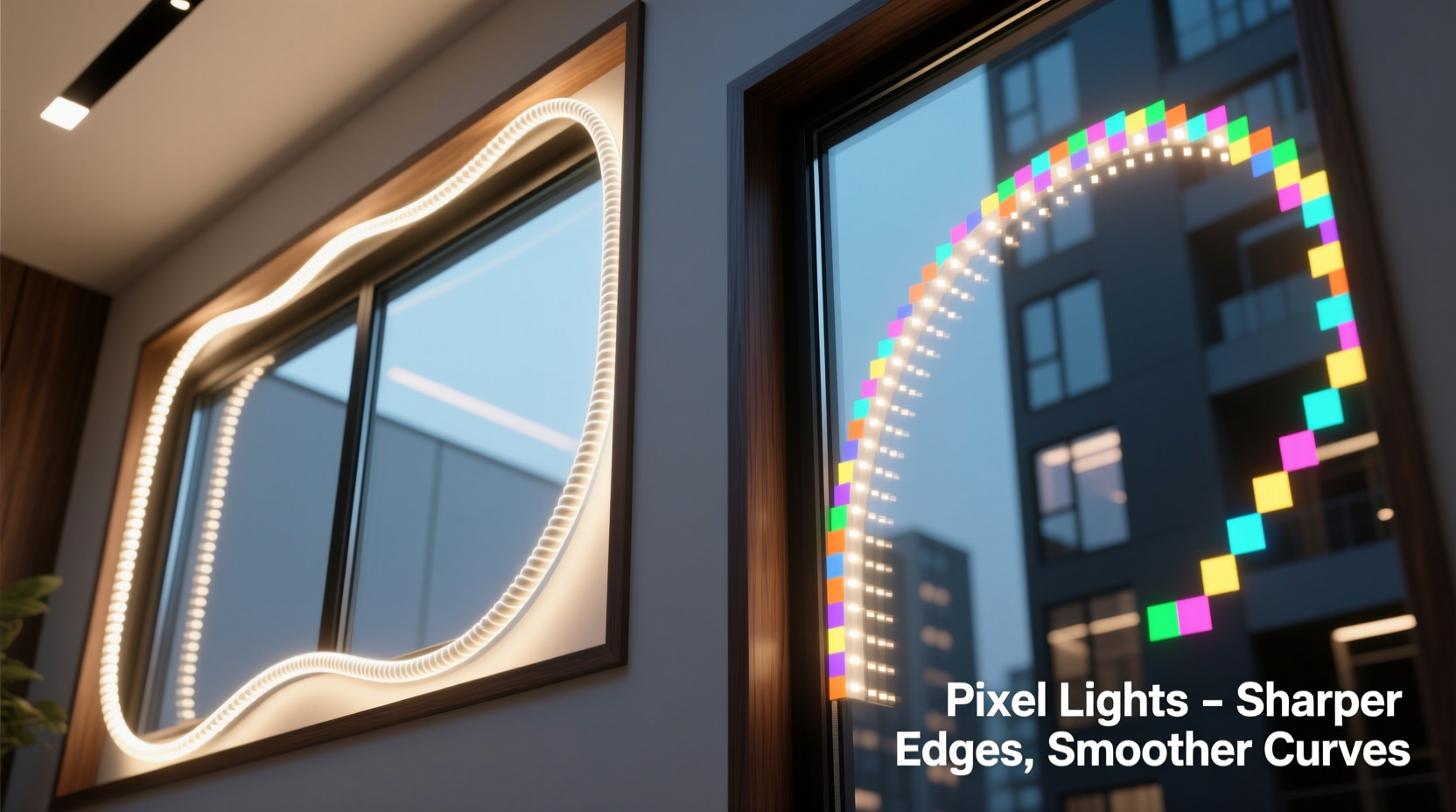
LED rope lights consist of small diodes encased in a flexible plastic tube, typically 8–12mm in diameter. The LEDs are usually spaced closely together—every half inch to an inch—but they function as a single continuous strand. You cannot control individual bulbs; instead, the entire length illuminates uniformly.
Rope lights are valued for their durability, weather resistance, and ease of installation. They come in warm white, cool white, and multi-color variants, though full RGB color changing is less common unless using specialized versions. Because of their tubular design, they diffuse light evenly along the strip, creating a soft glow ideal for ambient outlining.
They perform reasonably well on straight runs and gentle curves. However, their rigidity becomes a limitation when navigating tight corners. Most standard rope lights have a minimum bend radius of about 2 inches, meaning sharp 90-degree window corners may require careful shaping or even cutting and splicing—which compromises waterproofing and longevity.
How Pixel Lights Work for Architectural Lighting
Pixel lights, also known as individually addressable LED strips or digital lights, take a different approach. Instead of functioning as a single unit, each LED—or “pixel”—can be controlled independently. These are commonly found in strip form (flexible circuit boards) or encased in silicone tubes similar to rope lights, but with far greater precision.
Each pixel is spaced at regular intervals—typically 1.5\", 2\", or 3\"—and communicates via data protocols like WS2812B or DMX. This allows for dynamic effects: chasing sequences, color wipes, dimming by section, and static color zones. For window outlining, the real advantage is targeted control over corners and curves.
Because pixel strips are mounted on flexible printed circuits, they can bend tightly around 90-degree angles without kinking. High-density versions (e.g., 60 LEDs per meter) offer near-continuous lines, mimicking the appearance of rope lights while providing superior corner definition.
“With pixel mapping, we can assign specific brightness and color values exactly where the window turns. That level of detail transforms basic outlining into architectural art.” — Marcus Tran, Lighting Designer & Holiday Display Consultant
Sharpness and Curve Performance: A Direct Comparison
When evaluating which system produces sharper edges and smoother curves, three factors dominate: physical flexibility, LED density, and control granularity.
- Physical Flexibility: Pixel strips, especially thin flexible PCB versions, can conform precisely to window mullions and sills. Rope lights, being thicker and more rigid, often sit slightly away from the frame at corners, creating a lifted, imprecise look.
- LED Density: While traditional rope lights pack LEDs densely, cheaper versions may have noticeable dark spots between emitters. High-density pixel strips (30–60 LEDs/meter) eliminate this issue and allow seamless transitions around arcs.
- Control Granularity: Even if two systems look identical when lit white, only pixel lights let you adjust brightness per segment. This means you can subtly boost output at corners to compensate for shadowing, ensuring uniform visibility from all viewing angles.
In practical terms, consider a double-hung window with a central crossbar. With rope lights, the entire frame glows uniformly, but the joint where vertical and horizontal sections meet may appear brighter due to overlapping light sources. With pixel lights, you can program the corner pixels to maintain consistent intensity, avoiding hotspots and preserving clean geometry.
Real-World Example: Urban Townhouse Window Upgrade
A homeowner in Chicago wanted to highlight the tall, narrow windows of their historic brownstone. Initial attempts with 10mm RGB rope lights resulted in poor corner adherence—the lights bowed outward at each turn, breaking the crisp line. Additionally, the red channel dimmed faster than others over time, leading to inconsistent color after six months.
They switched to a 5V WS2812B pixel strip mounted on a backing channel. Using a simple controller, they programmed all windows to display a steady warm white. The thinner profile allowed exact placement along every edge, including the arched top of the entry window. After two seasons, the system remained fully functional, with no degradation in color balance. Neighbors reported thinking the trim was backlit from within.
Comparison Table: Key Features Side-by-Side
| Feature | LED Rope Lights | Pixel Lights |
|---|---|---|
| Individual Control | No – entire strand only | Yes – per LED or zone |
| Minimum Bend Radius | ~2 inches | ~0.5 inches (flexible strip) |
| Typical LED Spacing | 0.5”–1” | 0.6”–2” (adjustable density) |
| Color Options | Single color or limited RGB | Full RGB + white, customizable |
| Corner Sharpness | Moderate – prone to lifting | Excellent – conforms tightly |
| Installation Complexity | Low – plug-and-play | Medium – requires controller setup |
| Cost (per foot) | $2–$4 | $4–$8+ |
Step-by-Step Guide to Installing Pixel Lights for Crisp Window Outlines
For those seeking professional-grade results, follow this sequence to install pixel lights with maximum precision:
- Measure Each Window Segment: Break down the perimeter into horizontal and vertical runs. Note any curves or angled sections.
- Select High-Density Strips: Choose 60 LEDs per meter (≈1.5\" spacing) for near-continuous appearance. Ensure IP65 or higher rating for outdoor use.
- Cut Only at Marked Points: Never cut between pixels. Use end caps or silicone sealant on exposed ends.
- Use Aluminum Profile Channels: Install U-shaped aluminum tracks along the window frame. These protect the strip, improve heat dissipation, and create a clean, recessed look.
- Secure Corners with L-Brackets: For inside corners, use small metal brackets to guide the strip around the turn without bending too tightly.
- Test Before Final Mounting: Power up the strip while loosely placed to verify color consistency and functionality.
- Connect to Controller: Use a compatible 5V or 12V power supply and controller (e.g., WLED, Falcon F16). Assign static white or dynamic scenes as desired.
- Seal All Connections: Apply dielectric grease and waterproof connectors to prevent moisture ingress.
- Map and Adjust: If using multiple windows, label each run and fine-tune brightness levels so all outlines appear uniform from street level.
When to Choose Rope Lights Instead
Despite the advantages of pixel lights, rope lights still have a place in residential lighting—especially for budget-conscious projects or temporary installations. They’re ideal when:
- You want a simple, always-on white outline without special effects.
- The windows have large-radius curves, such as circular porthole-style units.
- Installation time is limited, and complex wiring must be avoided.
- Long-term ownership isn’t a priority (e.g., rental properties).
Modern hybrid solutions now exist—some manufacturers offer \"semi-pixel\" rope lights with segmented control over 6–12 inch zones. While not as precise as true pixel strips, these provide a middle ground for those wanting mild customization without full programming.
Frequently Asked Questions
Can I use pixel lights to match my existing rope light color?
Yes. Most pixel systems include tunable white settings and millions of RGB combinations. Use a color picker app or compare under nighttime conditions to find an exact match. Some controllers even save presets for quick switching between holidays or seasons.
Do pixel lights flicker or fail more often than rope lights?
Poor-quality pixel strips may suffer from signal degradation or dead pixels, especially in long runs. However, reputable brands with proper voltage injection and surge protection last just as long as rope lights—often exceeding 30,000 hours. Always buy from trusted suppliers and avoid ultra-cheap imports.
Are there wireless options for controlling pixel-lit windows?
Yes. Systems like WLED paired with ESP32 microcontrollers allow Wi-Fi control via smartphone apps or voice assistants. You can schedule sunrise/sunset activation, sync with music, or switch colors remotely—something impossible with standard rope lights.
Final Recommendation: Precision Wins
For homeowners and designers who prioritize clean lines, accurate geometry, and lasting quality, pixel lights are the superior choice for window outlining. Their ability to conform tightly to corners, deliver consistent illumination, and adapt over time makes them worth the initial investment.
Rope lights remain viable for straightforward applications where cost and simplicity outweigh the need for precision. But when the goal is sharp edges and smooth curves—particularly on modern or architecturally detailed homes—pixel-based systems offer unmatched performance.
“The difference between amateur and professional lighting is rarely about brightness—it’s about intention. Pixel lights let you draw with light, not just flood it.” — Lena Choi, Architectural Illumination Specialist
Take Action Today
If you're planning your next exterior lighting project, don’t default to what’s familiar. Evaluate your window shapes, consider how light interacts with shadows at night, and choose the technology that gives you real control. Whether upgrading a single bay window or outlining an entire façade, investing in pixel lights can transform functional illumination into lasting visual impact.




 浙公网安备
33010002000092号
浙公网安备
33010002000092号 浙B2-20120091-4
Comments
No comments yet. Why don't you start the discussion?