
When choosing between two premium TVs—the LG C2 with OLED technology and the Samsung QN95B featuring high-end QLED—consumers face a critical decision. Both deliver exceptional performance, but they do so in fundamentally different ways. The LG C2 offers perfect blacks and cinematic contrast, while the Samsung QN95B counters with superior brightness and anti-glare performance. Understanding the strengths and limitations of each technology helps determine whether OLED’s visual fidelity justifies its price and trade-offs over advanced QLED.
Picture Quality: Contrast, Color, and Realism
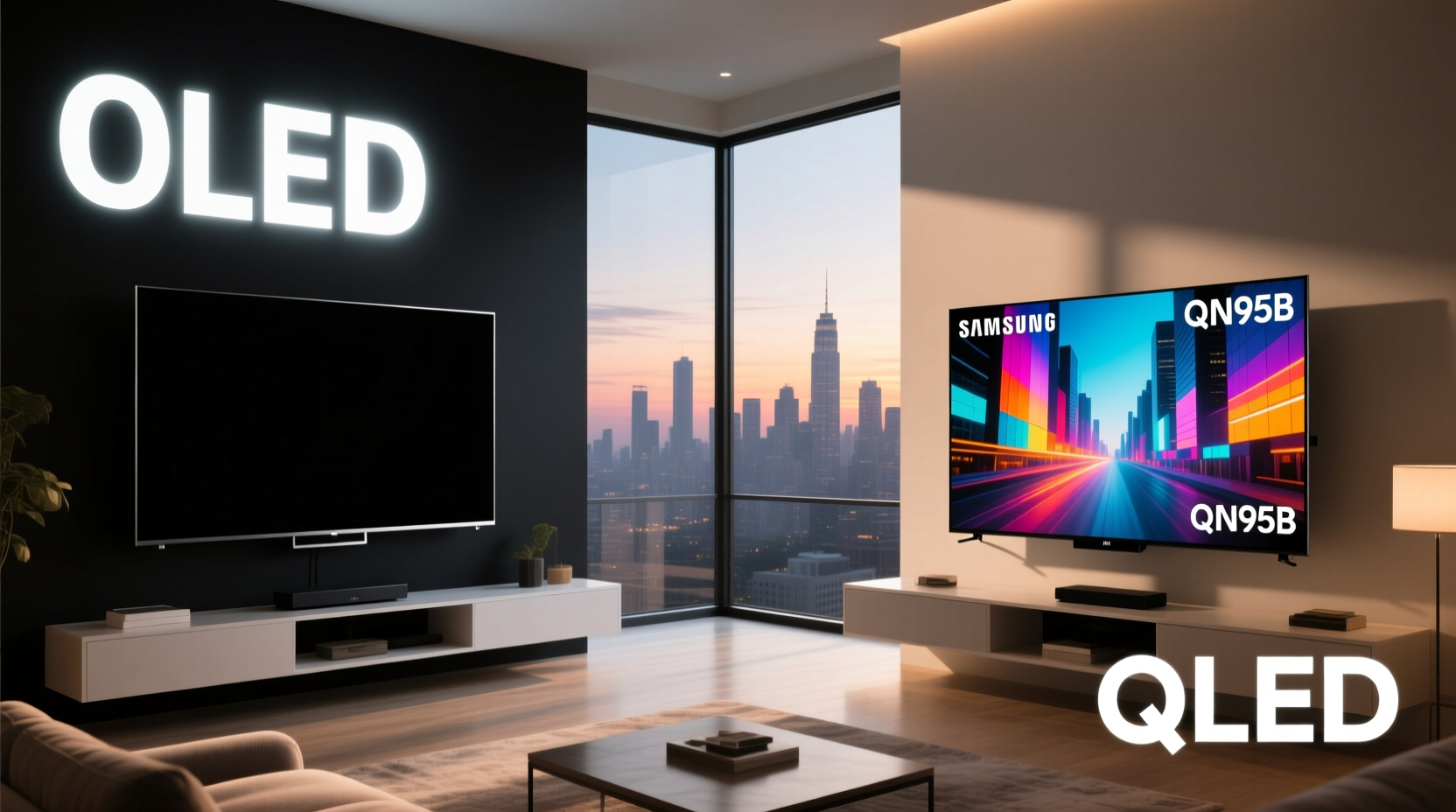
OLED and QLED take divergent paths to image excellence. The LG C2 uses self-emissive pixels that turn off completely when displaying black, resulting in infinite contrast and pixel-level precision. This means dark scenes in movies or games appear profoundly deep, with no light bleed or haloing around bright objects—a hallmark of local dimming in LED-backlit displays like the QN95B.
In contrast, the Samsung QN95B employs a full-array mini-LED backlight with hundreds of zones for dynamic lighting control. While this significantly improves black levels compared to standard LED TVs, it still can't match the absolute black of OLED. Light blooming—especially around small bright elements on dark backgrounds—is occasionally visible.
“OLED remains unmatched for cinematic content. If you watch a lot of film or play story-driven games, the depth and realism are transformative.” — David Chen, AV Testing Lab Director
However, QLED excels in color volume thanks to its higher peak brightness (up to 2,000 nits) and quantum dot layer. In brightly lit rooms, the QN95B maintains vibrancy where the LG C2 may appear washed out. HDR highlights—like sunlight reflecting off metal or explosions in action films—pop more convincingly on the Samsung set under strong ambient light.
Brightness and Room Suitability
A key factor often overlooked is viewing environment. The LG C2 peaks at around 800 nits in full-screen HDR, dropping to about 1,000 nits in small window measurements. While sufficient for most home theaters, it struggles in sun-drenched living rooms. The QN95B, with its anti-glare coating and 2,000-nit output, handles glare and reflections far better, making it ideal for daytime viewing or rooms with large windows.
That said, OLED’s lack of backlight allows for perfect per-pixel control, meaning even in dim scenes with subtle gradients, shadow detail is preserved without crushing. This nuance benefits filmmakers’ intent and enhances immersion in darker genres like horror or noir.
Lifespan and Burn-in Risk: A Practical Reality Check
One of the longest-standing concerns with OLED is burn-in—the permanent discoloration caused by static images displayed for extended periods. The LG C2 includes multiple mitigation technologies: pixel refreshers, logo dimming, and scrolling. In real-world testing, moderate use with varied content rarely leads to noticeable burn-in within the first three years.
Still, users who frequently watch news channels with persistent tickers, play HUD-heavy video games for hours daily, or leave paused screens indefinitely should remain cautious. Samsung’s QN95B, using inorganic LEDs, does not suffer from burn-in, offering peace of mind for long-term ownership under demanding usage patterns.
On the flip side, OLED panels degrade uniformly over time. After several thousand hours, overall brightness diminishes slightly, but color accuracy remains stable. QLED’s longevity is less studied at this tier, but early data suggests minimal degradation under normal conditions.
Performance Comparison Table
| Feature | LG C2 (OLED) | Samsung QN95B (QLED) |
|---|---|---|
| Panel Type | OLED | Quantum Dot Mini-LED |
| Peak Brightness (HDR) | ~800 nits (full screen), ~1,000 nits (small area) | Up to 2,000 nits |
| Contrast Ratio | Infinite (true blacks) | High (limited by backlight) |
| Viewing Angles | Excellent (consistent color up to 80°) | Moderate (color shift beyond 30°) |
| Response Time | 0.1ms (near-instantaneous) | 2–4ms (very fast, but not pixel-level) |
| Burn-in Risk | Low to moderate with proper use | None |
| Anti-Glare Coating | No (glossy panel) | Yes (matte finish) |
| Best For | Dark rooms, movie lovers, gamers wanting perfect blacks | Bright rooms, sports viewers, mixed-use households |
Gaming and Input Performance
For gamers, both TVs offer HDMI 2.1 support, 120Hz refresh rates, VRR, and ALLM. However, the LG C2 edges ahead due to its near-zero response time and flawless motion clarity. Fast-paced shooters or racing games benefit from the absence of motion blur and instant pixel transitions.
The QN95B performs admirably with low input lag (~10ms) and excellent processing, but slight blooming during rapid transitions between light and dark scenes can distract competitive players. Additionally, Samsung’s Game Bar interface provides quick access to settings, giving it a usability advantage for console gamers switching between modes.
Real-World Example: Two Households, Two Choices
Consider two buyers: Maria, a film enthusiast who watches movies nightly in a dedicated media room with blackout curtains. She chose the LG C2. After 18 months, she reports “jaw-dropping” realism in night scenes, with starfields in space documentaries appearing as if floating in darkness. No signs of burn-in emerged despite regular use, thanks to enabling pixel shift and avoiding static menus.
Meanwhile, James, a sports fan with a bright open-concept apartment, selected the QN95B. During afternoon football games, the screen remains vivid even with sunlight hitting the wall behind the TV. He appreciates the lack of reflection and consistent color across wide seating angles. While he notices some haloing around scorebugs, it doesn’t detract from enjoyment.
Their experiences highlight a crucial truth: the best TV depends not just on specs, but on how and where it’s used.
Step-by-Step: Choosing Between LG C2 and Samsung QN95B
- Evaluate your room lighting. If natural or ambient light is strong, lean toward QN95B.
- Assess primary content type. Movies and narrative games favor OLED; live sports and bright shows suit QLED.
- Consider viewing angles. Wider seating arrangements benefit from OLED’s consistency off-axis.
- Review usage habits. Heavy gaming with static HUDs increases burn-in risk—use safeguards or opt for QLED.
- Compare long-term priorities. Value longevity and brightness? QLED. Prioritize contrast and realism? OLED.
Frequently Asked Questions
Is OLED burn-in inevitable?
No. Modern OLEDs like the LG C2 include robust protection. With balanced usage—avoiding extreme brightness and static images for days—burn-in is unlikely within typical ownership periods (3–5 years).
Can QLED match OLED black levels?
Not fully. Even with mini-LED and dense dimming zones, QLED relies on blocking backlight, which results in some light leakage. True black remains exclusive to OLED.
Which lasts longer?
QN95B has no burn-in risk and handles brightness stress well. LG C2 may show slight luminance drop after many years, but both are expected to last 7+ years with care.
Final Verdict: Is OLED Worth It Over QLED?
The answer hinges on your expectations and environment. If you seek the most cinematic, immersive experience in controlled lighting, the LG C2’s OLED panel delivers a qualitative leap in picture perfection. Its infinite contrast and pixel-level accuracy create a sense of depth no QLED can replicate.
But if your living space is bright, you watch varied content throughout the day, or you prioritize durability under heavy use, the Samsung QN95B offers compelling advantages. Its brilliance, anti-glare surface, and zero burn-in risk make it a safer, more versatile choice for mainstream premium viewing.
Ultimately, OLED isn’t universally “better”—it’s different. And for many, that difference is transformative. But for others, practicality outweighs perfection. Weigh your priorities honestly, and you’ll find the right fit.




 浙公网安备
33010002000092号
浙公网安备
33010002000092号 浙B2-20120091-4
Comments
No comments yet. Why don't you start the discussion?