
In 2014, smartphone buyers faced a pivotal decision: stick with Android or make the leap to iOS. The LG G3 and iPhone 6 were flagship devices representing two very different philosophies in mobile design and user experience. One offered cutting-edge specs and innovation; the other delivered refinement, ecosystem integration, and brand loyalty. For users debating an upgrade—especially those moving from Android to iPhone or vice versa—the question wasn’t just about features. It was about whether the change truly improved their daily digital life.
This article examines that decision through real-world usage, hardware capabilities, software ecosystems, and long-term satisfaction. By comparing both phones across key categories, we aim to answer whether switching between these platforms in 2014 was a meaningful upgrade—or simply a change for change’s sake.
Design and Build: Form Meets Function
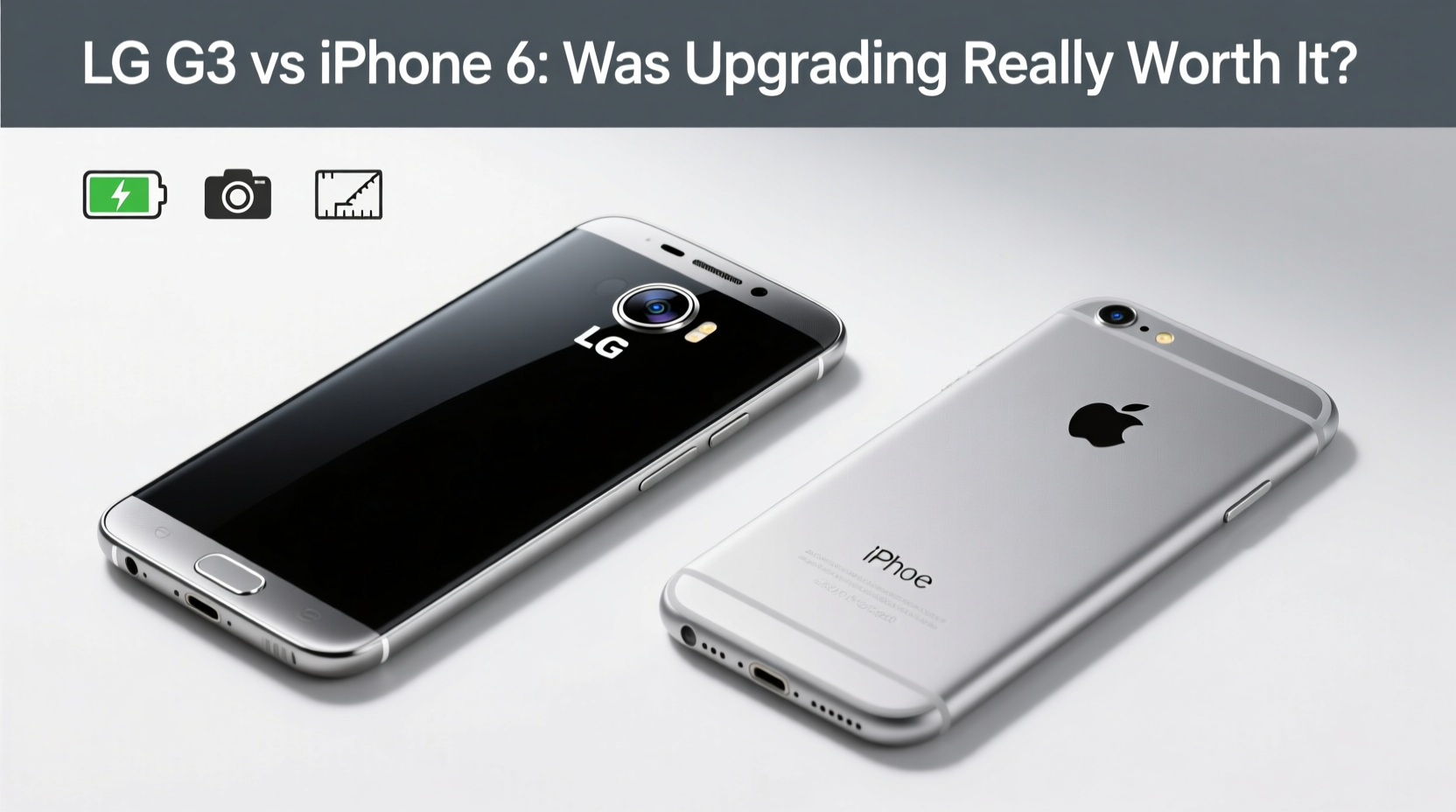
The LG G3 stood out with its polished metal frame, soft-touch plastic back, and sleek minimalist aesthetic. At 5.5 inches, it was large for its time but balanced well thanks to its narrow bezels and ergonomic curvature. Its QHD (1440p) display set a new benchmark for sharpness, offering vivid colors and deep blacks that rivaled early OLED panels.
In contrast, the iPhone 6 introduced Apple’s first significantly larger screen at 4.7 inches—a modest size by today’s standards but a bold shift from the 4-inch iPhone 5s. Crafted from aluminum with chamfered edges, the iPhone 6 felt premium and pocketable. However, its 750p Retina display, while crisp, couldn't match the pixel density of the G3.
Apple prioritized comfort and familiarity; LG pushed boundaries. If you valued screen real estate and visual fidelity, the G3 won hands down. But if you preferred compact ergonomics and build consistency, the iPhone 6 had strong appeal.
Performance and Software Experience
Under the hood, the LG G3 packed a Qualcomm Snapdragon 801 processor with 3GB of RAM—generous for Android at the time. It ran near-stock Android 4.4.2 with LG’s subtle UX enhancements, delivering fast app launches and multitasking agility. The high-resolution screen did impact battery life slightly, but optimizations helped maintain all-day usability.
The iPhone 6 featured Apple’s custom A8 chip with only 1GB of RAM, yet iOS 8’s efficient memory management made it feel snappier than many higher-spec Android rivals. Apps launched quickly, transitions were buttery smooth, and background processes were tightly controlled. iOS offered fewer customization options, but greater system-wide consistency.
“iOS isn’t about raw power—it’s about how efficiently every ounce of performance is used.” — David Kim, Mobile Systems Analyst, TechInsight Weekly
For developers and tech enthusiasts, the G3 offered more flexibility: themes, sideloading, file access. For average users seeking reliability and simplicity, the iPhone 6 provided a frictionless experience. Upgrading from an older Android device to the G3 meant noticeable speed gains. Switching to the iPhone 6 meant trading some control for polish.
Camera Comparison: Photos That Matter
The LG G3 came with a 13MP rear camera featuring optical image stabilization (OIS), laser autofocus, and HDR support. In good lighting, it produced richly detailed images with accurate color reproduction. Low-light performance was decent but inconsistent, sometimes producing noise or over-processing.
The iPhone 6 also had a 13MP sensor (up from 8MP on the 5s), improved dynamic range, True Tone flash, and better low-light algorithms. While not class-leading in specs, Apple’s image processing pipeline ensured reliable results across conditions. Videos shot in 1080p at 60fps were noticeably smoother and more stable than the G3’s output.
| Feature | LG G3 | iPhone 6 |
|---|---|---|
| Resolution | 13MP | 13MP |
| Autofocus | Laser AF | Contrast Detect |
| Video Recording | 1080p @ 30fps | 1080p @ 60fps |
| Low-Light Performance | Moderate (some noise) | Strong (balanced exposure) |
| Front Camera | 2.1MP | 1.2MP |
Despite similar megapixel counts, the iPhone 6 generally delivered more consistent photo quality. Social media sharers and casual photographers benefited from plug-and-play excellence. Enthusiasts who liked manual controls found more tools on the G3, including exposure adjustment and white balance presets.
Real-World Example: Sarah’s Upgrade Dilemma
Sarah had been using a Samsung Galaxy S4 for nearly two years. Her phone lagged, the battery died by noon, and her photos looked grainy. She considered upgrading to the LG G3 but was intrigued by friends praising the iPhone 6.
She ultimately chose the iPhone 6 for its seamless integration with her MacBook and iCloud. She loved how her photos synced instantly, messages appeared on her laptop, and Siri responded reliably. Though she missed customizable widgets and the larger screen, she appreciated the reduced clutter and longer software support.
After six months, she said, “I didn’t realize how much mental load my old Android added until I switched. The iPhone just works.” For Sarah, upgrading wasn’t about specs—it was about reducing friction.
Battery Life and Long-Term Value
The LG G3 housed a 3000mAh battery, which powered its QHD display for about 14–16 hours of mixed use. Heavy gamers or streamers needed midday charging. Fast charging was supported, but wireless charging adoption was still limited.
The iPhone 6 had a smaller 1810mAh battery but benefited from iOS efficiency. Apple claimed up to 14 hours of talk time, and real-world testing showed around 12–13 hours of active use. Standby drain was minimal, making it reliable for travel.
Software updates played a crucial role in longevity. Apple provided iOS updates for the iPhone 6 until 2019 (iOS 12), maintaining security and compatibility. LG offered only one major OS update for the G3 (to Android 5.0), ending meaningful support by 2016.
Checklist: Was Your Upgrade Worth It?
- ✅ Did your new phone improve daily responsiveness?
- ✅ Does it integrate well with your other devices?
- ✅ Are you receiving timely software updates?
- ✅ Is battery life sufficient without constant charging?
- ✅ Do you actually use the advanced features you paid for?
- ✅ Has app compatibility remained stable over time?
Frequently Asked Questions
Did the LG G3 have better specs than the iPhone 6?
On paper, yes. The G3 had a higher-resolution display, more RAM, faster charging, and a larger battery. However, the iPhone 6 compensated with superior software optimization, smoother animations, and longer update support. Real-world performance often felt comparable despite the spec gap.
Could the iPhone 6 handle multitasking like the LG G3?
While the iPhone 6 had only 1GB of RAM compared to 3GB on the G3, iOS managed background tasks efficiently. Users rarely experienced app reloads unless running many intensive apps. However, power users doing heavy multitasking might have noticed limitations compared to Android’s more open architecture.
Is upgrading from either phone worthwhile today?
Neither device receives security updates anymore and cannot run modern apps effectively. As of 2024, both are obsolete. This analysis serves as a retrospective lesson in evaluating upgrades—not a recommendation for current use.
Conclusion: What \"Worth It\" Really Means
Was upgrading from the LG G3 to the iPhone 6—or vice versa—worth it? The answer depends on what you valued most. If you prioritized display quality, customization, and forward-looking specs, the G3 offered tangible benefits. If you sought ecosystem harmony, long-term software care, and intuitive design, the iPhone 6 justified its appeal beyond benchmarks.
The broader takeaway is that “upgrading” shouldn’t be automatic. True value comes from alignment with your lifestyle, workflow, and expectations. In 2014, many switched platforms expecting dramatic improvements, only to find trade-offs they hadn’t anticipated. Others discovered unexpected efficiencies that transformed their relationship with technology.




 浙公网安备
33010002000092号
浙公网安备
33010002000092号 浙B2-20120091-4
Comments
No comments yet. Why don't you start the discussion?