
When shopping for a premium TV, two names dominate the conversation: LG’s OLED and Samsung’s QLED. One promises perfect blacks and cinematic depth, the other boasts vibrant colors and unmatched brightness. But with both brands spending millions on advertising, it's fair to ask—how much of the difference is real, and how much is just marketing noise?
The answer isn’t as simple as “OLED wins” or “QLED is better.” Each technology has strengths shaped by physics, not just branding. Understanding what sets them apart—and where they converge—can help you make a decision based on your viewing habits, room environment, and long-term expectations.
How OLED and QLED Work: The Core Difference
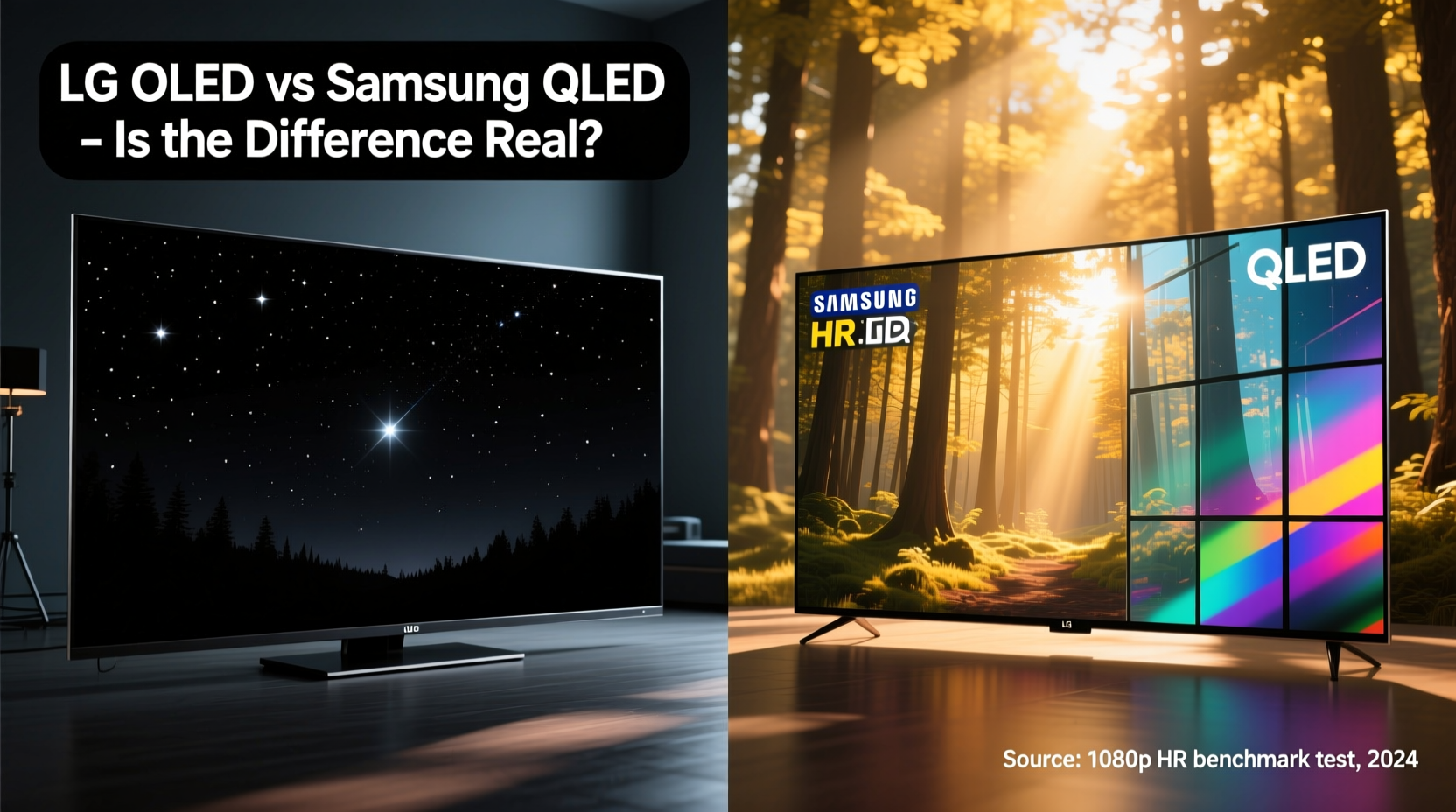
The fundamental distinction between LG OLED and Samsung QLED lies in how they produce light and color.
OLED (Organic Light-Emitting Diode) panels are self-emissive. Each pixel generates its own light. When a pixel needs to display black, it turns off completely—resulting in true, absolute black. This gives OLED its legendary contrast ratio and deep, three-dimensional image quality.
QLED (Quantum-dot Light Emitting Diode), on the other hand, is a type of LCD/LED TV enhanced with quantum dots. It uses a backlight (usually full-array with local dimming) that shines through a quantum dot layer to enhance color. Blacks are achieved by dimming or blocking the backlight, but because the backlight is always on somewhere, true black is difficult to achieve without blooming (halos around bright objects).
“OLED’s per-pixel illumination allows for infinite contrast, which fundamentally changes how shadow detail and depth are rendered.” — Dr. Alan Park, Display Technology Researcher, MIT Media Lab
Picture Quality: Breaking Down the Key Factors
To determine whether the differences are perceptible or exaggerated, let’s examine four core aspects of picture quality.
1. Contrast and Black Levels
This is where OLED consistently outperforms QLED. Because OLED pixels can turn off individually, scenes with dark skies, night-time cityscapes, or dimly lit interiors appear more natural and immersive. There’s no light bleed, no grayish blacks—just pure darkness when needed.
QLED TVs use advanced local dimming zones to minimize backlight bleed, but even high-end models like the Samsung QN900C struggle to match OLED’s precision. In darker rooms, this difference is immediately noticeable.
2. Brightness and HDR Performance
Here, QLED takes the lead. Samsung’s top-tier QLED models can peak at over 2,000 nits, compared to most OLEDs, which max out around 800–1,000 nits (though newer models like the LG G3 reach ~1,500). Higher brightness makes QLED better suited for brightly lit living rooms, especially during daytime viewing.
For HDR (High Dynamic Range) content, this means brighter highlights—sun glinting off metal, explosions, sunlight through windows—appear more vivid and lifelike on QLED. However, OLED compensates with superior tone mapping, preserving detail in both shadows and highlights despite lower peak brightness.
3. Color Accuracy and Gamut
Both technologies deliver excellent color reproduction, but in different ways. QLED leverages quantum dots to expand the color gamut, particularly in reds and greens, resulting in punchy, saturated visuals ideal for sports and nature documentaries.
OLED, while slightly less bright in color volume, offers more accurate color grading out of the box, making it preferred by filmmakers and content creators. Many professional studios use OLED monitors for color-critical work.
4. Viewing Angles and Uniformity
OLED maintains consistent color and contrast even at extreme side angles—ideal for wide seating arrangements. QLED, being an LCD-based technology, suffers from color shift and reduced contrast when viewed off-center, though anti-reflective coatings on newer models have improved this.
Screen uniformity is another win for OLED. QLED panels can exhibit clouding or flashlighting (uneven backlight distribution), especially in dark scenes. OLED avoids this entirely due to lack of a backlight.
Side-by-Side Comparison Table
| Feature | LG OLED | Samsung QLED |
|---|---|---|
| Black Levels | Perfect (pixels turn off) | Good (with local dimming), but prone to blooming |
| Peak Brightness | 800–1,500 nits | 1,500–2,500+ nits |
| Color Volume | Excellent, especially in dark scenes | Superior in bright environments |
| Viewing Angles | Near-perfect up to 80° | Moderate degradation beyond 30° |
| Lifespan / Burn-in Risk | Lower risk with modern protections, but still possible | Negligible risk |
| Best For | Dark rooms, movies, gaming, content creation | Bright rooms, sports, daytime TV, vibrant visuals |
A Real-World Example: The Living Room Dilemma
Consider Sarah, a graphic designer who loves binge-watching sci-fi series in her basement home theater. She values deep blacks and accurate colors. After testing both an LG C3 OLED and a Samsung QN90B QLED, she found the OLED made space scenes feel expansive and immersive—the stars popped against true black voids. The QLED, while brighter, made dark scenes look washed out and lacked depth.
Contrast this with James, who lives in a sun-drenched apartment. His TV faces a large window, and he watches news and sports throughout the day. The QLED’s higher brightness and anti-glare coating kept the picture clear and colorful, even under direct sunlight. The OLED, while stunning at night, struggled with reflections and looked dull during afternoon viewing.
Their experiences highlight a crucial point: the “better” TV depends on context, not just specs.
Addressing the Hype: What Marketing Doesn’t Tell You
Manufacturers emphasize their strengths while downplaying weaknesses. LG touts “perfect blacks” and “cinema-grade color,” while Samsung highlights “brilliant brightness” and “no burn-in.” Both claims are technically true—but incomplete.
For instance, LG now includes pixel-refreshing tech and logo dimming to reduce burn-in risk, making static content safer than ever. Meanwhile, Samsung has improved local dimming algorithms, reducing halo effects. Yet neither fully eliminates their core limitations.
The real takeaway? The picture difference is not hype—it’s measurable and visible. But whether it matters to you depends on your priorities.
Quick Decision Checklist
- ✅ Do you watch mostly movies, series, or play games in low-light conditions? → Consider OLED.
- ✅ Is your room very bright or do you watch a lot during the day? → Lean toward QLED.
- ✅ Are you concerned about long-term static images (news tickers, game HUDs)? → QLED may be safer.
- ✅ Do you value accurate color reproduction over vibrancy? → OLED has the edge.
- ✅ Do you want the thinnest, most futuristic design? → OLED panels are thinner and more flexible.
Frequently Asked Questions
Can you see the difference between OLED and QLED on regular cable TV?
Less so. Standard-definition or compressed HD content doesn’t leverage the full capabilities of either panel. The biggest differences appear with 4K HDR, Blu-ray, and streaming in high dynamic range.
Is OLED burn-in still a serious issue?
Modern OLED TVs include preventive measures like pixel shifting, screen savers, and automatic brightness adjustments. For most users with varied content, burn-in is unlikely within a normal lifespan. However, if you leave the same channel or game menu on for hours daily, it remains a risk.
Do QLEDs last longer than OLEDs?
In theory, yes—because they don’t degrade organic materials. However, LED backlights can dim over time, and QLEDs are more prone to clouding. Both technologies typically last 7–10 years with normal use.
Final Verdict: It’s Not Hype—But It’s Not Universal Either
The picture difference between LG OLED and Samsung QLED is real, rooted in fundamental display science. OLED delivers deeper blacks, better contrast, and wider viewing angles. QLED counters with higher brightness, better daylight visibility, and no burn-in concerns.
Neither is objectively “better.” The choice comes down to your environment and viewing habits. If you prioritize cinematic quality and control over lighting, OLED is worth the premium. If you need a bright, durable TV for a lively household, QLED makes more sense.




 浙公网安备
33010002000092号
浙公网安备
33010002000092号 浙B2-20120091-4
Comments
No comments yet. Why don't you start the discussion?