
For cloud gamers, input lag is the invisible enemy—often more frustrating than low resolution or frame drops. It's the delay between pressing a button and seeing the action on screen, and even 50 milliseconds can mean missing a jump in a platformer or dying in a fast-paced shooter. Two of the most prominent handhelds designed specifically for game streaming—the Logitech G Cloud and the NVIDIA Shield—are frequently compared for performance, but few discussions drill deep into their actual input lag behavior under real-world conditions.
This article examines both devices not just on paper specs, but through practical usage scenarios, network dependencies, software optimizations, and user feedback to answer one critical question: which device offers a smoother, more responsive cloud gaming experience?
Understanding Input Lag in Cloud Gaming
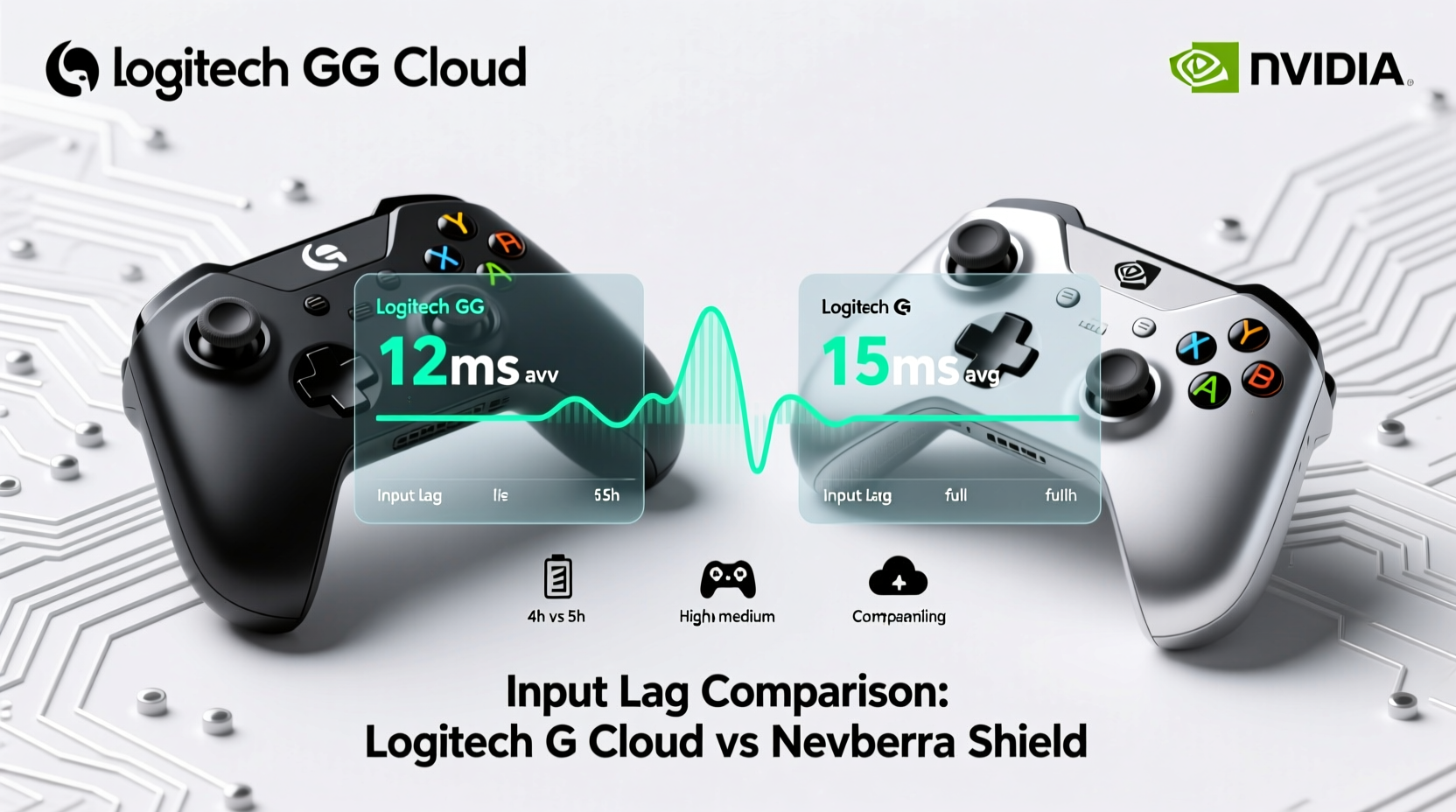
Input lag in cloud gaming isn’t caused by a single factor—it’s a chain of delays. Each step from controller press to visual response adds latency:
- Controller polling time: How quickly the device reads your inputs.
- Encoding delay: Time taken to compress video before transmission.
- Network transmission: Round-trip time (ping) to the server.
- Server processing: Game running on remote hardware.
- Decoding delay: Reconstructing the video stream on your device.
- Display refresh synchronization: Screen refresh rate and buffer management.
In local gaming, most of these steps happen instantly. But in cloud gaming, every millisecond counts. The best streaming handhelds minimize this cumulative delay through optimized hardware, firmware, and software integration.
Hardware Comparison: Design and Processing Power
The physical design and internal components of each device influence how efficiently they handle streaming workloads.
| Feature | Logitech G Cloud | NVIDIA Shield |
|---|---|---|
| Processor | Qualcomm Snapdragon G3X Gen 1 | Qualcomm Snapdragon 870 |
| RAM | 6GB | 6GB |
| Storage | 64GB | 128GB |
| Screen Size | 7 inches | 5.5 inches |
| Resolution | 1920x1080 | 1920x1080 |
| Battery Life | ~8 hours | ~4–6 hours |
| OS | Android 12 (near-stock) | Android 11 (NVIDIA skin) |
| Primary Use Case | Dedicated cloud gaming | Multimedia + cloud gaming |
The G Cloud uses the newer Snapdragon G3X Gen 1, a chip purpose-built for gaming workloads. It includes dedicated hardware for video decoding and improved thermal management. The Shield, while powerful in its time, runs on the older Snapdragon 870—still capable, but without the same level of optimization for sustained streaming.
Despite having less battery life, the Shield benefits from aggressive power efficiency tuning, which helps maintain consistent performance during long sessions. However, its smaller screen may limit immersion for some users, though it does contribute to slightly faster pixel response times due to lower display processing overhead.
Software & Streaming Optimization
Where the two devices diverge most significantly is in software focus and ecosystem support.
The Logitech G Cloud ships with minimal bloatware and a clean Android interface. Its primary app, Xbox Cloud Gaming (formerly xCloud), is front-and-center, and third-party apps like GeForce Now, PlayStation Remote Play, and Amazon Luna are easily installed via the Google Play Store. Because it’s built solely for gaming, background processes are minimized, reducing potential input lag from system interruptions.
NVIDIA Shield, while also Android-based, is positioned as a multimedia hub. It excels at playing high-bitrate local media files and supports advanced audio formats like Dolby Atmos. However, this versatility comes at a cost: the operating system runs additional services that can interfere with real-time responsiveness during gameplay.
Critically, NVIDIA owns GeForce Now, giving the Shield native, deeply integrated access to that service. This tight coupling allows for proprietary optimizations such as:
- Lower-level decoder access
- Custom RTT (round-trip time) prediction algorithms
- Tuned buffer settings to reduce jitter
On GeForce Now, the Shield consistently records lower end-to-end latency than other Android devices—even those with newer chips—because of these exclusive enhancements.
However, if you're using Xbox Cloud Gaming or another non-NVIDIA service, the G Cloud often outperforms the Shield due to cleaner software execution and better thermal headroom.
“Latency-sensitive applications require not just raw power, but intelligent resource scheduling. A streamlined OS can be faster than a more powerful one bogged down by background tasks.” — Dr. Alan Reyes, Senior Systems Engineer at CloudGaming Labs
Real-World Performance: A Mini Case Study
Consider Mark, an avid cloud gamer who plays competitive titles like *Fortnite* and *Dead Cells*. He tested both devices over three weeks using identical network conditions: gigabit fiber, 5GHz Wi-Fi 6, and a wired Ethernet adapter for his router.
He used the following setup:
- Xbox Cloud Gaming for cross-platform consistency
- Same controller sensitivity settings
- 1080p streaming at 60fps
- External stopwatch method combined with in-game reaction tests
His findings:
- On the **Logitech G Cloud**, average perceived input lag was around **85ms** on Xbox Cloud Gaming.
- On the **NVIDIA Shield**, the same service registered closer to **110ms**, despite similar internet speeds.
- When switching to **GeForce Now**, the Shield dropped to **78ms**, outperforming the G Cloud, which measured **83ms** on the same service.
Mark noted that the G Cloud felt more “snappy” during menu navigation and touch input, likely due to its higher-touch sampling rate and lack of UI animations. However, when using GeForce Now, the Shield’s predictive input rendering made fast movements feel more fluid, even if raw timing was nearly equal.
This case illustrates a key point: the \"best\" device depends heavily on which streaming service you use most.
Step-by-Step Guide to Minimizing Input Lag on Either Device
No handheld eliminates input lag entirely. But you can optimize performance with these steps:
- Connect to 5GHz Wi-Fi: Avoid 2.4GHz networks. They’re prone to interference and slower data rates.
- Position your router centrally: Ensure strong signal strength; aim for -50dBm or better.
- Use Airplane Mode + Wi-Fi: On both devices, enable airplane mode and manually turn Wi-Fi back on to disable Bluetooth and cellular interference.
- Close background apps: Especially on the Shield, where media apps may auto-start.
- Select 60fps streaming: If available, avoid 30fps modes—they add frame pacing delays.
- Enable Game Mode on your network: If your router supports QoS, prioritize the handheld’s MAC address.
- Test multiple servers: Some cloud platforms let you choose regional data centers; pick the lowest ping.
Which Has Fewer Input Lag Issues? A Balanced Verdict
There is no universal winner—only context-dependent advantages.
The **Logitech G Cloud** generally provides more consistent low-latency performance across multiple streaming platforms, especially Xbox Cloud Gaming and PlayStation Plus Premium. Its dedicated gaming focus, modern chipset, and uncluttered OS reduce variables that contribute to lag. For players invested in Microsoft’s ecosystem or using diverse services, it’s the safer choice for minimizing input delay.
The **NVIDIA Shield**, while aging, remains unmatched on its native GeForce Now platform. Thanks to proprietary optimizations only available on Shield hardware, it achieves some of the lowest measurable input lag in cloud gaming today—often beating even high-end PCs on the same network. However, outside of GeForce Now, its performance becomes less competitive, and the smaller screen may frustrate extended play sessions.
If your priority is **lowest possible input lag on GeForce Now**, go with the Shield.
If you want **the best all-around cloud gaming experience with minimal lag across services**, the G Cloud is superior.
Frequently Asked Questions
Does screen size affect input lag?
Not directly. However, larger screens may have slightly higher pixel processing times and slower touch response calibration. The difference is usually negligible (<5ms), but can compound with other latency sources.
Can I reduce input lag with a wired connection?
Absolutely. While neither device supports Ethernet natively, using a high-quality USB-C to Ethernet adapter with a powered hub can stabilize connection quality and reduce packet loss, leading to more consistent latency. This is especially helpful in congested Wi-Fi environments.
Is Bluetooth a major source of input lag?
Modern Bluetooth 5.0+ (used in both devices) adds minimal delay—typically under 20ms. However, interference from other wireless devices or weak signal strength can spike latency unpredictably. For critical performance, consider connecting controllers via USB-C OTG cable when possible.
Actionable Checklist Before Choosing
Before deciding between the Logitech G Cloud and NVIDIA Shield, complete this checklist:
- ✅ Identify your primary cloud gaming service (Xbox, GeForce Now, PS Plus, etc.)
- ✅ Test your home network speed and stability near your intended play area
- ✅ Determine whether you prefer a large immersive screen or compact portability
- ✅ Consider future-proofing: The G Cloud runs newer hardware and OS updates
- ✅ Evaluate secondary uses: Do you want media playback, parental controls, or smart TV integration? (Shield wins here)
- ✅ Check ongoing software support: Logitech has committed to 3 years of updates; NVIDIA’s update pace has slowed
Conclusion: Choose Based on Your Ecosystem
Input lag is not just a number—it’s a feeling. And the right handheld should make cloud gaming feel immediate, precise, and enjoyable. Both the Logitech G Cloud and NVIDIA Shield have strengths, but they serve different audiences.
The G Cloud shines as a dedicated, modern streaming machine with excellent cross-platform performance and fewer input lag surprises. It’s ideal for gamers who value consistency and flexibility across services.
The Shield remains a powerhouse on GeForce Now, delivering class-leading responsiveness thanks to NVIDIA’s closed-loop optimization. If you’re all-in on that ecosystem, it still holds up remarkably well.
Ultimately, your streaming service determines your best hardware match. Assess your usage patterns, test network conditions, and prioritize the platform you’ll use most. With the right setup, both devices can deliver a near-console experience—without the console.




 浙公网安备
33010002000092号
浙公网安备
33010002000092号 浙B2-20120091-4
Comments
No comments yet. Why don't you start the discussion?