
In the high-stakes world of competitive gaming, every millisecond counts. The right mouse can mean the difference between a clutch victory and a narrow defeat. Two contenders consistently dominate conversations among professional esports athletes and enthusiasts: the Logitech G Pro X Superlight and the Razer Viper V3 Pro. Both are feather-light, precision-engineered tools designed for peak performance in fast-paced games like CS2, Valorant, and Apex Legends. But which one truly deserves a spot on your desk?
This deep dive compares both mice across critical dimensions—design, sensor technology, battery life, build quality, and real-world responsiveness—to help you make an informed decision based on your grip style, hand size, and gameplay demands.
Ergonomic Design and Build Quality
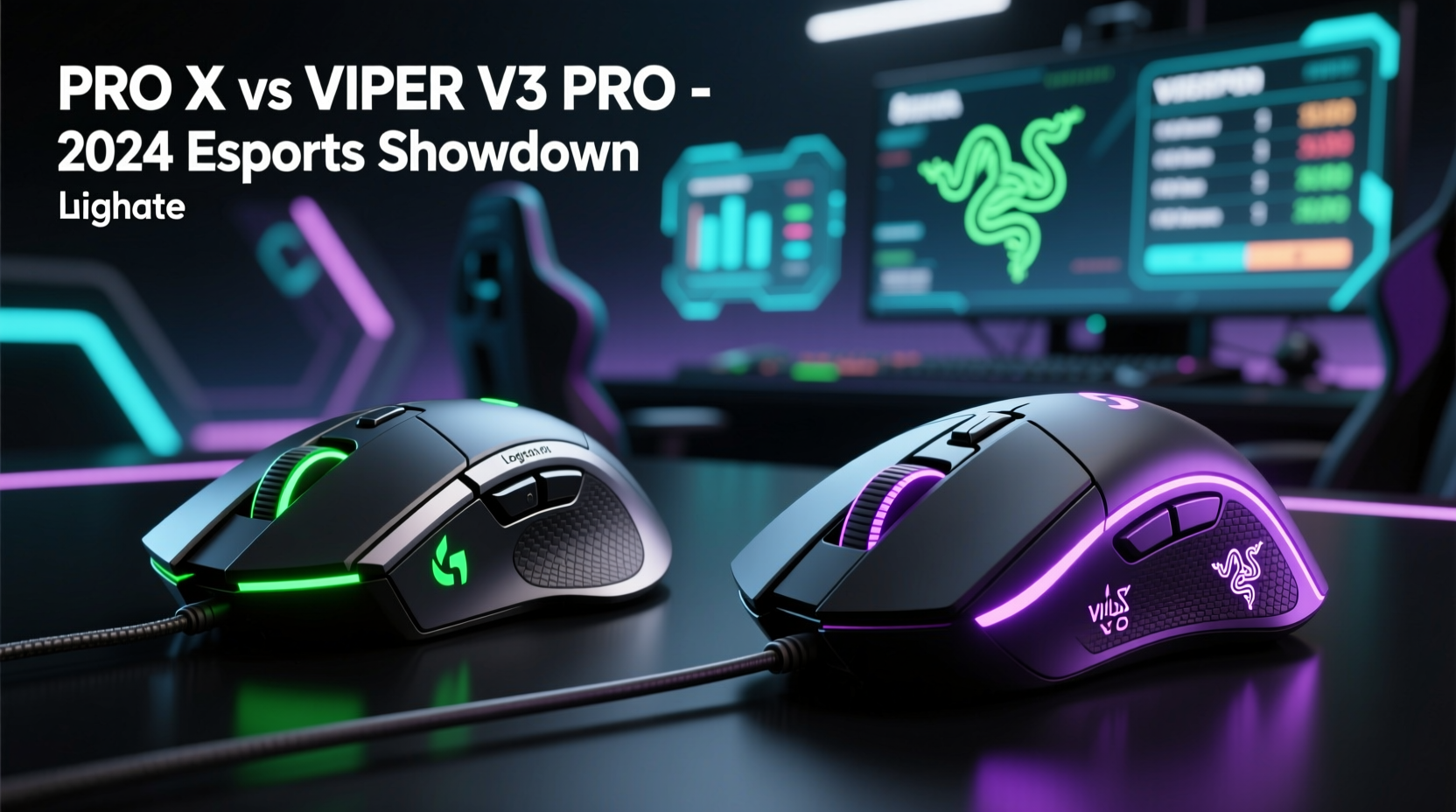
The physical feel of a mouse is often the deciding factor for long gaming sessions. Comfort translates directly to control, especially during extended tournaments or practice marathons.
The Logitech G Pro X Superlight features a symmetrical design weighing just 63 grams. Its matte coating provides consistent grip without attracting fingerprints, while the sculpted sides accommodate claw and fingertip grips exceptionally well. It lacks side buttons on the left (a deliberate choice by Logitech to prevent accidental clicks), making it ideal for players who prioritize minimalism and reliability.
In contrast, the Razer Viper V3 Pro takes lightweight engineering further, tipping the scales at only 59 grams. Razer achieved this through aggressive honeycomb shell construction, which reduces material without sacrificing structural integrity. This open-shell design increases ventilation but may collect dust more easily over time. The shape remains largely symmetrical but with slightly sharper angles near the rear, favoring medium to small-handed users who use fingertip or claw grips.
Both mice use PTFE feet for smooth glide, though the Viper V3 Pro’s modular feet system allows for replacement customization. The Superlight uses fixed but premium-grade skates that last longer under normal conditions.
Sensor Performance and Tracking Precision
At the heart of any elite gaming mouse lies its optical sensor. In professional esports, pixel-perfect tracking and lift-off distance accuracy are non-negotiable.
The Logitech G Pro X Superlight is equipped with the **HERO 25K sensor**, capable of up to 25,600 DPI with zero smoothing, filtering, or acceleration. Independent tests show it maintains 99.6% tracking consistency across all surfaces, including low-quality mousepads. Its lift-off distance is factory-calibrated to approximately 1mm, minimizing cursor drift when repositioning.
Razer counters with the **Focus Pro 30K Optical Sensor** in the Viper V3 Pro, offering even higher maximum DPI (up to 30,000) and enhanced surface calibration via Razer Synapse. What sets it apart is adaptive lift-off distance adjustment—automatically detecting your pad texture and optimizing detachment height. In practical use, this means fewer recalibrations when switching pads mid-tournament.
“Sensor consistency matters more than peak specs. A jittery 30K sensor isn’t better than a rock-solid 25K.” — Daniel Kim, Esports Hardware Analyst at PCPerf
While the numbers favor Razer on paper, real-world usage shows marginal differences. Most pros cap their DPI between 800–1600, where both sensors perform flawlessly. However, the Focus Pro's intelligent surface detection gives it a slight edge in dynamic environments such as LAN events with unfamiliar gear.
Battery Life and Wireless Reliability
No wired tether should hold back a champion. Both mice rely on wireless connectivity using proprietary 2.4GHz protocols—Logitech’s Lightspeed and Razer’s HyperSpeed—both renowned for sub-1ms response times.
The G Pro X Superlight delivers up to **70 hours** on a single charge with RGB lighting turned off. Charging via USB-C takes about two hours, and there’s no onboard charging indicator beyond a brief LED flash.
The Viper V3 Pro offers around **90 hours** under similar conditions, thanks to improved power management and lower idle consumption. Razer also includes a charging dock sold separately, allowing quick top-ups between matches. Battery status is viewable only through Synapse software, not on-device.
| Feature | Logitech G Pro X Superlight | Razer Viper V3 Pro |
|---|---|---|
| Weight | 63g | 59g |
| Max DPI | 25,600 | 30,000 |
| Battery Life | Up to 70 hours | Up to 90 hours |
| Wireless Tech | Lightspeed | HyperSpeed |
| RGB Lighting | Logo-only (customizable) | Logo + side indicators |
| Onboard Memory | Yes (5 profiles) | No (requires Synapse) |
For tournament players, the lack of onboard memory in the Viper V3 Pro could be a drawback. You must reinstall Synapse on any new machine to restore settings, whereas the Superlight retains configurations independently—a crucial advantage in bring-your-own-device competitions.
Button Layout and Click Feel
Click latency and tactile feedback influence reaction speed and shot consistency. Both mice use optical switches rated for 90 million clicks, ensuring longevity and instant actuation.
Logitech employs its **Hybrid Optical-Mechanical Switches**, combining physical contact with light-based registration. This hybrid approach reduces debounce delay and prevents double-clicking issues common in pure mechanical designs. The result is crisp, predictable input with moderate pre-travel resistance favored by trigger-disciplined shooters.
Razer uses **Optical Mouse Switches Gen-3**, fully light-triggered with faster reset points. Users report slightly quicker resets compared to Logitech, beneficial in rapid-fire scenarios like flick shots in Overwatch or Warzone. However, some find the initial press too light, leading to unintended inputs during intense strafing.
Side button placement differs subtly. The Superlight has two rear-placed buttons reachable only by lifting the thumb slightly. The Viper V3 Pro places them closer to the base, increasing accessibility but raising the risk of accidental activation during palm shifts.
Real-World Competitive Use: A Mini Case Study
Consider the experience of Alex Tran, a semi-professional Valorant player competing in regional EMEA circuits. After using the G Pro X Superlight for two years, he switched to the Viper V3 Pro ahead of a major LAN event.
“I loved the consistency of the Logitech,” Alex explains. “But after trying the Viper V3 Pro at a friend’s setup, I noticed how much less fatigue I had during 8-hour practice days. The 4-gram difference sounds minor, but over time, my wrist felt lighter, more responsive.”
However, challenges emerged. At the tournament, his custom DPI and polling rate settings didn’t carry over because the venue PC lacked Razer Synapse. He had to manually adjust settings mid-match, costing precious seconds. “I won’t make that mistake again,” he admits. “Now I keep a USB stick with Synapse portable installed.”
Despite the hiccup, Alex continues using the Viper V3 Pro daily, citing superior glide and sensor adaptability. Yet he keeps the Superlight as a backup for travel and plug-and-play scenarios.
Which One Should You Choose?
Selecting between these two elite mice depends on your priorities:
- Choose the Logitech G Pro X Superlight if: You value plug-and-play reliability, prefer slightly more contoured shaping, want onboard profile storage, or compete in environments where installing software isn't allowed.
- Choose the Razer Viper V3 Pro if: You prioritize absolute minimum weight, desire cutting-edge adaptive sensor tech, appreciate longer battery life, and don’t mind relying on Synapse for full functionality.
Quick Decision Checklist
- Do you frequently switch computers? → Superlight (onboard memory)
- Are you sensitive to wrist strain? → Viper V3 Pro (lighter)
- Do you use multiple DPI presets mid-game? → Superlight (hardware profiles)
- Do you play on varied mousepad types? → Viper V3 Pro (adaptive LOD)
- Is battery longevity critical? → Viper V3 Pro (90h vs 70h)
Frequently Asked Questions
Can either mouse work without drivers?
Yes, both function as basic wireless mice without software. However, advanced customization—DPI stages, polling rate, RGB, macros—requires Logitech G Hub or Razer Synapse.
Is the honeycomb shell on the Viper V3 Pro durable?
Yes. Despite appearances, Razer uses reinforced polymers tested to withstand typical desktop wear. Some users report minor debris accumulation, easily cleaned with compressed air.
Does the Superlight support Bluetooth?
No. The G Pro X Superlight uses only 2.4GHz Lightspeed wireless. Bluetooth was omitted to save space and power, focusing solely on gaming performance.
Final Verdict: Excellence in Different Forms
The battle between the Logitech G Pro X Superlight and the Razer Viper V3 Pro isn’t about declaring a universal winner—it’s about matching tool to task. The Superlight stands as a benchmark of proven reliability, trusted by pros across FPS titles for its balanced design and independence from software. It’s the Swiss Army knife of esports mice: simple, effective, and always ready.
The Viper V3 Pro pushes innovation forward. With class-leading weight reduction, smarter sensor logic, and extended battery life, it represents the next evolution in hyper-light competition gear. But it demands loyalty to Razer’s ecosystem and careful preparation for software-dependent setups.
Ultimately, both are worthy of championship-level play. Your hand size, grip preference, and competitive environment will guide the final call. Try them side by side if possible. Failing that, consider starting with the Superlight for its broader compatibility, then upgrading to the Viper V3 Pro once you’re deep in the ecosystem.




 浙公网安备
33010002000092号
浙公网安备
33010002000092号 浙B2-20120091-4
Comments
No comments yet. Why don't you start the discussion?