
For professionals, writers, coders, and anyone who spends hours at a desk, the right keyboard isn’t just about aesthetics—it’s about endurance, accuracy, and long-term physical well-being. Two keyboards frequently surface in discussions about premium typing experiences: the Logitech MX Keys and the Keychron K3. Both promise comfort, but they deliver it differently. One is engineered by a mainstream tech giant with decades of human interface experience; the other comes from a growing mechanical keyboard brand beloved by enthusiasts. But when it comes to actual typing comfort—reduced fatigue, tactile feedback, wrist alignment, and sustained use—which one truly wins?
This isn’t a battle of specs alone. It’s about how each keyboard feels after three hours of writing, whether your fingers glide smoothly or strain with every keystroke, and if your wrists remain neutral or ache by midday. Let’s dissect both models across design, switch types, ergonomics, customization, and real-world usability to determine which keyboard genuinely enhances typing comfort.
Design Philosophy and Build Quality
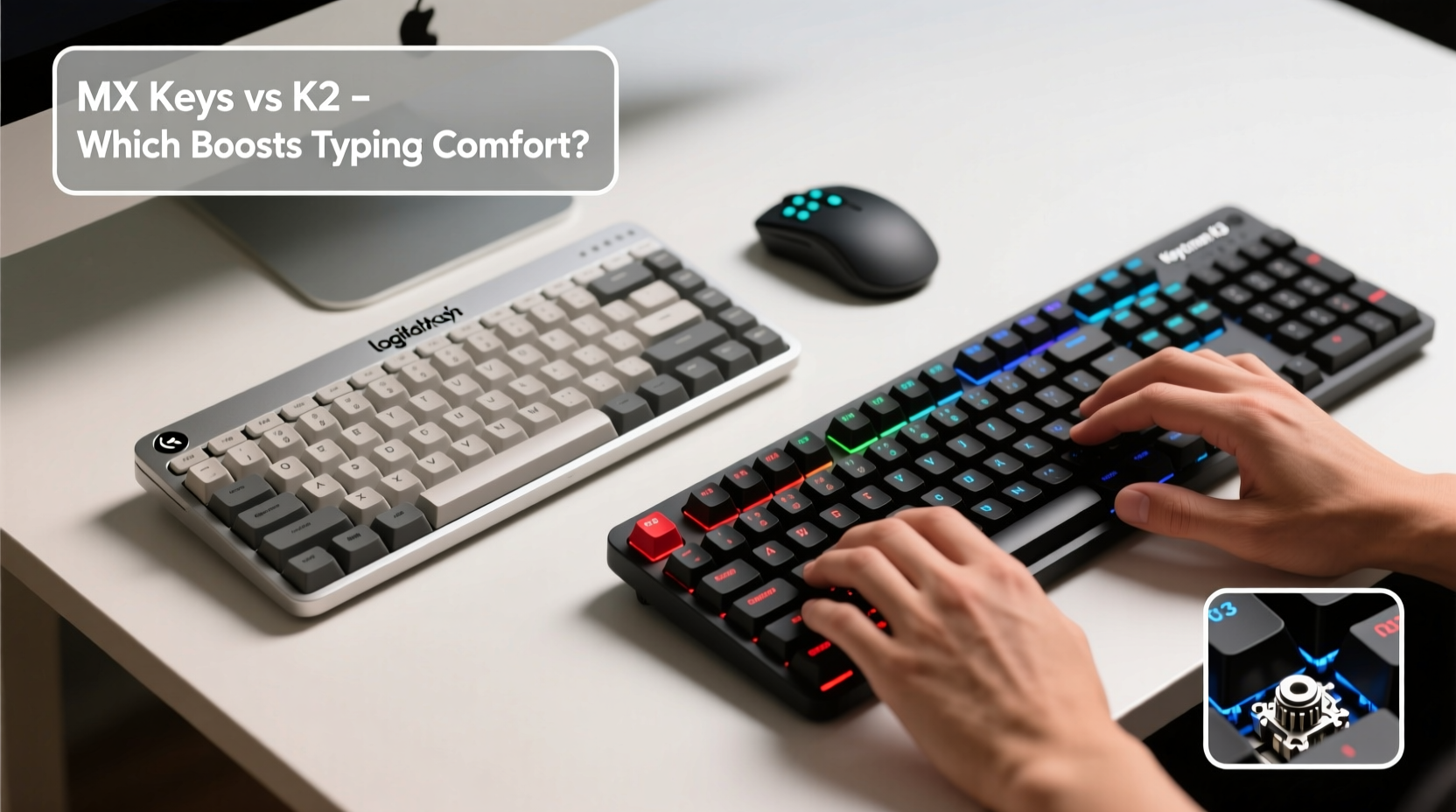
The Logitech MX Keys and Keychron K3 take different approaches to form and function. The MX Keys embodies minimalist corporate elegance—a low-profile, aluminum-top keyboard designed for seamless integration into professional environments. Its slim profile, subtle backlighting, and compact layout make it ideal for minimalist desks and multi-device workflows. It’s built with a brushed aluminum top plate that gives it a premium feel, and its stable base minimizes wobble during intense typing sessions.
In contrast, the Keychron K3 embraces mechanical keyboard culture with a tenkeyless (TKL) layout and hot-swappable switch support. It uses a plastic case with a metal plate, offering durability without the weight of full metal construction. While not as sleek as the MX Keys, the K3’s design prioritizes modularity and user control. Its slightly elevated rear legs (with optional tilt adjustment via flip feet) allow users to fine-tune their typing angle—an often-overlooked factor in comfort.
One critical difference lies in keycap profile. The MX Keys uses a spherical-dome keycap design where each key has a concave surface tailored to fingertip curvature. This promotes consistent finger placement and reduces lateral slipping. The Keychron K3, depending on configuration, typically ships with OEM-profile keycaps—slightly taller with a more pronounced curve. These offer deeper finger nesting, which some typists find more secure during long sessions.
Switch Type and Tactile Feedback
This is where the fundamental divergence occurs. The MX Keys uses Logitech’s proprietary low-profile dome switches, which simulate a mechanical feel using rubber domes beneath scissor-like mechanisms. These provide a soft, quiet actuation with moderate tactile bump—ideal for office settings where noise matters. The travel distance is only 1.5mm, meaning less vertical movement per keystroke, which can reduce finger strain during rapid input.
The Keychron K3, being a true mechanical keyboard, offers multiple switch options—most commonly Gateron Red, Brown, or Blue switches. These have a standard 4mm travel distance and 2mm actuation point. Gateron Browns are tactile and moderately clicky; Reds are linear and smooth; Blues are loud and sharply tactile. Users can even swap switches themselves thanks to hot-swap sockets, allowing personalized tuning of feel.
From a comfort perspective, shorter travel (as in the MX Keys) may benefit those with repetitive strain concerns or lighter touch typists. However, mechanical switches offer more precise feedback, letting users know exactly when a keystroke registers—this can reduce “bottoming out,” the habit of slamming keys fully down, which contributes to hand fatigue.
“Tactile consistency and reduced actuation force are more important than raw speed when evaluating typing comfort.” — Dr. Lena Torres, Ergonomics Researcher at MIT Human Factors Lab
Ergonomic Layout and Wrist Support
Comfort isn’t just about switches—it’s about posture. The MX Keys features a gently curved keywell and a negative tilt (when used without risers), encouraging a natural hand slope that aligns wrists with forearms. This mimics ergonomic keyboard principles without requiring an unconventional shape. Additionally, its integrated palm rest—though firm—is a rare inclusion in mainstream keyboards, offering immediate wrist support straight out of the box.
The Keychron K3 lacks a built-in palm rest but supports external ones easily due to its standard layout. It ships with two sets of feet: one flat, one angled upward. The upward tilt promotes a more traditional typing posture, but it may elevate wrists too high for some users, potentially increasing carpal tunnel pressure. Without a wrist rest, prolonged use can lead to discomfort—especially for those accustomed to padded support.
Another ergonomic consideration is typing angle. The MX Keys’ fixed low profile keeps hands closer to the desk, reducing shoulder elevation. The K3, while slimmer than many full-sized mechanical boards, still sits slightly higher unless paired with a negative tilt stand. For users working at standing desks or non-standard heights, this flexibility (or lack thereof) becomes crucial.
Comparison Table: Ergonomic Features
| Feature | Logitech MX Keys | Keychron K3 |
|---|---|---|
| Integrated Palm Rest | Yes | No |
| Adjustable Tilt | No (fixed shallow angle) | Yes (two-angle flip feet) |
| Negative Tilt Option | Yes (by removing feet) | No (only positive tilt) |
| Keycap Profile | Spherical DSA (low profile) | OEM (medium height) |
| Typing Angle Recommendation | Ideal for neutral wrist alignment | Better with external wrist rest |
Real-World Typing Experience: A Mini Case Study
Consider Sarah, a technical writer who logs 6–8 hours daily typing reports, emails, and documentation. She previously used a standard membrane keyboard and began experiencing mild wrist soreness after lunch. She tested both the MX Keys and K3 over two-week periods, alternating weekly.
With the MX Keys, she noticed immediate improvement. The short key travel meant she didn’t have to press hard, and the built-in palm rest kept her wrists supported. The backlighting adjusted automatically based on ambient light, reducing eye strain during early mornings. After two weeks, her wrist discomfort decreased significantly.
Switching to the Keychron K3, she appreciated the satisfying tactile feedback of the Gateron Brown switches and enjoyed the quieter environment (thanks to foam padding inside the case). However, without a wrist rest, her left wrist started to hover slightly, leading to tension by day five. Once she added a memory foam wrist pad, comfort improved—but the initial oversight highlighted a gap in out-of-box ergonomics.
Ultimately, Sarah preferred the MX Keys for pure comfort, though she praised the K3’s customizability and long-term potential with modifications.
Customization and Long-Term Adaptability
While the MX Keys excels in plug-and-play comfort, the Keychron K3 shines in adaptability. It supports QMK/VIA firmware, allowing full remapping, macro programming, and layer customization. For power users who want to optimize layouts—like switching to Colemak or creating shortcuts—the K3 offers far greater freedom.
Moreover, the ability to hot-swap switches means you can experiment with different feels: try silent reds for late-night work, tactile teardrops for daytime clarity, or even low-force optical switches. This level of personalization can dramatically improve long-term comfort, especially as typing habits evolve.
The MX Keys, while customizable through Logitech’s Options+ software, remains limited. You can remap keys and set app-specific profiles, but you cannot change the physical feel. If the default dome switches don’t suit your stroke, there’s no workaround. Firmware updates are automatic and reliable, but the hardware itself is locked in place.
Checklist: Choosing Based on Your Needs
- Choose the MX Keys if: You want a quiet, low-maintenance keyboard with excellent out-of-box ergonomics and multi-device support.
- Choose the K3 if: You value tactile precision, plan to customize switches or layout, and don’t mind adding accessories for comfort.
- Need silent operation? → MX Keys has the edge.
- Type aggressively? → Mechanical switches on the K3 may prevent bottoming-out injuries.
- Work across Mac, Windows, Linux? → Both support multi-OS, but K3 offers deeper OS-level programmability.
Frequently Asked Questions
Is the Logitech MX Keys worth it for heavy typists?
Absolutely. Its low-profile switches are designed for speed and endurance, with minimal finger travel reducing fatigue. The responsive backlighting and stable base further enhance the typing rhythm, making it a top choice for writers, editors, and programmers who prioritize efficiency and comfort.
Can I use the Keychron K3 quietly in an office?
Yes, but with conditions. Opt for linear switches like Gateron Reds or silent browns, and ensure the case includes sound-dampening foam (which the K3 does). Pair it with O-rings and a desk mat to minimize noise. Even then, it won’t be as quiet as the near-silent MX Keys.
Which keyboard lasts longer?
Mechanical switches like those in the K3 are typically rated for 50–100 million keystrokes, compared to 20–30 million for membrane/dome systems. However, the MX Keys’ robust build and IP-rating for minor spill resistance give it durability advantages in unpredictable environments. With proper care, both can last 5+ years.
Final Verdict: Which Keyboard Actually Boosts Typing Comfort?
The answer depends on what kind of comfort you need. If your priority is immediate, no-fuss relief from wrist strain and finger fatigue—with a design that supports neutral posture right out of the box—the Logitech MX Keys is the superior choice. Its thoughtful integration of palm rest, low-profile keys, and intelligent lighting creates a cohesive ecosystem for sustained, comfortable typing.
However, if you’re willing to invest time and possibly additional accessories to tailor your setup, the Keychron K3 offers a path to deeply personalized comfort. The ability to swap switches, adjust angles, and program layouts means you can evolve your typing experience over months or years. For tactile lovers and tinkerers, this adaptability translates into long-term satisfaction.
In clinical terms, the MX Keys better adheres to established ergonomic standards. In enthusiast circles, the K3 earns praise for empowering user agency. Neither is objectively “better”—but for most people seeking genuine typing comfort without extra setup, the MX Keys delivers a more complete, ready-to-use solution.
“The best keyboard isn’t the one with the most features—it’s the one that lets you forget you’re typing.” — Adrian Cho, Senior UX Designer at Input Labs
Take Action: Optimize Your Workspace Today
Don’t settle for discomfort. Whether you choose the polished refinement of the Logitech MX Keys or the customizable depth of the Keychron K3, make sure your keyboard supports—not strains—your body. Evaluate your daily usage, test setups if possible, and remember: small changes in key travel, angle, or feedback can yield major improvements in endurance and well-being. Try adjusting your typing posture, add a wrist rest if needed, and consider switching to a board that respects both your productivity and your physical health.




 浙公网安备
33010002000092号
浙公网安备
33010002000092号 浙B2-20120091-4
Comments
No comments yet. Why don't you start the discussion?