
In recent years, momentum has grown in several democracies to lower the voting age from 18 to 16. Proponents argue that young people deserve a voice in decisions affecting their futures, particularly on issues like climate change and education. However, this shift raises significant concerns grounded in developmental psychology, civic behavior, and institutional stability. While inclusivity is a noble goal, expanding suffrage to younger teens demands careful scrutiny. The arguments against lowering the voting age are not rooted in dismissing youth but in safeguarding the integrity and effectiveness of democratic participation.
Cognitive and Emotional Development Limitations
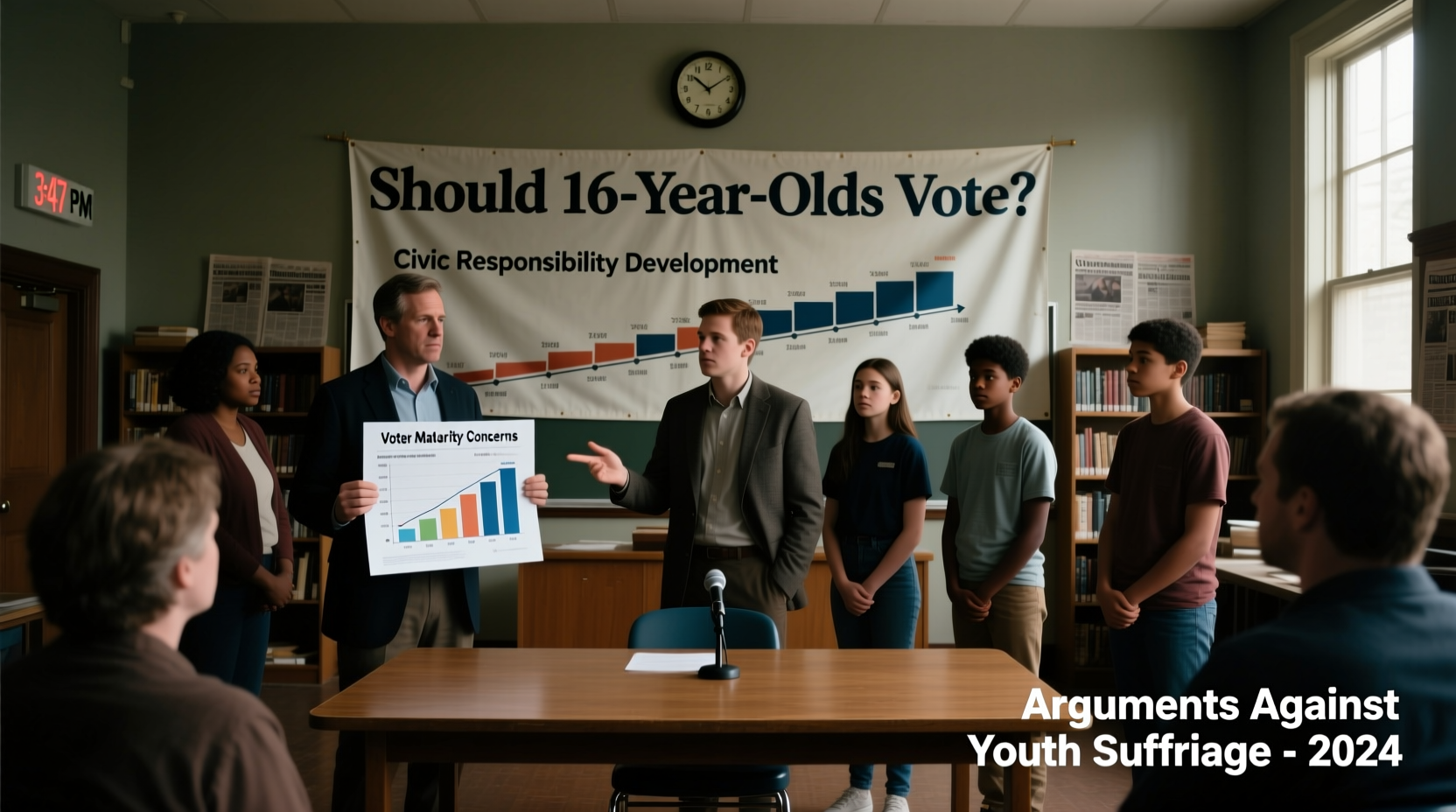
One of the most substantiated arguments against allowing 16-year-olds to vote centers on brain development. Neuroscience consistently shows that the prefrontal cortex—the region responsible for decision-making, impulse control, and long-term planning—continues developing into the mid-20s. At 16, adolescents are still refining their ability to assess complex information, resist peer influence, and weigh trade-offs.
This neurological reality impacts political judgment. Voting requires more than opinion; it demands the capacity to evaluate policy consequences, recognize misinformation, and understand systemic trade-offs—skills that are still maturing at age 16. A study by the National Institutes of Health found that teenagers are more likely to make choices based on immediate emotional responses rather than long-term reasoning.
“Adolescents can hold strong opinions, but their decision-making is often influenced by emotion and social context rather than critical analysis.” — Dr. Sarah Thompson, Cognitive Psychologist, University of Michigan
Limited Political Engagement and Information Processing
Voting is not just a right—it’s a responsibility that assumes a baseline level of political awareness. Research indicates that 16- and 17-year-olds exhibit significantly lower levels of political knowledge compared to adults. A 2022 Pew survey revealed that only 38% of U.S. high school seniors could correctly identify the three branches of government.
Without foundational civic knowledge, votes may be cast based on popularity, social media trends, or parental influence rather than informed evaluation. This risks reducing elections to referendums on charisma or emotion rather than policy substance.
Furthermore, adolescents are among the least engaged demographics when it comes to consuming news from reliable sources. They are more likely to rely on algorithm-driven platforms like TikTok or Instagram for political information—channels prone to bias, misinformation, and oversimplification.
Barriers to Informed Voting Among Teens
- Lack of access to comprehensive civic education
- High susceptibility to social media manipulation
- Dependence on family or peer group opinions
- Low motivation to research complex policy issues
Risks of Dependency and Undue Influence
At 16, most individuals are still financially and emotionally dependent on their parents or guardians. This dependency creates a unique vulnerability to coercion or indirect influence in voting behavior. Unlike independent adults who form opinions through personal experience, many 16-year-olds live in households where political views are shaped by family dynamics.
School environments also play a role. If civics classes or school administrators express strong political leanings, students may feel pressured—explicitly or implicitly—to conform. This undermines the principle of autonomous, private decision-making central to democratic voting.
In Austria, one of the few countries with a partial 16-vote system, researchers observed that younger voters were more likely to support parties favored by their parents or teachers. This suggests that adolescent voting may amplify existing power structures rather than introduce fresh perspectives.
Lower Voter Turnout Among Youth May Undermine Legitimacy
Even if 16-year-olds gain the right to vote, actual participation remains a concern. Data from Scotland, where 16- and 17-year-olds voted in the 2014 independence referendum, showed high initial turnout (75%)—but this enthusiasm did not persist. In subsequent local elections, youth participation dropped sharply, aligning with broader trends of declining youth engagement.
A fragmented electorate with low turnout among new voters can weaken the perceived legitimacy of election outcomes. If large segments of the newly enfranchised fail to participate, it raises questions about whether the expansion of voting rights translates into meaningful representation—or merely symbolic inclusion.
| Country/Region | Voting Age | Youth Turnout (Ages 16–17) | Notes |
|---|---|---|---|
| Scotland (Referendum 2014) | 16+ | 75% | High initial engagement, not sustained |
| Austria (National) | 16+ | ~58% | Gradual decline in youth turnout |
| Germany (Some states) | 16+ | 50–60% | Varies by regional election significance |
| United States | 18+ | 45% (18–29) | Illustrates broader youth disengagement trend |
Institutional and Logistical Challenges
Lowering the voting age introduces administrative complexities. Schools would likely become de facto voter registration hubs, raising concerns about neutrality and data privacy. Integrating 16-year-olds into voter rolls requires coordination between education departments, electoral commissions, and identity verification systems—infrastructure that many regions lack.
There’s also the question of consistency. If 16-year-olds can vote, why can’t they serve on juries, enlist in the military without parental consent, or sign legal contracts? The current threshold of 18 represents a societal consensus on adulthood across multiple domains. Lowering the voting age selectively disrupts this balance, potentially creating confusion about what constitutes responsible citizenship.
“The voting age isn’t arbitrary—it’s a proxy for a bundle of adult responsibilities and rights. Changing one without the others creates an asymmetry that weakens civic coherence.” — James Rutherford, Constitutional Law Professor, Columbia University
Checklist: Key Considerations Before Lowering the Voting Age
- Evaluate the quality and reach of civic education programs
- Assess political knowledge levels among 16-year-olds
- Study long-term voter turnout trends in pilot regions
- Analyze risks of familial or institutional influence on young voters
- Review alignment with other legal age thresholds (e.g., contracts, jury duty)
- Ensure secure and neutral voter registration processes through schools
- Monitor misinformation exposure via social media platforms
Mini Case Study: Germany’s Experiment with 16-Year-Old Voters
In several German states, including Brandenburg and Hamburg, 16-year-olds have been allowed to vote in local and state elections since the early 2000s. Initial results showed a spike in youth engagement during election campaigns, with schools hosting debates and mock elections.
However, follow-up studies revealed a troubling pattern. While turnout was moderately high in first-time elections, it declined rapidly in subsequent cycles. Moreover, political scientists noted that many young voters relied heavily on their parents’ party preferences, with limited evidence of independent political exploration.
One 17-year-old voter in Hamburg admitted, “I didn’t really know the differences between the parties. I asked my dad, and he told me which one aligned with our values.” This anecdote reflects a broader issue: access to the ballot does not guarantee autonomous or informed decision-making.
Frequently Asked Questions
Don’t 16-year-olds pay taxes? Shouldn’t they have a say?
While some 16-year-olds earn income and pay taxes, their tax burden is typically minimal compared to working adults. More importantly, taxation and voting are not directly linked in modern democracies—children and non-citizens may contribute economically without voting rights. The principle of “no taxation without representation” applies broadly to citizen populations, not individual contributors.
What about climate change? Aren’t young people most affected?
It’s true that younger generations will bear the long-term consequences of environmental policy. However, representation doesn’t require universal suffrage at younger ages. Youth voices can be amplified through school councils, advisory boards, and advocacy organizations without compromising electoral integrity. Specialized mechanisms may be more effective than broad voting rights.
Has lowering the voting age worked anywhere?
Results are mixed. Austria reports modest success, but youth turnout remains inconsistent. In contrast, pilot programs in U.S. cities like Takoma Park, Maryland, show that while 16-year-olds can participate, their engagement often fades without sustained support. There is no conclusive evidence that lowering the voting age leads to lasting democratic improvement.
Conclusion
Lowering the voting age to 16 is a well-intentioned idea aimed at increasing youth engagement and intergenerational fairness. Yet, the arguments against it are substantial and grounded in psychology, civic behavior, and institutional design. Without parallel investments in civic education, media literacy, and youth empowerment programs, expanding suffrage risks diluting the quality of democratic participation.
The goal should not be to lower the voting age as a symbolic gesture, but to cultivate informed, resilient citizens capable of thoughtful engagement. That process begins long before election day—and lasts far beyond it.




 浙公网安备
33010002000092号
浙公网安备
33010002000092号 浙B2-20120091-4
Comments
No comments yet. Why don't you start the discussion?