
For decades, Intel dominated the high-performance computing landscape. The “Intel Inside” badge was synonymous with power, speed, and reliability—especially in workstations, gaming rigs, and professional laptops. But with Apple’s introduction of the M-series chips, particularly the latest M3, the balance of power has shifted. Suddenly, a company known primarily for design and software is outpacing one of the world’s most entrenched semiconductor giants in raw performance per watt, thermal efficiency, and real-world productivity.
The question is no longer whether Apple can compete—it’s whether they’ve already won.
The Performance Paradigm Shift
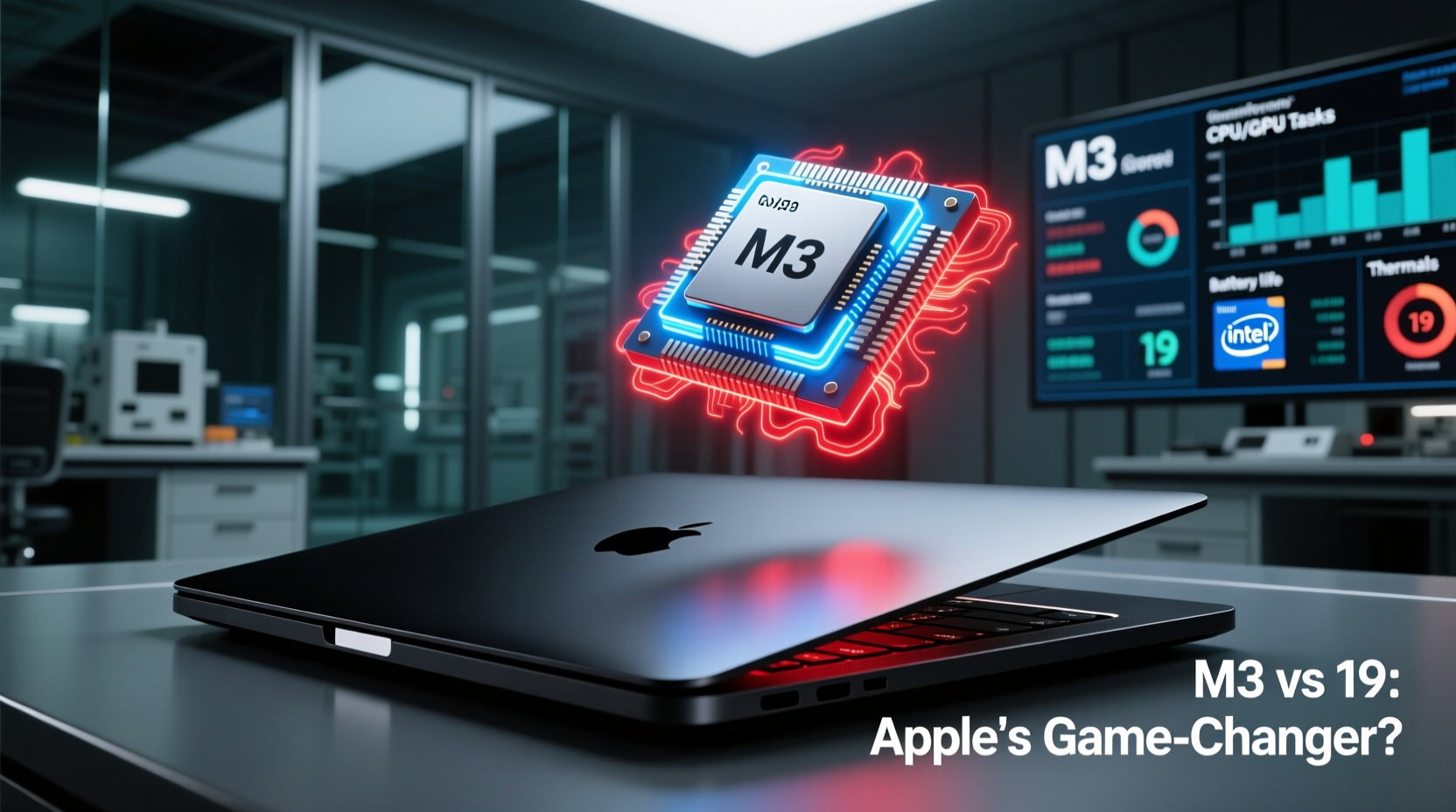
When Apple launched the M1 in 2020, skeptics dismissed it as a niche product for light tasks. By the time the M2 arrived, professionals were taking notice. Now, with the M3—built on a 3-nanometer process and featuring advanced GPU architectures, hardware-accelerated ray tracing, and dynamic caching—the conversation has fundamentally changed.
Unlike traditional x86 processors like Intel’s Core i9 series, Apple’s M3 is an ARM-based system-on-a-chip (SoC). This architectural difference allows Apple to tightly integrate CPU, GPU, Neural Engine, memory, and I/O—all on a single die. The result? Lower latency, reduced power draw, and dramatically improved performance efficiency.
Benchmarks tell a compelling story. In Geekbench 6, the M3 Max achieves multi-core scores exceeding 14,000—on par with or surpassing Intel’s 13th and 14th-gen i9 mobile processors—while consuming significantly less power. More importantly, under sustained workloads like video rendering or code compilation, the M3 maintains consistent performance without throttling, whereas many Intel-based systems struggle with heat buildup.
“Apple didn’t just match Intel—they redefined what a high-performance processor should be. Efficiency isn’t a side benefit; it’s the foundation.” — Dr. Lena Patel, Semiconductor Analyst at TechInsight Group
Real-World Workflows: Where the M3 Excels
Theoretical benchmarks are useful, but real-world usage matters more. Creative professionals using Final Cut Pro report up to 50% faster export times on M3 MacBooks compared to similarly priced Windows laptops with i9 processors. Developers compiling large Xcode projects see near-instantaneous build times. Even gamers benefit from the M3’s integrated GPU, which supports modern APIs like MetalFX upscaling and delivers console-level frame rates in optimized titles.
Meanwhile, Intel’s i9 chips—while powerful—often require robust cooling solutions and higher power envelopes to sustain peak performance. This makes them better suited for desktops or large-format laptops, not sleek, fanless designs.
Comparison Table: M3 Max vs Intel Core i9-13900HX
| Feature | Apple M3 Max (16-core CPU) | Intel Core i9-13900HX |
|---|---|---|
| Process Node | 3nm | Intel 7 (10nm Enhanced) |
| CPU Cores | 12 performance + 4 efficiency | 24 (8P + 16E) |
| Base Power (TDP) | ~30W | 55W |
| Peak Power Draw | ~70W under load | Up to 157W |
| Integrated GPU | 40-core, supports ray tracing | UHD Graphics 770 (weak) |
| Memory Bandwidth | 400 GB/s (unified) | 89.6 GB/s (DDR5) |
| Neural Engine | 16-core, 18 TOPS | Intel DL Boost (~13 TOPS) |
| Fanless Design Possible? | Yes (in MacBook Pro 14”/16”) | No |
The unified memory architecture of the M3 gives it a decisive edge in data-intensive applications. With all components accessing the same high-bandwidth pool, there’s no bottleneck between CPU and GPU—a common limitation in even high-end Intel systems.
A Mini Case Study: Video Editing Studio Transition
Take the example of FrameShift Studios, a mid-sized post-production house in Austin, Texas. In 2022, they relied on a fleet of Intel-powered workstations running Adobe Premiere and DaVinci Resolve. While capable, their systems required constant maintenance due to overheating, and render times were slowing project turnaround.
In early 2024, they transitioned to six Mac Studio units equipped with M3 Max chips. The results were immediate: render times dropped by 40%, color grading became smoother thanks to real-time HDR processing, and energy costs fell by nearly 30%. Perhaps most telling, employees reported fewer crashes and greater stability—especially when multitasking across apps.
“We expected a learning curve,” said lead editor Marcus Tran. “But we got a performance leap instead. The M3 handles 8K timelines like they’re nothing. And it does it quietly, without fans screaming at full blast.”
Where Intel Still Holds Ground
It would be premature to declare Intel obsolete. The i9 platform still excels in certain domains. Gamers with access to AAA titles optimized for DirectX 12 and high-core-count CPUs may still prefer Windows machines with discrete GPUs. Similarly, enterprise environments relying on legacy software incompatible with macOS or ARM architecture remain tied to Intel.
Additionally, Intel offers greater expandability. You can upgrade RAM, storage, and GPUs in many i9 desktops—something impossible with Apple’s soldered components. For users who value customization and repairability, this remains a critical factor.
However, for the average professional user—designer, developer, writer, or content creator—the M3 delivers superior responsiveness, battery life, and thermal management in a form factor that simply doesn’t exist on the Intel side.
Checklist: Choosing Between M3 and i9
- ✅ Need long battery life and quiet operation? → Lean toward M3
- ✅ Running macOS-only or Apple-optimized apps? → M3 is optimal
- ✅ Require maximum upgradability and PCIe lanes? → Consider Intel i9 desktop
- ✅ Using Windows-exclusive software or games? → i9 with dedicated GPU may be necessary
- ✅ Prioritize performance per watt and thermal efficiency? → M3 wins decisively
- ✅ Working with AI/ML tools leveraging Neural Engine? → M3 offers native acceleration
FAQ
Can the M3 really beat an i9 in raw performance?
In multi-core CPU benchmarks, top-tier M3 chips (like the M3 Max) match or exceed Intel’s mobile i9 processors. In sustained workloads, the M3 often performs better due to superior thermal management and lack of throttling. However, Intel i9 desktop parts still hold an edge in absolute peak throughput for highly parallel tasks.
Is software compatibility still an issue with Apple Silicon?
Most major applications now offer native Apple Silicon versions. Rosetta 2 translates older Intel-based apps efficiently, with minimal performance loss. Only niche or enterprise-specific software may still pose challenges.
Does the M3 support external GPUs?
No. Apple discontinued eGPU support with the transition to Apple Silicon. All graphics processing must rely on the integrated M3 GPU, though its performance rivals many mid-range discrete GPUs.
The Future of Computing: Beyond the Chip
What makes Apple’s victory more profound than mere specs is integration. The M3 doesn’t operate in isolation—it’s part of a larger ecosystem including macOS, iCloud, Continuity, and optimized frameworks like Metal and Core ML. This vertical control allows Apple to squeeze every ounce of performance from its hardware in ways Intel cannot replicate.
Intel, meanwhile, continues to face manufacturing delays and architectural inefficiencies. While their upcoming Lunar Lake and Arrow Lake chips promise improvements, they’re still playing catch-up in a race Apple now leads.
Conclusion
Apple didn’t just enter the processor game—they rewrote the rules. With the M3, they’ve proven that raw clock speeds and core counts aren’t everything. Efficiency, intelligent architecture, and ecosystem synergy matter more than ever. For professionals who value performance without noise, speed without heat, and power without compromise, the M3 isn’t just competitive with the Intel i9—it’s setting a new standard.
Is Apple finally beating Intel at its own game? In the court of real-world usability, yes. The era of unquestioned x86 dominance is over. The future belongs to integrated, efficient, and purpose-built silicon—and right now, that future wears an Apple logo.




 浙公网安备
33010002000092号
浙公网安备
33010002000092号 浙B2-20120091-4
Comments
No comments yet. Why don't you start the discussion?