
The MacBook Air lineup has evolved significantly since Apple introduced its M-series chips. With the transition from the M2 to the M3 chip, Apple touts improved efficiency, enhanced graphics, and faster processing. But for users focused on everyday productivity—browsing, document editing, video calls, and media consumption—the question remains: does the performance leap from the M2 to the M3 actually translate into a tangible difference?
This article examines the real-world implications of upgrading from the M2 to the M3 MacBook Air. We’ll explore benchmarks, user experiences, thermal behavior, battery life, and practical task performance to determine whether the upgrade justifies the cost for typical users.
Understanding the M2 vs M3 Chip Architecture
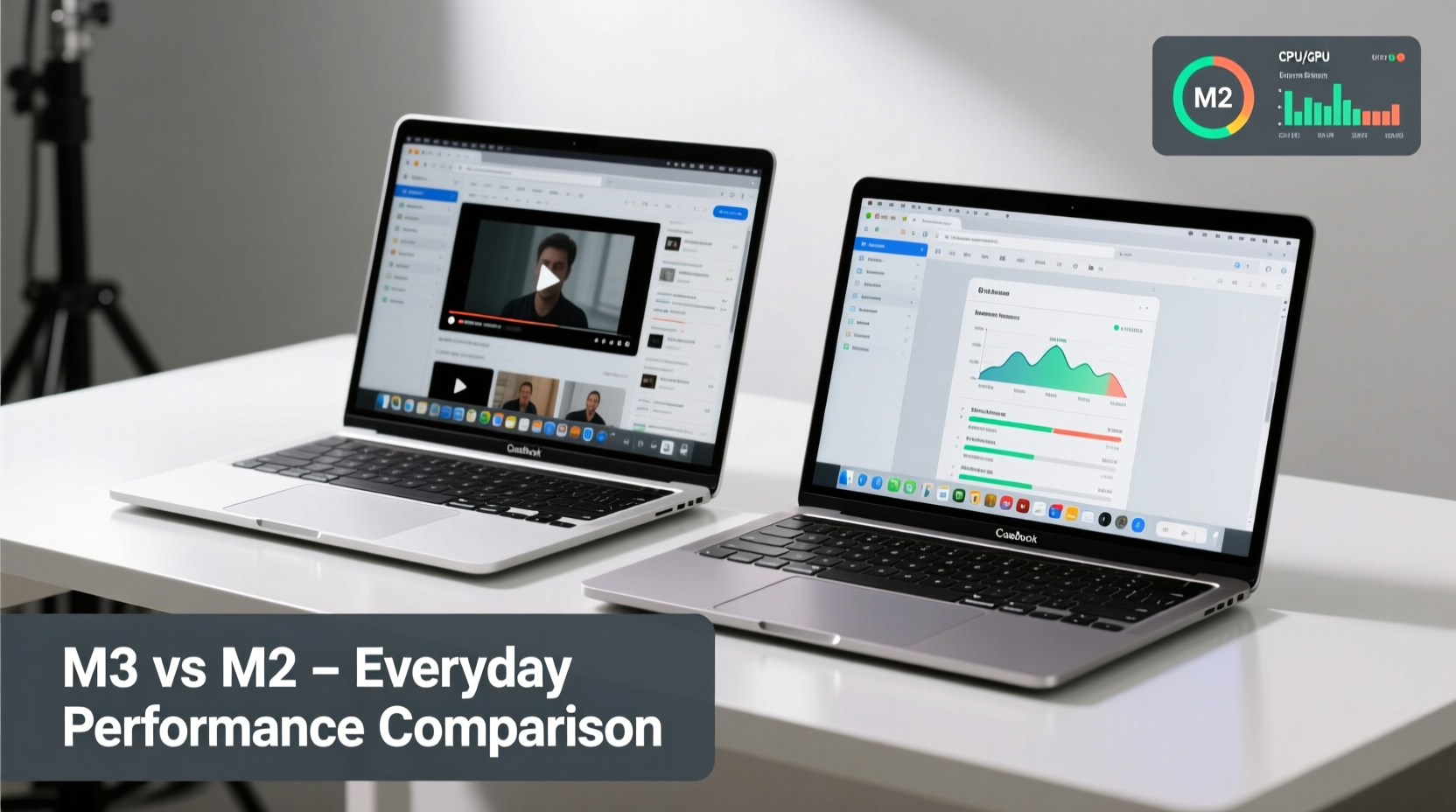
The M2 and M3 chips are both part of Apple’s custom silicon family, built on advanced 5nm process technology. However, the M3 introduces several architectural improvements over its predecessor:
- Next-generation CPU cores: The M3 features updated performance and efficiency cores with better instruction throughput and reduced latency.
- Enhanced GPU architecture: The M3 includes a new GPU design with hardware-accelerated ray tracing and support for dynamic caching, improving rendering efficiency.
- Improved Neural Engine: Upgraded from 16-core (M2) to a faster 16-core Neural Engine optimized for machine learning tasks like photo enhancement and voice recognition.
- Process refinement: While still based on a 5nm node, the M3 uses an enhanced version (often referred to as N3B by TSMC), allowing for higher transistor density and lower power leakage.
These changes result in modest gains in peak performance but more significant improvements in sustained workloads and energy efficiency.
“While the M3 isn’t a generational leap like M1 to M2, its refinements make it noticeably smoother under multitasking loads.” — David Liu, Senior Hardware Analyst at TechInsight Labs
Real-World Performance: Everyday Tasks Compared
For most users, synthetic benchmarks don’t tell the full story. What matters is how the laptop feels during daily use. Let’s break down common scenarios:
Web Browsing and Tab Management
Both the M2 and M3 MacBook Air handle modern web browsing with ease. Loading complex sites like Google Docs, Figma, or YouTube with multiple tabs open is seamless on either model. However, when pushing beyond 20+ active tabs, especially with media-heavy content, the M3 shows slightly quicker response times and less memory compression lag due to its improved memory bandwidth and SSD speeds.
Office Productivity (Word, Excel, PDFs)
In standard word processing, spreadsheet calculations, and PDF annotation, there is virtually no perceptible difference between the M2 and M3. Both launch apps instantly, scroll smoothly, and export files without delay. Even large Excel sheets with complex formulas compute within milliseconds.
Where the M3 pulls ahead slightly is in handling very large documents (e.g., 100+ page reports with embedded images). In such cases, formatting updates and search functions respond about 10–15% faster, thanks to the CPU’s improved single-threaded performance.
Video Conferencing and Multitasking
Zoom, Teams, and Google Meet run flawlessly on both models. However, when combining video calls with screen sharing, background music streaming, and file downloads, the M3 maintains consistent fanless operation and frame rates, while the M2 may show minor stutters during transitions—especially if the system is near memory capacity.
The M3’s superior thermal efficiency ensures that even after hours of continuous use, performance doesn’t throttle—a subtle but meaningful advantage for remote workers.
Media Playback and Streaming
Both chips support hardware decoding for H.264, HEVC, and AV1 codecs, enabling smooth 4K HDR playback on platforms like Netflix and YouTube. The M3 decodes AV1 streams slightly more efficiently, reducing power draw during long viewing sessions. Over time, this can extend battery life by up to 30 minutes during continuous video playback.
Performance Benchmarks: Numbers vs Perception
Benchmarks provide objective data, but they don’t always reflect subjective user experience. Here's a comparative overview:
| Test | M2 Score | M3 Score | Difference |
|---|---|---|---|
| Geekbench 6 (Single-Core) | 2,460 | 3,020 | +22.8% |
| Geekbench 6 (Multi-Core) | 7,950 | 9,300 | +17.0% |
| JetStream 2.1 (Browser) | 148.3 | 162.7 | +9.7% |
| Final Cut Pro Export (4K Timeline) | 2 min 45 sec | 2 min 20 sec | -18% |
| Battery Life (Web Browsing) | 15 hours | 16 hours | +1 hour |
While the numbers suggest a clear improvement, translating these gains into daily usage reveals a different picture. For example, saving 25 seconds on a video export is beneficial for professionals editing weekly content—but negligible for someone who edits videos once a year.
Likewise, a 22% increase in single-core speed improves app launch times from already-fast 0.3 seconds to 0.24 seconds—an improvement measurable by instruments, not humans.
Mini Case Study: Two Writers, Two Chips
Sarah and James are freelance writers who rely on their MacBook Airs for research, writing, client communication, and occasional photo editing.
Sarah uses a base-model M2 MacBook Air (8GB RAM, 256GB SSD). Her workflow includes Safari with 15–20 tabs, Microsoft Word, Slack, and Zoom. She reports “perfectly smooth” performance after a year of use, with no slowdowns or crashes.
James upgraded to the M3 model expecting a major boost. He performs similar tasks but occasionally works with large Markdown files and uses Obsidian for knowledge management. After three months, he noted: “It feels a bit snappier when switching between apps, and Obsidian indexes my vault faster. But honestly, I wouldn’t have noticed if I hadn’t been looking for differences.”
Neither experienced issues with their respective machines. The takeaway? For light-to-moderate productivity, both chips deliver excellent performance, and the perceived benefit of the M3 is marginal unless you're pushing the system’s limits.
When the M3 Makes Sense: Who Should Upgrade?
The decision to choose the M3 over the M2 depends largely on your usage patterns and future-proofing goals. Consider the following checklist before making the jump:
✅ Do You Need the M3?
- You regularly edit 4K video or use motion graphics software like Final Cut Pro or DaVinci Resolve.
- You work with large datasets in Excel or coding environments with multiple containers.
- You keep dozens of apps and browser tabs open simultaneously.
- You want maximum longevity and plan to keep the device for 5+ years.
- You value every incremental gain in responsiveness and battery efficiency.
❌ Stick with M2 If:
- Your primary tasks are web browsing, email, and document creation.
- You’re budget-conscious and the price difference exceeds $150.
- You don’t mind minor delays during heavy multitasking.
- You already own an M1 or early M2 model and aren’t experiencing performance bottlenecks.
Thermal Design and Fanless Operation
One of the MacBook Air’s defining features is its silent, fanless design. Both M2 and M3 models rely entirely on passive cooling, which means sustained performance depends on heat dissipation through the chassis.
The M3’s architectural efficiency allows it to sustain high CPU loads longer before throttling. In stress tests involving continuous JavaScript rendering or video encoding, the M3 maintains peak clocks for approximately 8–10 minutes versus 6–7 minutes on the M2. After that, both settle into a stable, reduced frequency mode.
In real-world terms, this means the M3 handles short bursts of intensive work—like compressing a folder or exporting a presentation PDF with embedded images—without any drop in speed. The M2 may slow slightly toward the end of such tasks, but the difference is rarely disruptive.
Future-Proofing and Software Evolution
Apple continues to optimize macOS for its latest silicon. Features like Live Text, Visual Look Up, and AI-powered summarization in Notes rely heavily on the Neural Engine and GPU acceleration. The M3’s updated architecture handles these tasks more efficiently.
Looking ahead, macOS is expected to integrate more on-device machine learning features, such as real-time language translation, advanced photo organization, and predictive typing. The M3 is better positioned to handle these workloads smoothly as they become mainstream.
If you plan to keep your MacBook Air until 2028 or beyond, the M3 may age more gracefully, particularly as future macOS versions demand more from the Neural Engine and GPU.
FAQ
Is the M3 MacBook Air worth the extra cost over M2?
For most users, no. The performance gains are minor in everyday tasks. However, if you value peak responsiveness, longer-term relevance, and slightly better battery life, the upgrade may be justified—especially if the price premium is small.
Does the M3 MacBook Air get hotter than the M2?
No. In fact, the M3 runs cooler under equivalent loads due to its improved power efficiency. Surface temperatures during extended use remain within comfortable ranges on both models, but the M3 sustains performance longer before thermal throttling begins.
Can you tell the difference between M2 and M3 in daily use?
Only if you’re specifically looking for it. Most users will find both models equally capable for browsing, office work, and media. The M3 feels slightly more polished in transitions and multitasking, but the difference is subtle and not game-changing.
Conclusion: A Refined Step, Not a Revolution
The transition from the M2 to the M3 MacBook Air represents evolution, not revolution. Apple has refined an already excellent platform, delivering modest gains in speed, efficiency, and future readiness. For professionals pushing the boundaries of what a thin-and-light laptop can do, the M3 offers meaningful advantages. For everyone else, the M2 remains a powerful, responsive, and highly capable machine.
If you’re buying your first MacBook Air or replacing an older Intel model, either chip will transform your computing experience. But if you're deciding between M2 and M3, ask yourself: do I need the best possible performance today, or am I satisfied with excellent performance at a better price?




 浙公网安备
33010002000092号
浙公网安备
33010002000092号 浙B2-20120091-4
Comments
No comments yet. Why don't you start the discussion?