
There are few experiences more frustrating than pressing the power button on your MacBook Pro and getting nothing in return—no chime, no light, no screen glow. Whether you rely on it for work, school, or personal projects, a non-responsive MacBook can bring your day to a halt. The good news is that many startup failures have simple explanations and even simpler solutions. Before assuming the worst, try these proven troubleshooting steps to get your Mac back online.
Step 1: Check the Power Source and Charger
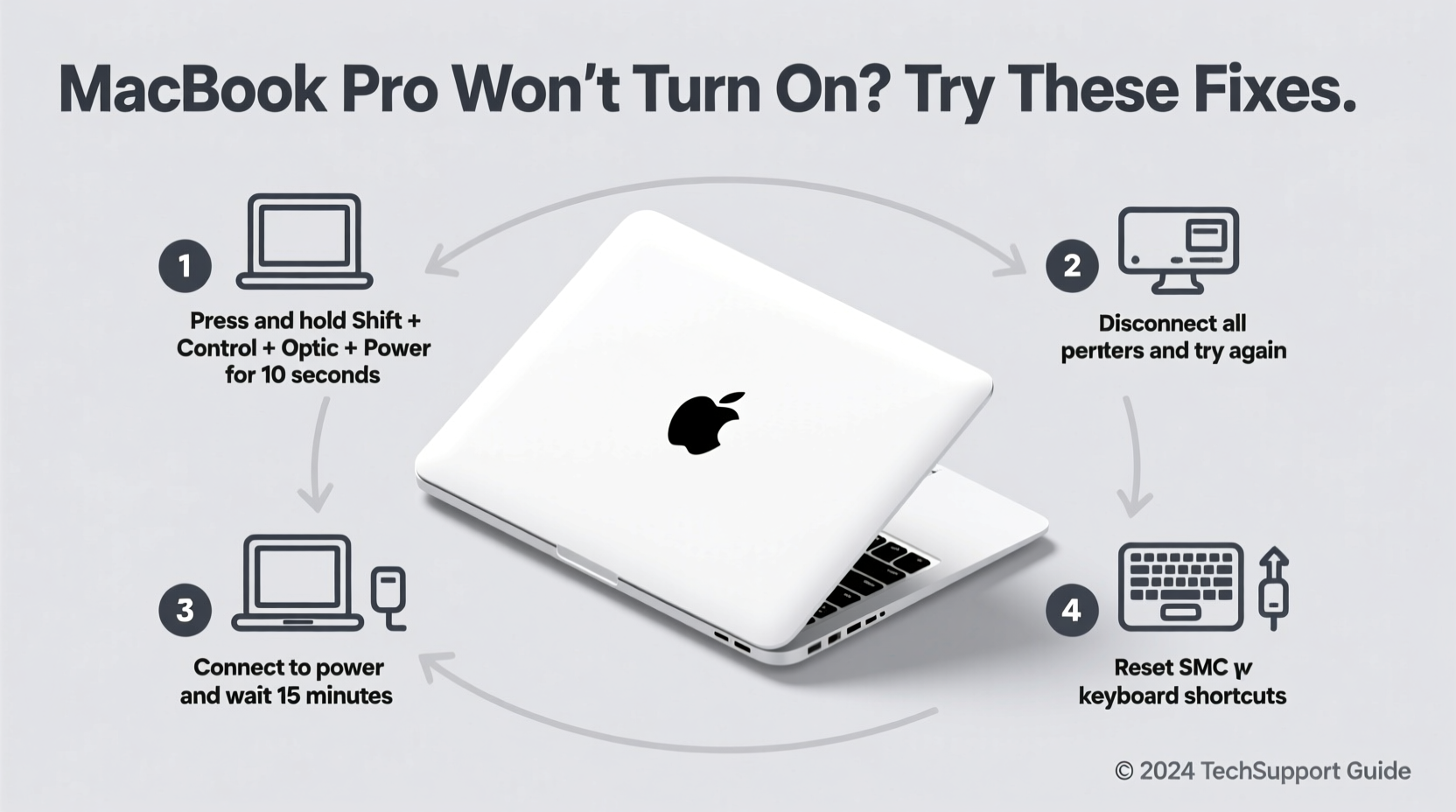
The most common reason a MacBook Pro won’t turn on is a faulty or disconnected power source. It’s easy to overlook something as basic as a loose cable, especially when stress clouds judgment.
Start by inspecting your charger and power adapter. Look for frayed wires, bent connectors, or signs of physical damage. If you're using a third-party charger, ensure it meets Apple's specifications. Inconsistent voltage or amperage from non-MFi-certified chargers can prevent proper charging or damage internal components over time.
Ensure the MagSafe or USB-C connector is securely attached to your MacBook. For models with USB-C, try a different port—some ports may charge while others don’t if there’s an internal issue. Plug the charger into a known working wall outlet. Avoid using extension cords or power strips temporarily to rule out circuit interruptions.
Step 2: Force Restart and Reset Key Combinations
If the machine appears completely dead, attempt a forced restart. This clears temporary system glitches that might be blocking startup.
For MacBook Pro models with Apple Silicon (M1, M2, M3 chips):
- Press and hold the power button for at least 10 seconds.
- Wait a few seconds, then press the power button again to restart normally.
For Intel-based MacBook Pros:
- Press and hold Control + Option + Shift on the left side of the built-in keyboard, along with the power button, for 10 seconds.
- Release all keys and press the power button to restart.
This process performs a System Management Controller (SMC) reset, which manages power delivery, battery charging, and thermal controls. On older models, resetting the SMC often resolves unresponsiveness related to sleep states or power distribution.
Step 3: Inspect Battery and Charging Indicators
Look closely at any visual feedback near the charging port. MagSafe-equipped models feature an LED indicator that glows amber when charging and green when fully charged. If there’s no light at all, the issue could be with the battery, logic board, or charger.
On USB-C models, check whether the screen shows a charging icon when connected. Even if the Mac doesn’t power on, connecting the charger should trigger a small battery icon on-screen after a few moments—if it doesn’t, the device may not be receiving power.
Try leaving the MacBook plugged in for at least 15–30 minutes before attempting another startup. A deeply drained battery may need time to accumulate enough charge to boot.
| Indicator | Meaning | Action |
|---|---|---|
| No light (MagSafe) | No power reaching Mac | Test charger, cable, outlet |
| Amber light (MagSafe) | Battery charging | Wait 15+ mins, retry startup |
| Green light (MagSafe) | Battery full | Attempt normal startup |
| Screen shows battery icon | Receiving power | Wait and retry boot |
| No response after 30 min | Potential hardware failure | Proceed to diagnostics |
Step 4: Diagnose Hardware Issues
If basic fixes fail, consider deeper hardware problems. Internal components like the logic board, RAM, or display can fail silently, mimicking a complete power outage.
Connect your MacBook to an external display using HDMI or Thunderbolt. If the external monitor lights up with an image, the issue may be with your built-in display or lid sensor—not a total system failure.
Listen carefully during startup attempts. Do you hear fan noise? A faint whirring suggests the logic board is active. Any sound indicates partial functionality, narrowing down the problem to display, GPU, or firmware layers.
One real-world example: Sarah, a freelance designer in Portland, thought her 2019 MacBook Pro was bricked after a sudden shutdown. She tried multiple chargers with no success. After connecting it to her studio monitor, she saw the login screen clearly—her internal display had failed, but the system was running perfectly. She continued working externally while arranging repair, avoiding unnecessary data loss or replacement costs.
“Many 'dead' Macs aren’t truly dead—they’re just not showing signs of life. Always test connectivity and output before concluding hardware failure.” — David Lin, Apple-Certified Technician, NYC Repair Hub
Step 5: Perform a DFU or Recovery Mode Boot
When software corruption prevents startup, entering recovery or Device Firmware Update (DFU) mode can help restore functionality. These modes bypass the operating system and allow direct access to repair tools.
To enter DFU mode (recommended for advanced users):
- Connect your Mac to a computer with macOS using a USB-C cable.
- Turn off the MacBook completely.
- Press and hold Power + Volume Up + Shift + Option for 2 seconds, then release only the power button while holding the others for 5 more seconds.
- If successful, Finder will detect the Mac in recovery mode, allowing reinstallation of macOS.
Alternatively, for standard recovery:
- Intel Mac: Hold Command + R while powering on.
- Apple Silicon: Press and hold the power button until startup options appear, then select Options.
From here, use Disk Utility to check the drive, reinstall macOS, or restore from backup.
Troubleshooting Checklist
- ✅ Verify the power outlet works with another device
- ✅ Inspect charger and cable for damage
- ✅ Try a different USB-C/MagSafe cable or adapter
- ✅ Force restart (10-second power button press)
- ✅ Reset SMC (Intel models only)
- ✅ Wait 15–30 minutes while charging before retrying
- ✅ Connect to external display to test video output
- ✅ Boot into Recovery Mode to assess system health
- ✅ Listen for fan or hard drive sounds
- ✅ Visit Apple Support or authorized service provider if unresolved
Frequently Asked Questions
Why won’t my MacBook Pro turn on even when plugged in?
This usually indicates a failure in power delivery. Common causes include a defective charger, damaged charging port, completely drained battery requiring extended charging, or internal hardware faults such as a failed logic board. Rule out external factors first—try different cables, outlets, and perform a force restart.
Can a MacBook Pro battery die permanently?
Yes. Lithium-ion batteries degrade over time and can fail after several years of use. If your MacBook hasn’t been used in months or has undergone hundreds of charge cycles, the battery may no longer hold a charge. In such cases, professional replacement is required. Note: A completely dead battery can prevent startup even when connected to power.
Does resetting the SMC fix startup issues?
On Intel-based Macs, yes—frequently. The SMC controls power management functions. Resetting it can resolve issues like fans running at full speed, failure to charge, or unresponsiveness after sleep. However, Apple Silicon Macs manage these functions differently and do not require manual SMC resets. Instead, a long press of the power button serves a similar diagnostic purpose.
Final Steps and When to Seek Help
If none of the above steps restore function, it’s time to consult professional support. Visit an Apple Store or Apple Authorized Service Provider for diagnostics. They can run Apple Diagnostics (hold D during startup on Intel Macs) or use internal tools to identify logic board, storage, or power-related failures.
Before sending your Mac in, remember: data recovery is possible even if the device won’t boot. Many shops offer drive extraction services to retrieve files from non-functional units.
Don’t rush to replace your MacBook Pro at the first sign of trouble. Most no-power scenarios stem from easily correctable issues. With methodical testing and patience, you’ll likely revive your machine—or at least preserve your data safely.




 浙公网安备
33010002000092号
浙公网安备
33010002000092号 浙B2-20120091-4
Comments
No comments yet. Why don't you start the discussion?