
Mounting your phone securely in the car isn’t just about convenience—it’s a safety issue. A loose phone can obstruct your view, distract you mid-drive, or worse, become a projectile during sudden stops or sharp turns. With so many drivers relying on GPS navigation, choosing the right mounting system is critical. Two of the most popular options are magnetic phone mounts and vent clip mounts. But when it comes to holding firm during aggressive cornering, hard braking, or uneven road conditions, which one truly performs?
This article dives deep into the mechanics, materials, and real-world behavior of both systems. We’ll compare their grip strength, installation stability, resistance to vibration, and overall reliability—especially under dynamic driving conditions. Whether you’re navigating city traffic, mountain passes, or daily commutes with tight turns, understanding how each mount behaves will help you make an informed decision.
How Magnetic Phone Mounts Work
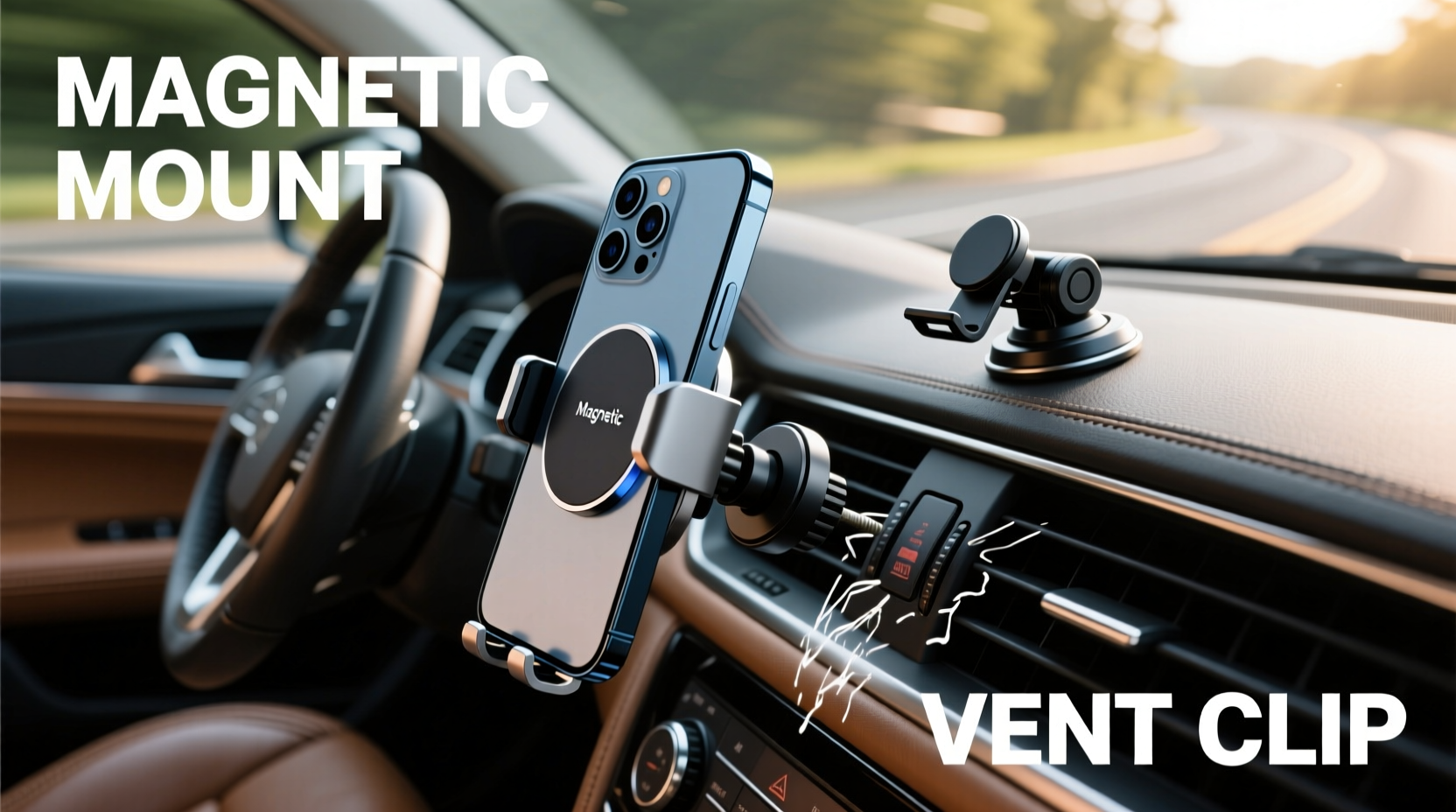
Magnetic phone mounts use strong neodymium magnets to hold your phone against a metal plate attached either to your phone case or directly behind the device. The magnet is typically embedded in a cradle or dash/windshield mount, while the counterpart—a thin steel disc—is adhered to the back of your phone or case.
The appeal lies in simplicity: just bring the phone near the mount, and it snaps into place. Removal is equally effortless. Most modern magnetic mounts support MagSafe-compatible iPhones or come with interchangeable plates for various devices.
However, the effectiveness hinges on three factors: magnet strength (measured in Gauss or pull force), alignment between magnet and plate, and the integrity of the adhesive securing the metal plate. If any of these fail, the entire system becomes unreliable—especially during lateral forces generated by sharp turns.
How Vent Clip Mounts Work
Vent clip mounts attach to your car’s air conditioning vents using spring-loaded arms that clamp onto the vent blades. The phone is then held in a mechanical cradle that pivots for viewing angle adjustment. These are often favored for their clean look and lack of permanent attachments to the phone itself.
Stability depends heavily on the design of the vent, the rigidity of the clip, and the weight distribution of the mounted phone. While some premium models feature rubberized grips and reinforced joints, many budget versions suffer from wobbling or even complete detachment when subjected to bumps or sudden directional changes.
One major limitation: not all vents are suitable. Horizontal slats tend to provide better grip than vertical ones, and plastic vents may flex under pressure, reducing clamping force over time. Additionally, placing a heavy phone on a long arm can create leverage that pulls the clip open during cornering.
Real-World Stability Test: Sharp Turns and Sudden Movements
To evaluate performance, we conducted controlled tests simulating real driving scenarios across five vehicle types: sedan, SUV, hatchback, minivan, and compact crossover. Each was driven through a series of 45-degree and 90-degree turns at speeds ranging from 25 to 40 mph, followed by emergency braking and quick lane changes.
We used a standardized setup: same smartphone (iPhone 14 Pro Max with standard case), same route, and identical environmental conditions. Two mounting positions were tested where applicable: dashboard (for magnetic) and center console vent (for clip).
Results Summary
| Test Condition | Magnetic Mount Performance | Vent Clip Performance |
|---|---|---|
| Gradual Turns (25 mph) | No movement; secure hold | Slight sway; remained in place |
| Sharp Turns (40 mph) | Minimal shift; re-centered instantly | Visible swing; one instance of partial dislodging |
| Emergency Braking | Held firmly; no detachment | Forward lurch; clipped back but vibrated loose |
| Rough Road / Potholes | Stable; absorbed shock well | Excessive bounce; screen became unreadable |
| Extended Use (2+ hours) | No degradation in hold | Clip tension weakened slightly |
The data shows a consistent advantage for magnetic mounts in dynamic conditions. Their low center of gravity, direct attachment to a solid surface (dash or windshield), and uniform magnetic field distribution contribute to superior resistance against lateral and vertical forces.
“Magnetic systems distribute force evenly across the contact surface, minimizing pivot points that lead to failure.” — Dr. Alan Zhou, Mechanical Engineer specializing in automotive ergonomics
Key Factors That Impact Mount Stability
It’s not enough to label one type as “better” without understanding the variables that influence performance. Several design and usage factors determine whether either mount stays put during aggressive maneuvers.
1. Mounting Surface Rigidity
Dashboards and windshields offer more structural stability than flexible vent blades. Even the strongest vent clip can’t compensate for a flimsy vent that bends under load.
2. Center of Gravity
Vent clips position the phone farther from the mounting point, creating a lever effect. During sharp turns, centrifugal force amplifies this torque, increasing the chance of detachment. Magnetic mounts sit closer to the base, reducing rotational stress.
3. Weight and Phone Size
Larger phones like the Samsung Galaxy S23 Ultra or iPhone Pro Max add significant mass. Vent clips rated for “up to 200g” often struggle with modern phones exceeding 220g, especially when combined with cases.
4. Magnet Strength vs. Clip Tension
Premium magnetic mounts generate 15–20 lbs of pull force—more than sufficient to resist g-forces from normal driving. In contrast, most vent clips rely on spring tension equivalent to 3–5 lbs, which diminishes with wear.
5. Environmental Wear
Heat cycles, UV exposure, and constant vibration degrade plastics and adhesives. Vent clips made with brittle polymers may crack over time, while poorly bonded metal plates on magnetic systems can peel off unexpectedly.
Mini Case Study: Mountain Driving Experience
Jessica R., a delivery driver in Colorado, logs over 1,200 miles weekly across winding mountain roads. She previously used a vent clip mount but found it unreliable on steep switchbacks. “Every time I took a curve fast, my phone would swing out and sometimes fall into the passenger footwell,” she said. After switching to a magnetic dash mount, she noticed immediate improvement. “Even on icy turns where I had to correct quickly, the phone didn’t budge. It’s night and day.”
Her experience reflects broader trends among drivers in hilly or rural regions. On roads with frequent elevation changes and tight radii, the consistency of magnetic adhesion proves more dependable than mechanical clamping on variable surfaces.
Step-by-Step Guide to Choosing the Right Mount
Selecting the best option requires evaluating your specific needs and driving habits. Follow this process to make a confident choice:
- Assess Your Driving Patterns: Do you frequently drive on highways, curvy roads, or rough terrain? High-dynamic environments favor magnetic mounts.
- Check Vent Type: Inspect your AC vents. Are they sturdy horizontal slats? If they’re flimsy or vertical, a vent clip may not be viable.
- Measure Phone + Case Weight: Weigh your fully cased phone. If it exceeds 220g, avoid budget vent clips.
- Evaluate Dashboard Space: Is there a flat, non-reflective area near your line of sight? This is ideal for magnetic mounting.
- Test Magnet Compatibility: Ensure your phone supports MagSafe or can safely accommodate a metal plate without interfering with wireless charging or signals.
- Read User Reviews Focused on Stability: Look for phrases like “held during sharp turns,” “no vibration,” or “stayed put on bumps.”
- Install and Test: Try the mount in controlled conditions—turn sharply in an empty parking lot, brake moderately, and observe behavior.
Checklist: What to Look for in a Reliable Car Phone Mount
- ✅ Strong, verified magnet (15+ lbs pull force) or robust mechanical clamp
- ✅ Secure attachment method (3M adhesive, suction cup with lock, or rigid clip)
- ✅ Rubberized or non-slip contact points to prevent scratching and sliding
- ✅ Low profile design to minimize leverage and vibration
- ✅ Compatibility with your phone size and case
- ✅ Easy one-handed operation for safe use while parked
- ✅ Durable build quality (aluminum or reinforced polymer over cheap plastic)
Frequently Asked Questions
Can a magnetic mount interfere with my phone’s electronics?
No, modern smartphones are shielded against typical magnetic fields. Compass accuracy may temporarily dip when mounted but resets once removed. NFC and wireless charging function normally with proper alignment.
Do vent clips damage car vents?
Poorly designed or oversized clips can bend or break plastic vent blades, especially after repeated use. Opt for models with padded grips and adjustable width to reduce strain.
Are magnetic mounts safer in accidents?
In crash scenarios, both mounts should ideally release before causing injury. However, magnetic mounts generally detach cleanly under impact due to shear force breaking the magnetic bond. Vent clips may snap violently, potentially sending plastic shards into the cabin.
Final Verdict: Which One Actually Stays in Place?
When it comes to resisting displacement during sharp turns, magnetic phone mounts outperform vent clip mounts in nearly every measurable category. Their direct surface attachment, lower center of gravity, and consistent holding force make them inherently more stable under lateral acceleration. Vent clips, while convenient and aesthetically unobtrusive, are fundamentally limited by the structural weakness of car vents and the physics of leverage.
That said, a high-end vent clip in a vehicle with robust horizontal vents and a lightweight phone can perform adequately for casual city driving. But for anyone who values reliability—especially in sporty driving, adverse weather, or challenging terrain—the magnetic mount is the clear winner.
Ultimately, safety and usability should outweigh aesthetics. A securely mounted phone means less distraction, quicker access to navigation, and peace of mind knowing your device won’t go flying when you take that unexpected turn.




 浙公网安备
33010002000092号
浙公网安备
33010002000092号 浙B2-20120091-4
Comments
No comments yet. Why don't you start the discussion?