
Every holiday season, families carefully unpack their cherished Christmas ornaments—many of which are decades old, handcrafted, or irreplaceable. Among the most common concerns during tree decorating is how to hang these fragile pieces without damaging them. Traditional metal hooks have long been the default, but in recent years, magnetic hangers have gained popularity as a gentler alternative. But when it comes to delicate glass baubles, vintage tinsel, or heirloom figurines, which method truly offers superior safety and peace of mind?
The choice between magnetic and hook hangers isn’t just about convenience—it’s about preservation. A single misstep can lead to cracked glass, bent loops, or broken paintwork. Understanding the mechanics, risks, and real-world performance of each option helps ensure your ornaments survive not just this season, but many more to come.
How Hook Hangers Work—and Where They Fall Short
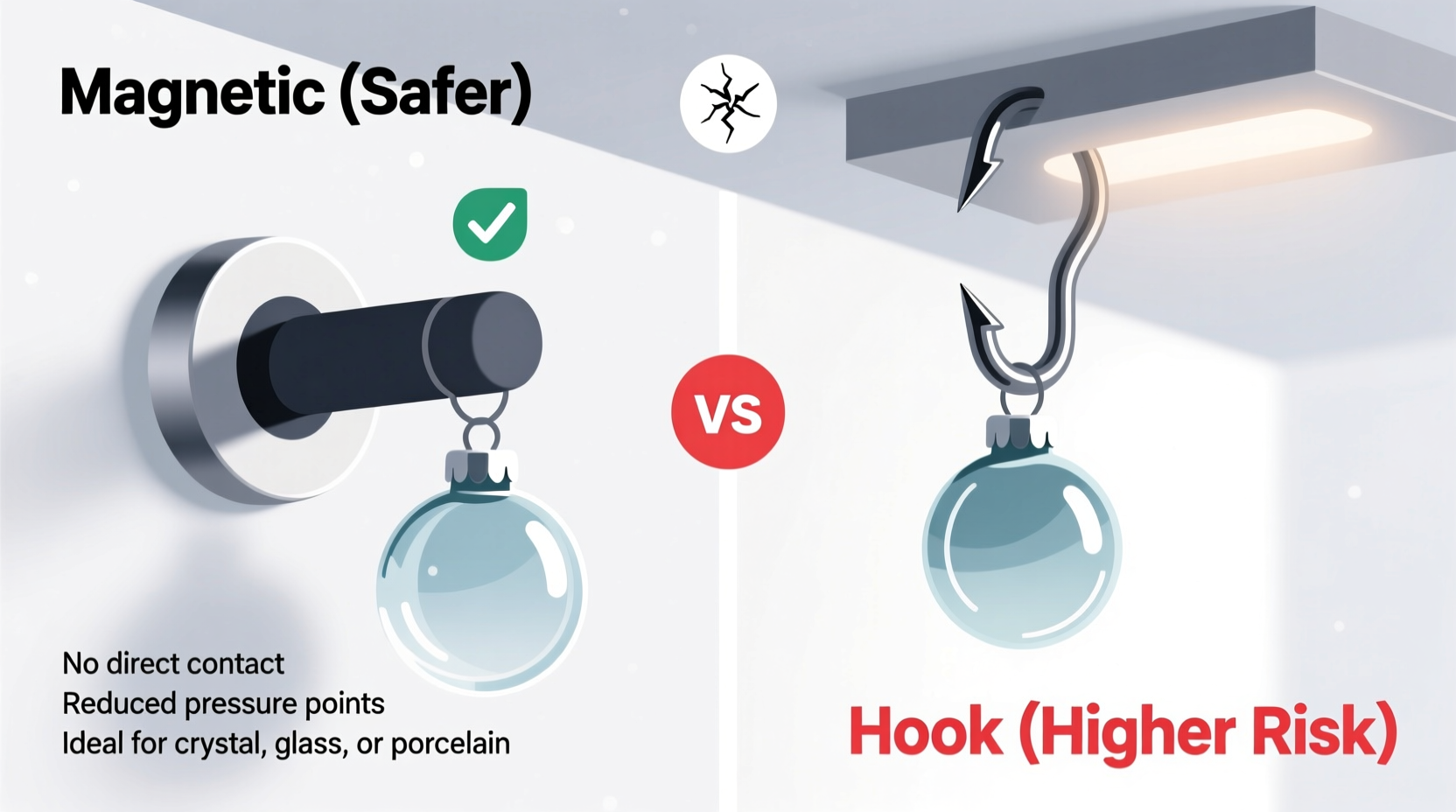
Traditional ornament hooks, typically made of thin metal wire, are designed to slip over a tree branch and then support the weight of an ornament via its loop or cap. Most modern ornaments come with a small plastic or metal cap that includes a built-in hanging loop. The hook attaches directly to this loop, suspending the ornament from the branch above.
While simple and inexpensive, this method carries several inherent risks:
- Pinching pressure: Metal hooks can pinch or deform soft plastic caps, especially if forced or left in place over time.
- Loop stress: Repeated use of hooks can stretch or weaken the hanging loop, particularly on older ornaments where the glue or material has degraded.
- Branch friction: As trees settle or are moved, branches shift, causing hooks to rub against bark or needles, increasing the risk of dislodging ornaments.
- Human error: During decoration, it's easy to apply too much force when attaching a hook, especially with small, fiddly hands or poor lighting.
For heavier or top-heavy ornaments, the leverage created by a standard hook can increase instability. If the center of gravity shifts, even slightly, the ornament may tilt and eventually fall.
The Rise of Magnetic Hangers: Innovation or Gimmick?
Magnetic hangers operate on a different principle. Instead of relying on a physical loop, they use two opposing magnets—one placed inside the ornament (or behind the surface), and one outside—to create a secure hold. For tree use, some designs clamp onto the branch magnetically while supporting the ornament’s weight through magnetic adhesion.
More commonly, magnetic systems are used for wall-mounted or shelf-displayed ornaments. However, newer models are now marketed specifically for Christmas trees, claiming to eliminate direct contact with fragile loops and reduce strain on delicate materials.
The appeal lies in contactless suspension. Since there’s no need to thread a hook through a loop, the risk of damaging that attachment point is eliminated. This makes magnetic options especially attractive for vintage or handmade ornaments with weak or glued-on loops.
Yet, magnets aren’t foolproof. Their effectiveness depends on several factors:
- Magnet strength: Weak magnets may fail under vibration or temperature changes.
- Surface compatibility: Magnets only work well on ferromagnetic materials. Most glass, plastic, or ceramic ornaments require an added metal disc or washer.
- Weight limits: Even strong neodymium magnets have thresholds. Exceeding them leads to sudden detachment.
- Alignment issues: If the magnets aren't perfectly aligned, the bond weakens significantly.
“Magnets can be excellent for display, but they must be properly rated for both weight and environmental conditions. Cold air from HVAC systems, for instance, can cause subtle shifts that break weak magnetic bonds.” — Dr. Alan Reyes, Materials Engineer and Holiday Decor Safety Consultant
Direct Comparison: Magnetic vs Hook Hangers
| Feature | Hook Hangers | Magnetic Hangers |
|---|---|---|
| Installation Ease | Simple, familiar process | Requires alignment; may need adhesive discs |
| Risk to Ornament Loop | High – can stretch or damage | Low – no direct contact |
| Weight Capacity | High – limited only by hook gauge | Variable – depends on magnet grade |
| Fragility Protection | Moderate – still relies on structural integrity | High – reduces stress points |
| Cost | Very low (often included) | Higher initial investment |
| Suitability for Heirlooms | Questionable due to wear | Better, if properly implemented |
| Tree Type Compatibility | All types | Limited to areas with accessible metal or added components |
From this comparison, it’s clear that magnetic hangers offer distinct advantages in protecting fragile attachment points. However, their limitations in universal application mean they’re not a one-size-fits-all replacement.
Real-World Example: Preserving a 1950s Glass Angel
Martha K., a collector from Vermont, inherited a set of hand-blown Czech glass ornaments from her grandmother. One piece—a delicate silver angel with a paper-thin loop—had survived 70 Christmases but began showing signs of stress after repeated hook use. Each year, the plastic cap would crack slightly more, and the loop would wobble.
Determined to preserve it, Martha experimented with miniature magnetic clamps. She attached a tiny adhesive-backed steel disc to the inside of the cap (using archival-safe glue) and paired it with a micro-magnet suspended from the branch. The setup held securely throughout the season, with no visible stress on the ornament.
She noted, however, that placement was critical. On flexible pine branches, wind-like movement from heating vents caused slight sway, testing the magnet’s hold. On sturdier spruce limbs, the system remained stable. Her solution? Use magnets only on inner, stable branches and reserve traditional hooks for outer, easily accessible spots with robust ornaments.
Step-by-Step Guide to Safely Using Magnetic Hangers
If you're considering switching to magnetic solutions for fragile ornaments, follow this tested sequence:
- Assess the ornament’s weight: Use a kitchen scale to determine exact grams. Most mini-magnets support 50–100g; stronger sets go up to 500g.
- Check material composition: Ensure either the ornament or its cap contains ferrous metal, or plan to add a steel disc.
- Select appropriate magnets: Choose rare-earth (neodymium) magnets with sufficient pull force. Look for products labeled for “vertical hold” or “gap resistance.”
- Prepare the mounting point: Clean the interior of the cap with isopropyl alcohol. Apply a rice-grain-sized drop of epoxy or museum putty to attach a steel washer. Let cure 24 hours.
- Attach the external magnet: Clip or tie the magnet to the branch so it aligns precisely with the internal disc.
- Test stability: Gently nudge the ornament to check for slippage. Avoid high-traffic areas or draft zones.
- Monitor periodically: Check every few days for loosening, especially in homes with pets or children.
This method works best for ornaments displayed near eye level or on stable sections of artificial trees with fixed branch positions.
When Hooks Are Still the Better Choice
Despite the innovation of magnetic systems, traditional hooks remain the most reliable option in several scenarios:
- Heavy ornaments (>300g): Few consumer-grade magnets can safely support dense glass or ceramic pieces long-term.
- Outdoor trees: Temperature swings and moisture degrade adhesive bonds and weaken magnetic fields.
- Unpredictable environments: Homes with active pets or young children benefit from the mechanical security of a hooked loop.
- Ornaments with no internal access: Sealed or fully painted caps make adding internal components impossible.
In these cases, upgrading to padded or silicone-coated hooks can mitigate damage. These feature soft tips that grip without scratching and distribute pressure more evenly across the loop.
Expert Checklist for Protecting Fragile Ornaments
- ✔️ Inspect each ornament’s hanging loop for cracks or weakness before use
- ✔️ Use padded or coated hooks for vintage or delicate pieces
- ✔️ Limit magnetic use to lightweight, indoor-display ornaments under 150g
- ✔️ Reinforce weak caps with clear nail polish or archival glue
- ✔️ Store ornaments flat with individual compartments to prevent loop deformation
- ✔️ Label magnetic-ready ornaments to avoid confusion next season
Frequently Asked Questions
Can I use magnets on all types of Christmas trees?
No. Magnetic hangers require either a metal branch core or an external anchor point. Most natural trees lack ferrous material, making magnets ineffective unless supplemented with metal clips. Artificial trees with metal frames work better, especially pre-lit models with internal wiring supports.
Do magnetic hangers damage ornament surfaces?
Generally, no—if used correctly. However, strong magnets can scratch glossy finishes if dragged across the surface. Always position them carefully. Also, avoid using magnets on ornaments containing magnetic media (e.g., old photo ornaments with magnetic backing), as fields may degrade image quality.
Are there hybrid solutions available?
Yes. Some manufacturers now offer “mag-hook” hybrids: a standard hook with an embedded magnet to stabilize the ornament and reduce swing. These combine mechanical security with magnetic dampening, offering a balanced approach for medium-risk displays.
Final Verdict: Which Is Safer?
After evaluating materials, mechanics, and real-world performance, the answer depends on context—but overall, magnetic hangers are safer for fragile ornaments—provided they are properly implemented.
They eliminate direct stress on loops, reduce handling risks during installation, and offer a clean, modern alternative to aging hooks. However, they are not universally applicable. For heavy, outdoor, or unpredictable settings, traditional hooks—especially upgraded padded versions—remain more dependable.
The safest strategy is a tiered approach: use magnets selectively for lightweight, irreplaceable items displayed in stable environments, and reserve hooks for everything else. By matching the hanger type to the ornament’s vulnerability and location, you maximize protection without compromising tradition.
“The goal isn’t to eliminate hooks or adopt every new gadget—it’s to understand the forces acting on your ornaments and choose the method that minimizes risk.” — Lena Peterson, Museum Conservator and Holiday Heritage Advisor
Take Action This Season
This holiday season, treat your ornaments not just as decorations, but as family artifacts worth preserving. Take an hour to inspect your collection, sort by fragility, and assign the right hanger to each piece. Whether you choose magnetic precision or trusted hooks, your care today ensures these treasures sparkle for generations to come.




 浙公网安备
33010002000092号
浙公网安备
33010002000092号 浙B2-20120091-4
Comments
No comments yet. Why don't you start the discussion?