
Warmth in interior design isn’t just about temperature—it’s a sensory impression shaped by light, texture, scale, and human association. A space can feel inviting or sterile, cozy or clinical, even at the same thermostat setting. Two increasingly popular architectural lighting interventions—mantle lights (focused linear illumination mounted above fireplaces or built-in shelving) and stair railing wraps (continuous LED strips concealed within or beneath handrail profiles)—both promise ambient enhancement. Yet they operate through fundamentally different mechanisms. One works through directed luminance and vertical emphasis; the other through subtle horizontal rhythm and tactile continuity. Understanding *how* each contributes to perceived warmth—not just brightness—is essential for intentional, emotionally resonant spaces.
How Warmth Is Perceived—Beyond Color Temperature
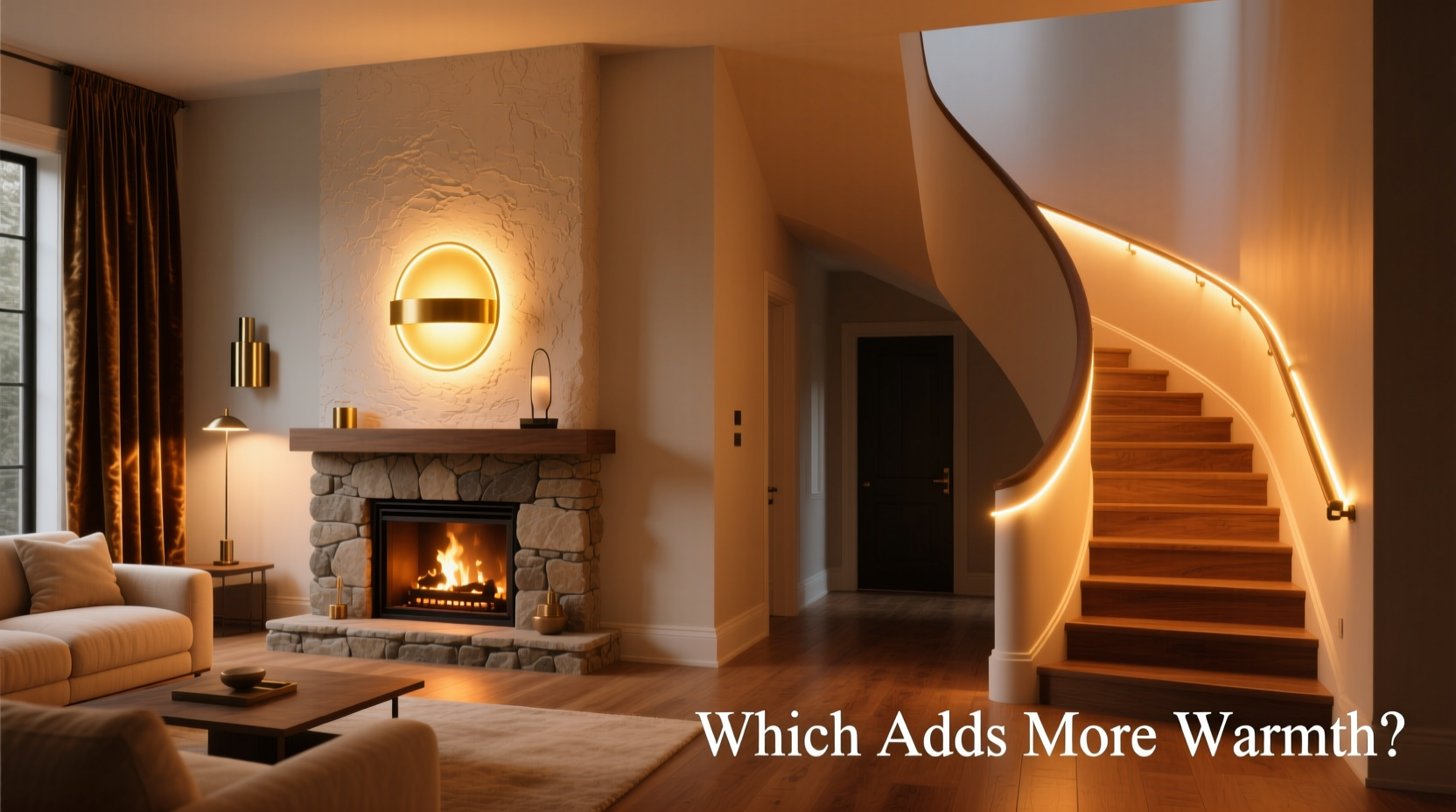
Many assume “warmth” is determined solely by correlated color temperature (CCT), measured in Kelvin. While 2700K–3000K light sources do evoke candlelight or sunset tones, real-world warmth emerges from three interlocking layers: chromatic warmth (hue and saturation), spatial warmth (how light shapes volume and intimacy), and tactile warmth (material response to light and proximity to human touch). A 2700K light strip behind cold, reflective glass feels distant and clinical; the same CCT cast softly onto aged oak mantel beams feels enveloping. Similarly, a warm-toned railing wrap loses its effect if installed on a thin, floating stainless-steel rail with no visual weight or hand contact. Warmth is relational—not inherent.
“Light doesn’t create warmth on its own—it reveals the warmth already present in materials, proportions, and human-scale details. The best lighting solutions don’t add heat; they amplify resonance.” — Lena Torres, Architectural Lighting Designer & Principal at Hearth Studio
Mantle Lights: Vertical Anchors That Frame Intimacy
Mantle lights are typically low-voltage, dimmable LED strips or integrated fixtures mounted along the top or underside of a fireplace mantel, bookshelf ledge, or built-in cabinetry. Their primary contribution to warmth lies in vertical layering and focal grounding.
When positioned to wash downward onto stone, brick, or wood surfaces—or upward to graze textured wall finishes—they generate soft shadows that emphasize material grain and depth. This chiaroscuro effect slows visual movement, encouraging pause and presence. Crucially, mantle lights anchor the eye at seated height—the natural vantage point for conversation, reading, or resting. That consistent, gentle glow becomes a psychological hearth: a non-thermal center of calm.
Their warmth multiplies when paired with compatible materials. A 2700K ribbon illuminating reclaimed white oak mantel planks delivers rich amber reflections and visible wood pores. The same fixture over glossy black tile creates sharp, cool highlights—technically warm in CCT but emotionally neutral. Mantle lights also benefit from layered control: pairing them with recessed ceiling lights (for general orientation) and table lamps (for task intimacy) creates a three-tiered warmth hierarchy that mimics natural daylight progression.
Stair Railing Wraps: Horizontal Cadence That Guides and Grounds
Stair railing wraps embed flexible, low-profile LED strips within custom-milled channels beneath wooden handrails, inside metal cap rails, or along the underside of glass balustrades. Unlike mantle lights, their warmth is kinetic and sequential—revealed only as one moves through space.
As a person ascends or descends, the illuminated rail creates a gentle, continuous path of light. This motion-responsive glow fosters subconscious safety and orientation—particularly valuable in transitional zones between floors. But warmth emerges not from intensity, but from proximity and repetition: the rail is within arm’s reach, often touched multiple times per day. When lit with warm-white LEDs (2700K–2900K) diffused through frosted acrylic or matte-finish walnut veneer, the light feels like an extension of the handrail itself—not an added element, but an inherent quality.
Where mantle lights deepen stillness, railing wraps deepen connection to architecture. They transform circulation into ritual: the soft pulse of light along a curve, the quiet glow where wood meets air, the way light catches the grain just before a landing. In open-plan homes, this horizontal band of light visually ties upper and lower levels—preventing the “floating floor” effect that can make multi-level spaces feel disjointed and cold.
Direct Comparison: Where Warmth Resides
To assess which intervention adds *more* warmth, we must evaluate context—not just specs. The following table compares key warmth-contributing factors across five dimensions:
| Factor | Mantle Lights | Stair Railing Wraps |
|---|---|---|
| Human Scale Engagement | Strong at seated/resting level; supports contemplation and social gathering | Strong at standing/walking level; supports movement, safety, and physical connection |
| Material Amplification | Excellent for vertical surfaces (stone, wood, plaster); reveals texture via grazing light | Excellent for handrail materials (wood, metal, composite); warmth increases with tactile richness and grain visibility |
| Spatial Definition | Creates intimate “zones” within larger rooms; shrinks perceived volume | Defines circulation paths and connects vertical volumes; prevents spatial fragmentation |
| Emotional Resonance | Associated with hearth, home, and repose; triggers limbic comfort responses | Associated with guidance, transition, and continuity; reduces subconscious anxiety in multi-level homes |
| Long-Term Warmth Consistency | High—if maintained and paired with warm-material mantels; degrades if surface becomes dusty or reflective | Moderate to high—if installed with diffusion and material integration; diminishes if rail finish wears or LEDs yellow over time |
Real-World Impact: A Case Study in Portland
In a 1920s Craftsman bungalow renovation in Portland’s Irvington neighborhood, designer Maya Chen faced a common challenge: the living room felt cavernous and disconnected from the dining area, while the open staircase created a visual void between floors. She installed both interventions—but with deliberate intentionality.
First, she added 2700K mantle lights beneath a newly restored Douglas fir mantel, angled to graze the original brick surround. The result was immediate: the fireplace became a luminous anchor, pulling the eye downward and creating a contained, grounded zone. Guests instinctively gathered there, drawn by the soft, textural glow.
Simultaneously, she embedded warm-diffused LEDs within a custom-walnut handrail that wrapped around a curved staircase. Crucially, she avoided uniform brightness—programming a subtle 10% dimming at the top and bottom landings to mimic natural light falloff. Residents reported two unexpected outcomes: children began using the stairs more confidently at night, and adults described the ascent as “feeling like being guided home.” The railing didn’t just illuminate—it reassured.
When asked which contributed more warmth, the homeowners consistently cited the railing—*not* because it was brighter, but because it was *always present*, always accessible, and always tied to movement and daily ritual. The mantle light warmed moments; the railing warmed the entire domestic rhythm.
Which Adds More Warmth? Contextual Decision Framework
Neither solution is universally superior. Warmth is additive, not absolute—and its value depends entirely on your space’s existing conditions and usage patterns. Use this step-by-step framework to decide:
- Assess your primary “cold spots”: Is the chill emotional (e.g., a large, empty living room) or functional (e.g., dark, steep stairs you navigate nightly)?
- Evaluate dominant human postures: Do people spend most time seated (favoring mantle lights) or moving vertically (favoring railing wraps)?
- Inspect existing materials: Does your mantel feature warm, absorbent textures (wood, stone, plaster)? Does your railing have tactile, organic finishes—or sleek, reflective ones?
- Map light layers: Do you already have ambient (ceiling), task (lamps), and accent (art lights) layers? Mantle lights fill the “focal accent” gap; railing wraps introduce “circulation accent”—a unique category.
- Consider maintenance access: Mantle lights are easily reachable for cleaning and bulb replacement. Railing wraps require professional access if embedded deep within millwork—factor in long-term serviceability.
Practical Tips for Maximizing Warmth—Regardless of Choice
Whether you choose mantle lights, railing wraps, or both, these principles elevate perceived warmth beyond basic installation:
- Diffuse, don’t expose: Always conceal LEDs behind frosted acrylic, fabric diffusers, or recessed channels. Bare diodes read as technical, not warm—even at 2700K.
- Match CCT to adjacent sources: If your overheads are 3000K and table lamps 2700K, mantle lights should be 2700K–2800K. Avoid mixing 2200K “candlelight” with 3000K elsewhere—it fractures cohesion.
- Use dimmers with memory settings: Program “evening warmth” presets (e.g., 20% brightness, 2700K) that activate with a single tap—reinforcing habit and mood.
- Layer with reflectivity: Position lights so they bounce off warm-toned walls (terracotta, ochre, deep sage) rather than cool whites or grays. Reflected light carries the hue of the surface it hits.
- Respect shadow hierarchy: Warmth needs contrast. Allow some areas to recede into soft shadow—especially behind furniture or along baseboards. Uniform illumination flattens dimension and kills warmth.
FAQ
Can I install both mantle lights and stair railing wraps in the same home?
Absolutely—and often advantageously. They serve complementary roles: mantle lights warm static zones (living rooms, bedrooms), while railing wraps warm dynamic zones (stairs, hallways, entries). To avoid visual competition, unify them with identical CCT (2700K), dimming protocols, and similar diffusion methods (e.g., frosted acrylic for both). The goal is harmony, not duplication.
Do warmer color temperatures (e.g., 2200K) always feel cozier than 2700K?
Not necessarily. 2200K mimics candlelight—ideal for ultra-intimate, low-ceilinged spaces like powder rooms or reading nooks. In larger rooms or kitchens, it can appear muddy or insufficiently bright. 2700K strikes the broadest balance: warm enough to feel inviting, bright enough to support function. Reserve 2200K for spaces used exclusively for rest or ritual.
Will a railing wrap feel warm if my staircase is glass and steel?
Only if intentionally designed for warmth. Glass and steel reflect cool tones and scatter light. To counteract this, embed LEDs within a warm-wood cap rail atop the steel, or use amber-tinted diffusers. Alternatively, pair the wrap with warm-toned wall sconces at landings—using the railing as a connective thread between warm anchors.
Conclusion
Warmth isn’t added—it’s awakened. Mantle lights awaken it in stillness, drawing attention to the textures and traditions that gather us. Stair railing wraps awaken it in motion, turning everyday transitions into moments of quiet assurance. Neither is inherently “warmer”; each reveals warmth where it already lives—in the grain of wood, the curve of a handrail, the quiet pool of light beside a chair. The most deeply warming spaces don’t rely on a single source, but on a thoughtful orchestration: light that responds to how we sit, how we walk, how we pause, and how we return. Start where your body spends its most frequent moments—then let the light follow, not lead.




 浙公网安备
33010002000092号
浙公网安备
33010002000092号 浙B2-20120091-4
Comments
No comments yet. Why don't you start the discussion?