
There’s a quiet revolution brewing in kitchens around the world. As specialty coffee culture grows, more home brewers are stepping beyond pod machines and drip filters, drawn to the allure of crafting true espresso. But when it comes to choosing equipment, a fundamental question arises: Should you go manual or automatic?
The choice isn’t just about convenience—it’s about philosophy. On one side, automatic and super-automatic machines offer consistency and speed with minimal effort. On the other, manual lever or piston-driven espresso machines demand skill, patience, and attention. They transform brewing into a ritual, not just a routine. But is that ritual worth the time, effort, and inevitable early mistakes?
This isn’t a debate with a single right answer. It’s about understanding what you value in your morning cup—and in the process of making it.
The Heart of the Matter: Control vs. Convenience
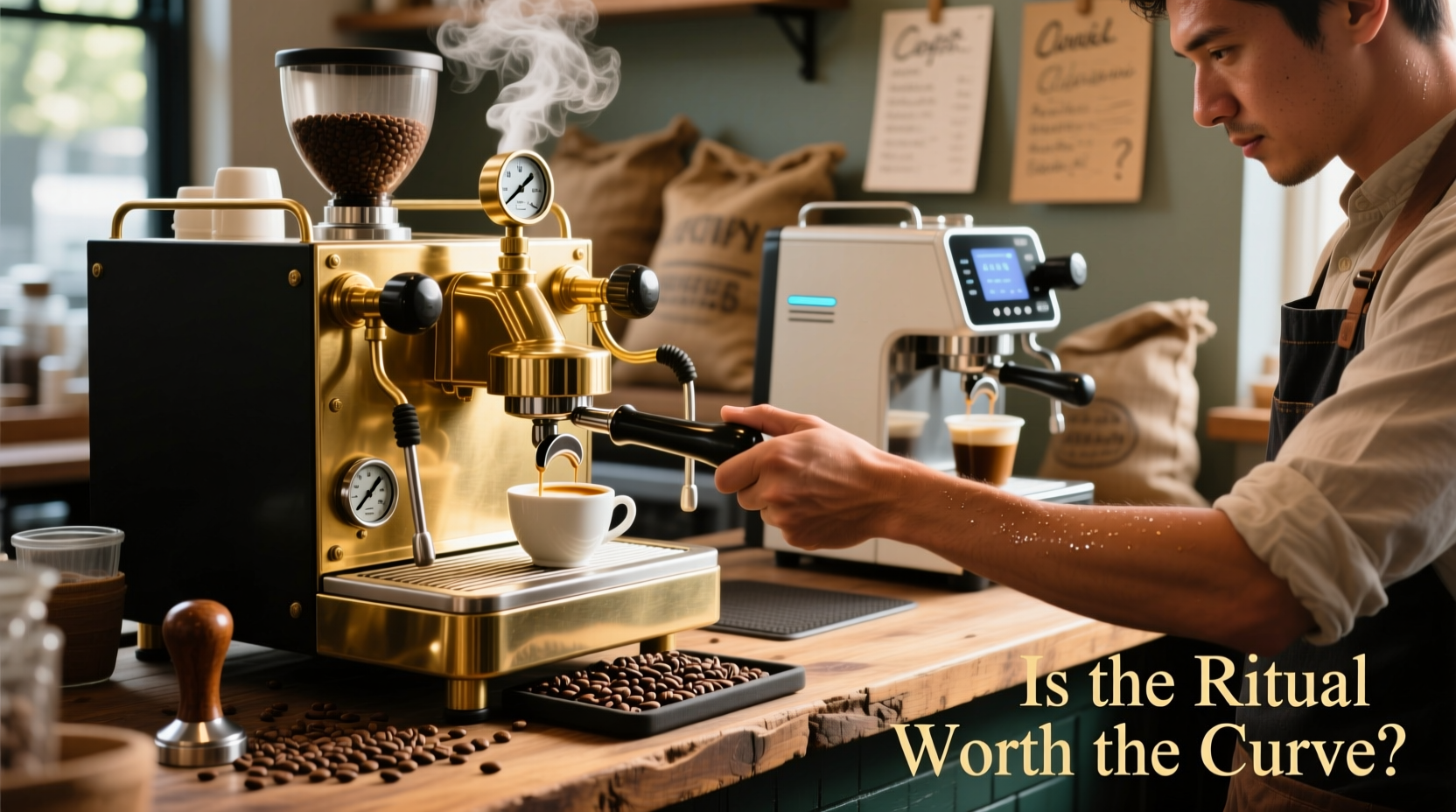
At its core, the difference between manual and automatic espresso machines lies in control. Automatic machines—whether semi-automatic, fully automatic, or super-automatic—handle most variables for you. You press a button or pull a lever, and the machine manages water temperature, pressure, grind size (in super-autos), and brew time.
Manual machines, by contrast, require the user to control every variable. From tamping pressure to pull timing, from grind adjustment to pre-infusion technique, the barista is deeply involved. This level of involvement isn’t just mechanical—it’s sensory. You learn to listen for the right sound in the crema, watch the flow of the shot, and adjust on the fly.
“Espresso made on a manual machine is never just a drink. It’s a performance where every variable is an instrument.” — Diego Campos, World Brewers Cup Judge
For some, this level of engagement is exhilarating. For others, it’s exhausting. The key is knowing which camp you fall into—or which one you want to grow into.
Breaking Down the Machines: What Each Type Offers
To make an informed decision, let’s examine the three main categories of home espresso machines.
Semi-Automatic Machines
These machines automate water delivery but leave grind, dose, tamp, and timing to the user. Most home enthusiasts start here. They offer a balance: built-in pumps and heating systems provide consistent pressure and temperature, while still requiring hands-on input.
Fully & Super-Automatic Machines
These take over nearly everything. Beans go in one end, and a finished espresso comes out the other. Grinders, dosing, tamping (via mechanical wipers), brewing, and even milk steaming are automated. Ideal for those who prioritize speed and consistency over craft.
Manual Lever Machines
True manual machines—like the classic La Pavoni or modern designs such as the Flair or Elektra Micro Casa—are hand-powered. You heat water externally or via a boiler, load the portafilter, and use a lever or piston to force hot water through the puck. There’s no pump, no electronics, just physics and practice.
Comparing Performance: Flavor, Consistency, and Learning Curve
Let’s compare these machines across critical factors that matter to serious coffee lovers.
| Feature | Manual Machine | Semi-Automatic | Super-Automatic |
|---|---|---|---|
| Flavor Potential | ★★★★★ (High – full control over extraction) | ★★★★☆ (Very Good – depends on user skill) | ★★★☆☆ (Good – limited by automation) |
| Consistency | ★★☆☆☆ (Low – highly user-dependent) | ★★★★☆ (High – with proper calibration) | ★★★★★ (Very High – machine-controlled) |
| Learning Curve | ★★★★★ (Steep – requires months of practice) | ★★★☆☆ (Moderate – weeks to master basics) | ★☆☆☆☆ (Minimal – ready in minutes) |
| Brew Time per Shot | 8–12 minutes (including prep) | 3–5 minutes | 1–2 minutes |
| Maintenance | Low (fewer parts, but descaling needed) | Moderate (group head cleaning, grinder upkeep) | High (automatic cleaning cycles, frequent servicing) |
| Cost (Entry-Level) | $150–$400 | $500–$1,200 | $800–$2,500+ |
The data shows a clear trade-off: the more control you have, the more responsibility you bear. Manual machines offer the highest ceiling for flavor nuance but require dedication to reach it. Super-automatics deliver reliable shots with near-zero effort—but often at the cost of complexity and depth in the cup.
A Day in the Life: Real-World Brewing Scenarios
Consider two coffee drinkers with different lifestyles.
Case Study: Maya, the Home Barista Enthusiast
Maya works from home and starts her day slowly. She enjoys the 15-minute morning ritual: grinding beans, warming her Flair Pro, tamping with her calibrated press, and pulling a slow, even 60-second shot using a pre-infusion technique. She savors the tactile feedback—the resistance of the lever, the rich aroma blooming mid-pull. Her reward? A layered espresso with notes of dark chocolate and bergamot that changes subtly with each bean she tries. For Maya, the process is part of the pleasure. Missing a shot motivates her to tweak her grind or dose—not frustrate her.
Case Study: James, the Busy Professional
James has five minutes before his first meeting. He drops beans into his Jura E8, presses “Espresso,” and walks away. Two minutes later, he’s sipping a clean, balanced shot with perfect crema. No guesswork, no cleanup beyond emptying the drip tray. On weekends, he might experiment with settings, but during the week, consistency and speed win. He doesn’t miss the ritual—he never knew he wanted it.
Both are valid. Neither is wrong. The question isn’t which machine is better, but which lifestyle it serves.
Mastering the Manual: A Step-by-Step Guide to Your First Real Espresso
If you’re intrigued by manual machines, here’s how to get started—with realistic expectations.
- Choose the Right Machine: Start with an affordable, user-friendly model like the Flair Neo or ROK二代. Avoid vintage levers until you understand the fundamentals.
- Invest in a Quality Grinder: Even the best machine fails with poor grind consistency. A burr grinder like the Baratza Encore or Timemore C2 is essential.
- Dial In Your Dose: Use a scale. Start with 16–18g of coffee for a double shot. Adjust based on basket size.
- Grind Fine, But Not Too Fine: Aim for table salt texture. Too fine = bitter, slow shot. Too coarse = sour, fast shot.
- Tamp with Even Pressure: Apply 30–40 pounds of force evenly. A calibrated tamper helps avoid channeling.
- Pre-Infuse (Optional): Let water saturate the puck for 15–20 seconds before full pressure. Enhances clarity.
- Pull the Shot: For lever machines, apply steady, controlled pressure. Target 25–30 seconds for a 1:2 ratio (e.g., 18g in, 36g out).
- Taste and Adjust: Sour? Grind finer. Bitter? Coarsen grind or reduce dose. Thin? Try longer pre-infusion.
Expect your first ten shots to be flawed. That’s normal. The learning curve is real, but so is the progress.
When Automation Wins (And When It Falls Short)
Automatic machines excel in high-throughput environments or for users who value predictability. A busy household, a small office, or someone with limited mobility may find super-automatics liberating. They handle cleaning cycles, milk texturing, and even bean storage—all with a few taps.
But they have limits. Built-in grinders often lack precision. Pre-set profiles can’t adapt to seasonal bean changes. And because the machine controls everything, there’s little room to explore under- or over-extraction for creative flavor profiles.
Worse, when something goes wrong—a clogged line, a worn burr—you’re dependent on service technicians or proprietary tools. Manual machines, by contrast, are often repairable with basic tools and YouTube tutorials.
“I’ve had my Flair for six years. Replaced a gasket once. Cost $5. My old super-auto died in three years—repair quote was $300.” — Linda Tran, Home Brewer & Coffee Educator
Is the Ritual Worth It? A Balanced Verdict
So, is the barista ritual worth the learning curve?
If your goal is simply caffeine, convenience, or consistency, then no—manual machines are overkill. A good semi-automatic or even a well-maintained super-automatic will serve you better.
But if you’re drawn to coffee as a craft—if you enjoy the process as much as the product—then yes, the ritual is absolutely worth it. Pulling a perfect shot after weeks of adjustment feels like a personal achievement. You develop a relationship with your beans, your grinder, your machine. You begin to taste not just coffee, but variables: roast profile, water mineral content, ambient humidity.
And the flavor? Manual machines often produce more nuanced, dynamic espressos. Because you control every phase, you can emphasize sweetness, acidity, or body depending on your preference. Automation standardizes; manual brewing personalizes.
Frequently Asked Questions
Can I make milk-based drinks with a manual machine?
Absolutely. While manual machines don’t steam milk automatically, you can pair them with a standalone electric milk frother, stovetop steamer, or handheld wand. Many manual brewers enjoy the extra control over milk texture.
How long does it take to learn manual espresso?
Most beginners see improvement within 2–4 weeks of regular practice. True mastery—consistently pulling balanced, flavorful shots—can take 3–6 months. Patience and note-taking accelerate the process.
Are manual machines less consistent than automatic ones?
Yes, initially. Human variability affects tamp, grind, and timing. However, with practice and tools (scale, timer, calibrated tamper), skilled users can achieve remarkable consistency—often exceeding poorly maintained automatic machines.
Your Next Step: Choose Based on Values, Not Hype
The choice between manual and automatic espresso machines isn’t about technology—it’s about intention. Are you looking for a tool, or an experience?
If you want coffee quickly and reliably, go automatic. Embrace the efficiency. Enjoy your time saved.
If you crave connection—to the bean, the process, the moment—embrace the manual path. Accept the early frustrations. Celebrate the small wins. You’re not just making espresso; you’re joining a lineage of tinkerers, perfectionists, and sensory explorers.
Either way, the best machine is the one you’ll use consistently and enjoy. But if you’ve ever wondered whether the barista ritual is worth it, the answer might lie not in specs or speed, but in the quiet satisfaction of a perfectly pulled shot—earned, not programmed.




 浙公网安备
33010002000092号
浙公网安备
33010002000092号 浙B2-20120091-4
Comments
No comments yet. Why don't you start the discussion?