
Brewing espresso at home has evolved from a luxury into a daily ritual for many coffee lovers. With advancements in home brewing technology, achieving cafe-quality espresso is no longer limited to professional baristas. But when it comes to choosing the right tool, two main contenders dominate the conversation: manual espresso makers and automatic machines. Each offers a unique path to that rich, velvety shot—but they differ significantly in experience, consistency, and outcome. Understanding these differences helps you decide not just what to buy, but how you want to engage with your morning ritual.
The Essence of Cafe-Quality Espresso
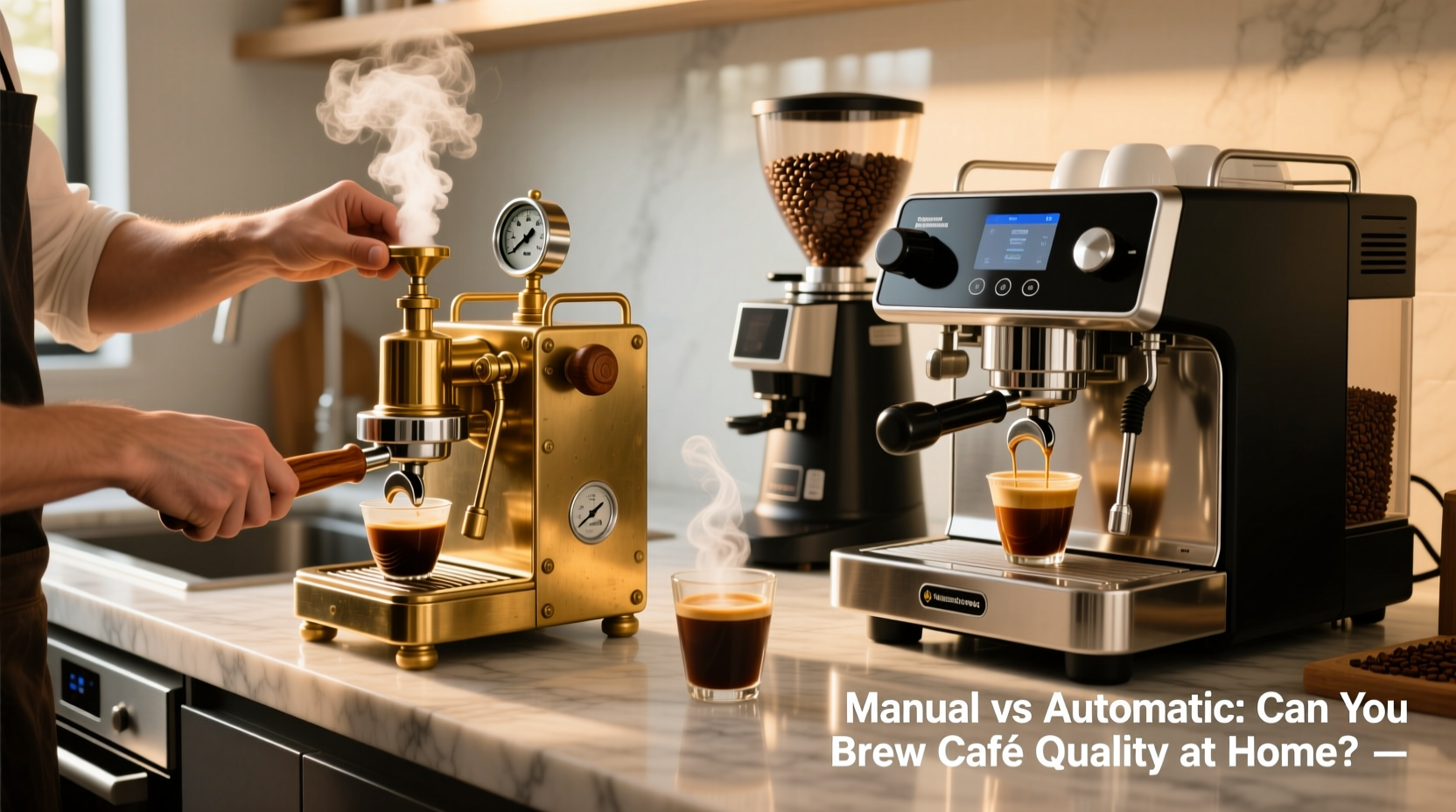
Cafe-quality espresso isn’t defined by branding or ambiance—it’s about precision. A proper shot requires water heated to 90–96°C (194–205°F), pressure around 9 bars, freshly ground beans dosed between 18–20 grams, and an extraction time of 25–30 seconds. The result should be a balanced shot with a thick, golden crema, layered sweetness, bright acidity, and a clean finish.
While both manual and automatic machines can hit these benchmarks, they do so through vastly different processes. One demands skill, timing, and attention; the other relies on engineering, sensors, and automation. Your choice depends not only on technical performance but also on your relationship with the craft of coffee.
Manual Espresso Makers: Mastery Through Effort
Manual espresso makers—often lever-style or hand-operated piston devices like the Flair, Elektra Microcasa, or La Pavoni—require the user to control every variable: grind size, tamping pressure, water temperature, and pull timing. There’s no motorized pump; instead, you generate the necessary 9 bars of pressure using a lever or spring mechanism.
This hands-on approach turns brewing into a tactile experience. You feel the resistance during the pull, hear the subtle changes in flow, and adjust mid-extraction if needed. For enthusiasts, this level of involvement is part of the appeal. It’s akin to playing a musical instrument—each shot is a performance.
However, mastery takes time. Achieving consistent results demands practice, precise grinding, and meticulous cleaning. Even slight variations in grind size or tamping can alter flavor dramatically. This learning curve can be frustrating for beginners but deeply rewarding for those who enjoy process-driven hobbies.
“With a manual machine, you’re not just making coffee—you’re participating in its creation. That connection changes how you taste it.” — Marco Silva, Specialty Coffee Educator
Automatic Machines: Precision Without the Pressure
Automatic espresso machines—including semi-automatic, super-automatic, and pod-based systems—handle most variables behind the scenes. Semi-automatic models still require you to grind, dose, and tamp, but use built-in pumps to deliver consistent pressure. Super-automatics go further, grinding beans, tamping, extracting, and even steaming milk at the push of a button.
These machines prioritize convenience and repeatability. Built-in thermoblocks or boilers maintain stable temperatures. Pressure profiling ensures optimal extraction. Digital displays allow fine-tuning of dose, volume, and pre-infusion. For busy households or those less interested in technique, this reliability is invaluable.
High-end models like the Breville Dual Boiler, Rocket R58, or Lelit Anna blend automation with artisanal control, offering PID temperature stability and programmable settings. They bridge the gap between hands-on craftsmanship and modern efficiency.
Yet automation comes at a cost—both financial and experiential. These machines are typically more expensive, require regular descaling, and may lack the sensory feedback that makes manual brewing engaging. Some argue that removing human input dulls the emotional resonance of the ritual.
Comparative Analysis: Key Decision Factors
| Factor | Manual Espresso Maker | Automatic Machine |
|---|---|---|
| Initial Cost | $100–$600 | $500–$3,000+ |
| Learning Curve | Steep – weeks to months for consistency | Gentle – ready in minutes |
| Consistency | Highly dependent on user skill | Engineered for repeatable results |
| Maintenance | Simple – hand-clean parts | Complex – descaling, filter changes, software updates |
| Portability | Often compact and travel-friendly | Bulky, requires power and water source |
| Creative Control | Full control over all parameters | Limited to available settings |
| Cafe-Quality Potential | Yes, with expertise | Yes, out of the box |
The table reveals a fundamental trade-off: manual brewers offer depth and engagement at the expense of convenience, while automatics deliver speed and consistency with less personal involvement.
Real-World Scenario: Two Homes, Two Choices
In Portland, Oregon, Sarah, a graphic designer and coffee hobbyist, invested in a Flair Pro 2 after years of drip coffee. She spends 15 minutes each morning dialing in her grind, practicing her tamp, and pulling shots. “It’s meditative,” she says. “I know exactly how each variable affects the taste. Last week, I adjusted my pre-infusion time by five seconds and suddenly got more chocolate notes from my Guatemalan beans.” Her machine cost $300, but she considers it a gateway to understanding coffee chemistry.
Meanwhile, in Chicago, James, a pediatrician with two young children, chose a De’Longhi Dinamica+ super-automatic. “I don’t have time to fuss,” he explains. “I press one button, get a perfect double shot with microfoam, and I’m out the door.” His machine cost $1,200 and requires monthly maintenance, but it fits his lifestyle. He enjoys excellent espresso daily without needing to learn the nuances of puck preparation.
Both achieve cafe-quality results. Their choices reflect priorities: Sarah values growth and engagement; James values efficiency and reliability.
Step-by-Step Guide: Choosing Your Path
- Evaluate Your Time Commitment: Are you willing to spend 10–20 minutes per brew session practicing technique? If yes, a manual maker may suit you. If not, automation saves time.
- Assess Your Skill Level: Beginners often struggle with manual machines. Start with a semi-automatic if you're new but want room to grow.
- Define Your Budget: Manual options are cheaper upfront. But remember: a good grinder is essential for either system and can cost $200–$500.
- Consider Space and Setup: Manual brewers need counter space and access to hot water. Automatics require dedicated outlets, water supply (for plumbed models), and ventilation.
- Taste Test Both Methods: Visit cafes using lever machines and automated setups. Note differences in body, clarity, and crema. Bring those preferences home.
- Prioritize Long-Term Goals: Want to compete in home barista competitions? Go manual. Want seamless integration into a fast-paced life? Choose automatic.
Expert Insight: What Professionals Recommend
Baristas and roasters often favor manual methods for training because they build foundational skills. However, when asked about home use, opinions split based on lifestyle.
“For home users, I recommend starting with a semi-automatic machine paired with a quality burr grinder. It gives enough control to learn, but enough consistency to enjoy great coffee daily.” — Lena Tran, Head Roaster at Apex Coffee Co.
She adds: “If someone tells me they wake up at 5:30 AM for work and have kids to feed, I won’t suggest a manual brewer. Passion matters, but so does practicality.”
FAQ: Common Questions Answered
Can a manual espresso maker really match a commercial machine?
Yes—high-end manual levers like the Elektra Tevere or Bezzera Strega can produce shots indistinguishable from commercial equipment when used by a skilled operator. However, consistency across multiple pulls is harder to maintain than with digital PID-controlled machines.
Do automatic machines make inferior espresso?
No. Many super-automatics use professional-grade components. Machines like the Jura Z10 or Saeco PicoBaristo use ceramic grinders, dual boilers, and adjustable pressure profiling. The stigma around automatics stems from older, low-end models—not today’s premium tier.
Is a grinder really that important?
Absolutely. More than any other factor besides bean freshness, grind quality determines extraction. Even the best machine fails with an inconsistent grind. Invest in a flat or conical burr grinder—avoid blade grinders entirely.
Checklist: Before You Buy
- ☑ Determine your daily coffee routine and available prep time
- ☑ Set a realistic budget (include grinder, scale, tamper)
- ☑ Research noise levels—some automatics are loud
- ☑ Check water hardness in your area—hard water damages machines faster
- ☑ Decide whether milk steaming is a priority (manual requires separate kettle/steamer)
- ☑ Read user reviews focused on long-term durability and customer support
- ☑ Test machines in person if possible—feel the build, try the interface
Final Verdict: Which Brews True Cafe Quality at Home?
Both manual and automatic machines can produce cafe-quality espresso. The difference lies not in potential, but in process.
If you seek immersion—a deeper understanding of extraction, pressure, and timing—a manual espresso maker rewards patience with unparalleled insight and satisfaction. It transforms brewing into a craft, where small improvements yield noticeable flavor gains.
If your goal is reliable, high-quality espresso with minimal effort, a well-chosen automatic machine delivers excellence day after day. Modern engineering has closed the gap, offering nuanced control even in fully automated systems.
Ultimately, the best machine is the one you’ll use consistently. A $300 manual brewer used daily with care will outperform a $2,000 super-automatic gathering dust. Consider not just what each machine can do, but what kind of coffee experience you want to live.




 浙公网安备
33010002000092号
浙公网安备
33010002000092号 浙B2-20120091-4
Comments
No comments yet. Why don't you start the discussion?