
Decluttering is no longer just about cleaning—it’s a philosophy, a lifestyle, and for many, a path to emotional clarity. Two approaches have dominated the conversation in recent years: Marie Kondo’s joyful tidying and the pragmatic Swedish tradition of “dödsbo” or death cleaning. While both aim to reduce clutter, they differ significantly in motivation, methodology, and—crucially—speed. So, which one clears clutter faster? The answer isn’t as simple as it seems, but with a closer look at goals, structure, and execution, we can determine when each method excels.
The Core Philosophy: Joy vs Legacy
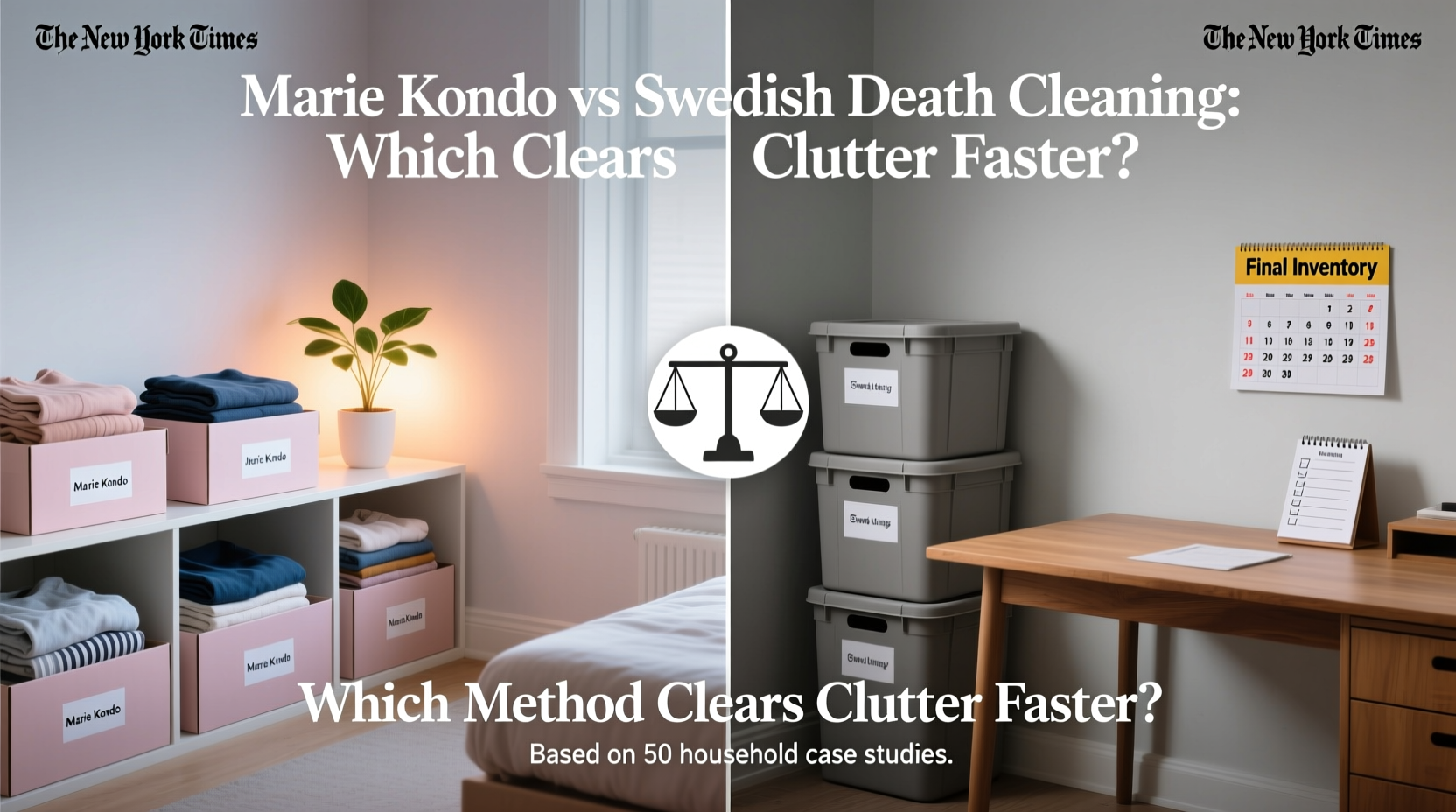
At its heart, Marie Kondo’s KonMari Method revolves around emotional resonance. Her famous question—“Does this spark joy?”—guides every decision. If an item brings happiness, it stays. If not, it’s thanked and released. This emotionally driven approach encourages deep personal reflection and often leads to transformative experiences. However, that introspection takes time. Sorting by category (clothes, books, papers, komono, sentimental) means multiple passes through your belongings, prolonging the process.
In contrast, Swedish death cleaning—popularized by Margareta Magnusson in her book *The Art of Dying Well*—is rooted in practicality and responsibility. The idea is to gradually remove unnecessary possessions during your lifetime so your family won’t be burdened after you’re gone. There’s little emphasis on emotion; instead, the focus is on utility, necessity, and legacy. You ask: “Will anyone want this?” or “Is this still useful?” Not “Do I love it?”
“We don’t need more things. We need fewer, better things—and the courage to let go before it’s too late.” — Margareta Magnusson, author of *The Gentle Art of Swedish Death Cleaning*
This fundamental difference shapes everything from pacing to outcomes. Kondo’s method is inward-looking and experiential; Swedish death cleaning is outward-facing and utilitarian. And because of this, Swedish death cleaning often clears clutter faster—but only if you’re ready to make quick decisions without emotional hesitation.
Speed Comparison: How Fast Can You Declutter?
To evaluate speed, we must define what “faster” means. Is it total time spent? Number of items removed per hour? Or long-term sustainability of the result?
Kondo’s method typically unfolds over weeks or even months. It requires setting aside dedicated blocks of time, ideally in one intensive session per category. Because sentimentality slows progress—especially in the “sentimental items” phase—the pace is inherently deliberate. People report spending days just on photographs or childhood mementos.
Swedish death cleaning, by design, is meant to be gradual. But when applied with urgency, it allows for rapid decision-making. Since the guiding principle is usefulness rather than emotion, there’s less internal debate. You see an unused kitchen gadget, remember no one uses it, and donate it immediately. No gratitude ritual, no folding technique—just removal.
Side-by-Side Breakdown: Key Differences That Affect Speed
| Factor | Marie Kondo Method | Swedish Death Cleaning |
|---|---|---|
| Pacing | Intensive, episodic (one category at a time) | Gradual, ongoing, or accelerated based on need |
| Decision Criteria | Emotional: \"Does this spark joy?\" | Practical: \"Will someone else need this?\" |
| Time Required | High (weeks to months) | Low to moderate (can be completed in days under pressure) |
| Sentimental Load | High—encourages deep emotional engagement | Low—actively discourages hoarding out of guilt |
| Best For | Emotional renewal, mindfulness, lifestyle change | Efficient downsizing, estate preparation, minimalism |
| Clutter Removal Speed | Slower due to reflection phases | Faster due to practical filters |
The table shows a clear trend: Swedish death cleaning wins on raw speed. But speed isn’t always the best measure of success. Kondo’s slower pace builds habits and awareness that help prevent future clutter. Death cleaning clears space quickly but may leave emotional gaps if done hastily.
Step-by-Step: Accelerated Clutter Clearance Using Hybrid Tactics
You don’t have to choose one method entirely. A hybrid approach leverages the strengths of both: the efficiency of death cleaning and the mindfulness of KonMari. Here’s how to clear clutter faster while maintaining intentionality:
- Start with Swedish death cleaning mindset: Walk through your home asking, “Would anyone miss this if it were gone?” Remove obvious non-essentials—expired products, duplicate tools, outdated electronics.
- Sort by room, not category: Unlike Kondo, who insists on sorting all clothes everywhere at once, work room by room. This reduces mental fatigue and speeds up decisions.
- Create three bins: Keep, Donate, Recycle. Do not add a “maybe” box. Indecision slows progress. If unsure, set a 48-hour timer. If unclaimed, donate.
- Apply Kondo’s joy check selectively: Only use “Does this spark joy?” for items in your “Keep” pile—especially clothing, photos, and gifts. This preserves meaning without slowing the entire process.
- Finish with a ceremonial release: Once boxes are packed, take a moment to acknowledge what you’ve let go of. This blends closure with efficiency.
Real Example: Clearing a Parent’s Home Before Relocation
Sarah, a 52-year-old project manager, had six weeks to downsize her mother’s house before moving her into assisted living. With over 40 years of accumulated belongings, the task felt overwhelming.
She began with the KonMari method but stalled in the photo albums after two days. Emotionally drained, she switched tactics. Using Swedish death cleaning principles, she asked: “Who will inherit this teapot? Does anyone bake with this mixer?” She sorted room by room, removing 60% of the contents in 10 days. Then, she revisited meaningful items—her mother’s wedding dress, handwritten recipes—and applied Kondo’s folding and storage techniques to preserve them intentionally.
The combination allowed her to clear clutter rapidly while honoring what mattered. In the end, she donated 18 bags, recycled five loads, and kept only two curated boxes of irreplaceable items.
“When you’re under time pressure, sentimentality has to be strategic. You can’t feel deeply about everything—or you’ll feel nothing at all.” — Sarah L., on managing a family downsizing
Action Checklist: Fast-Track Your Decluttering
Use this checklist whether you're preparing for a move, simplifying life, or helping an aging parent. Complete these steps to clear clutter efficiently:
- ☐ Define your goal: Is it speed, emotional healing, or estate readiness?
- ☐ Gather supplies: Boxes, labels, trash bags, markers
- ☐ Start with low-sentiment areas: Kitchen, garage, bathroom
- ☐ Use the “one-year rule”: If not used in the past year, consider donating
- ☐ Limit keepsakes to one box per person or era (e.g., “Childhood,” “Career”)
- ☐ Schedule donation drop-offs weekly to maintain momentum
- ☐ Photograph bulky sentimental items (e.g., trophies, artwork) before letting go
- ☐ Involve family early to clarify who wants what—avoid last-minute disputes
- ☐ Store important documents separately and digitize copies
- ☐ Celebrate milestones: After each room, take a break or treat yourself
FAQ: Common Questions About Speed and Effectiveness
Can I combine Marie Kondo and Swedish death cleaning?
Yes—and it’s often the most effective strategy. Use Swedish death cleaning to remove the bulk quickly, then apply Kondo’s principles to curate what remains. This balances speed with meaning.
Which method prevents clutter from coming back faster?
Marie Kondo’s method has a stronger long-term impact on habits. By teaching you to value only what sparks joy, it changes your relationship with consumption. Swedish death cleaning is excellent for one-time reduction but doesn’t inherently alter daily behavior.
Is Swedish death cleaning depressing?
Not necessarily. While the name sounds morbid, the practice is about dignity and responsibility. Many find it empowering to take control of their legacy. Framing it as “lightening the load” rather than “preparing for death” makes it more positive.
Conclusion: Choose the Right Tool for the Job
So, which method clears clutter faster? Objectively, Swedish death cleaning does. Its practical, no-nonsense criteria allow for swift decision-making, especially when time is limited or emotions are high. It’s ideal for downsizing, moving, or helping older relatives simplify their lives.
But faster isn’t always better. Marie Kondo’s method, though slower, fosters lasting change. It helps you understand why you accumulate, what you truly value, and how to live more intentionally. If your goal is transformation—not just tidiness—Kondo’s approach delivers deeper results.
The smartest path? Use Swedish death cleaning to accelerate the heavy lifting, then bring in Kondo’s wisdom to refine and sustain the outcome. Decluttering isn’t a race, but when speed matters, practicality beats poetry every time.




 浙公网安备
33010002000092号
浙公网安备
33010002000092号 浙B2-20120091-4
Comments
No comments yet. Why don't you start the discussion?