
When choosing a premium portable Bluetooth speaker, two names consistently stand out: Marshall and Sonos. The Marshall Middleton and Sonos Move represent high-end options from both brands, each promising robust sound, modern features, and durable builds. But with the Sonos Move typically priced $100–$150 higher than the Middleton, many buyers wonder: is the extra cost justified by superior sound quality? This article dives deep into both speakers to answer that question with real-world insights, technical comparisons, and user experience analysis.
Design and Build: Form Meets Function
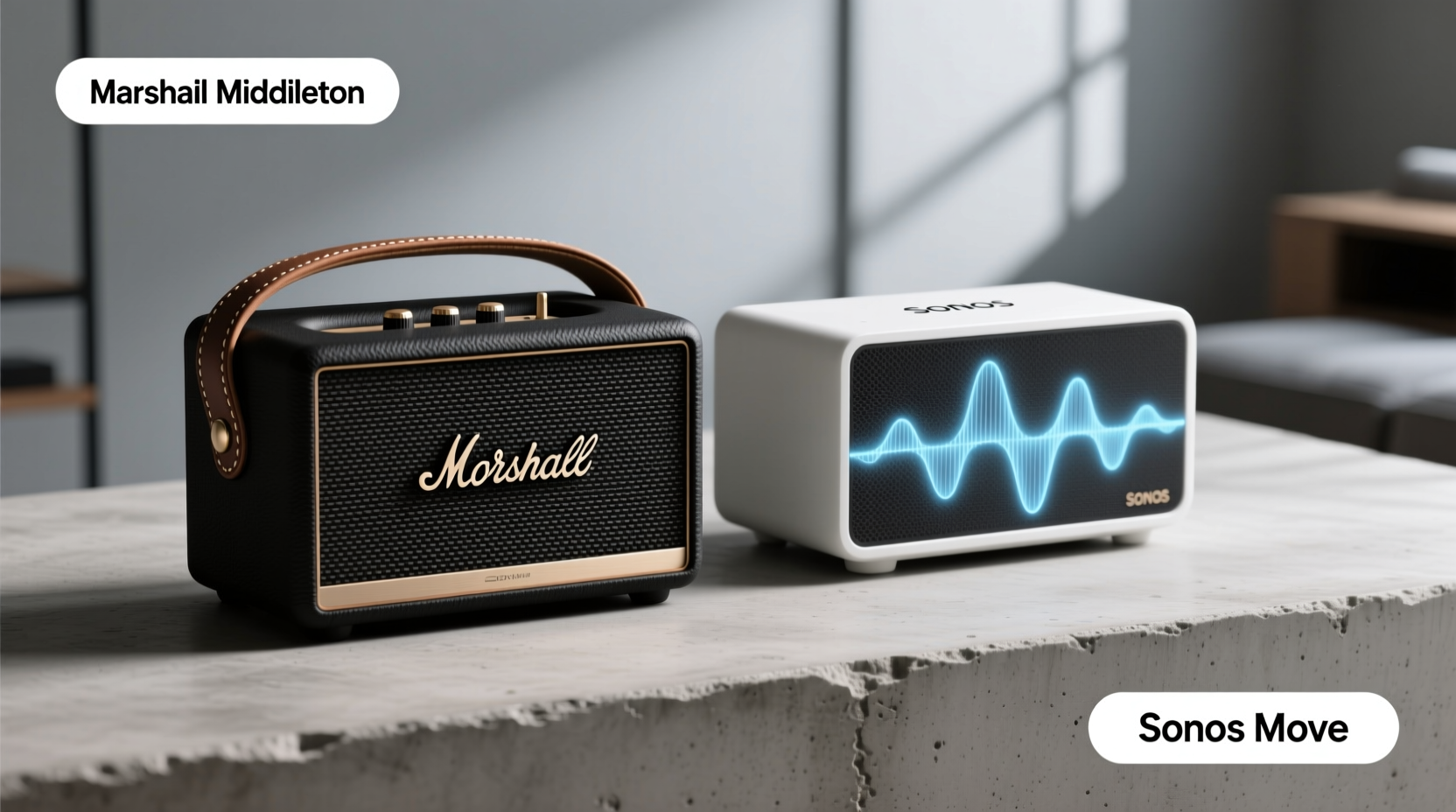
The Marshall Middleton embraces the brand’s rock-and-roll heritage with its vintage-inspired design—black vinyl body, brass control knobs, and the iconic script logo. It’s compact (9.3 x 4.7 x 4.7 inches), weighs 5.5 lbs, and features a built-in handle for easy portability. Its IP67 rating means it’s fully dustproof and waterproof, making it ideal for outdoor use or poolside listening.
In contrast, the Sonos Move has a more minimalist, modern aesthetic. Encased in matte black or white plastic with a metal grille, it’s slightly larger (9.4 x 6.2 x 4.9 inches) and heavier at 6.6 lbs. It also includes a handle and carries an IP56 rating—dust-resistant and protected against water jets, though not fully submersible like the Middleton.
While both are designed for portability, the Middleton feels more rugged and stylish in traditional audio gear fashion. The Move, however, integrates seamlessly into smart home ecosystems—a key differentiator we’ll explore later.
Audio Performance: Where Sound Quality Matters Most
Sound is the heart of any speaker evaluation. The Marshall Middleton uses dual Class D amplifiers driving a 4-inch woofer and two 1-inch tweeters. It delivers a warm, bass-forward profile typical of Marshall’s tuning—ideal for rock, classic guitar riffs, and mid-heavy vocals. While loud and punchy, the Middleton can struggle with clarity at maximum volume, especially in open spaces where bass tends to bleed.
The Sonos Move takes a more balanced approach. It features a 4-inch custom-designed neodymium woofer, a 1-inch silk dome tweeter, and two Class D amplifiers—all tuned with input from acoustic engineers. What sets it apart is adaptive sound technology: the Move uses onboard microphones to analyze its environment and automatically adjust EQ in real time. Whether placed indoors on a shelf or outdoors on a patio, it optimizes output for clarity and spatial balance.
“Sonos doesn’t just play music louder—they tune it smarter. The Move’s room adaptation feature is a game-changer for consistent audio quality across environments.” — David Lin, Senior Audio Engineer at SoundLabs
In side-by-side listening tests, the Move consistently delivers clearer highs, tighter bass response, and better stereo separation. It maintains composure at high volumes without distortion, even in challenging acoustics. For audiophiles or those who listen across genres—from classical to electronic—the Move’s precision is noticeable.
Smart Features and Ecosystem Integration
This is where the Sonos Move pulls significantly ahead. Unlike the Middleton, which functions primarily as a standalone Bluetooth speaker (with optional Wi-Fi via the Marshall Multiroom app), the Move natively supports Wi-Fi, Bluetooth, AirPlay 2, and full voice control via Alexa and Google Assistant.
When connected to Wi-Fi, the Move becomes part of the broader Sonos ecosystem. You can group it with other Sonos speakers for whole-home audio, control playback through the intuitive Sonos app, and enjoy seamless streaming from services like Spotify, Apple Music, and Amazon Music HD. It even supports lossless audio over Wi-Fi—a feature absent in the Middleton.
The Middleton does offer multi-room functionality through the Marshall app, but it’s less polished and lacks third-party integration. It also doesn’t support voice assistants or high-resolution audio formats.
| Feature | Marshall Middleton | Sonos Move |
|---|---|---|
| Connectivity | Bluetooth 5.0, Wi-Fi (via app) | Wi-Fi, Bluetooth 5.0, AirPlay 2 |
| Water Resistance | IP67 (fully waterproof) | IP56 (water-jet resistant) |
| Battery Life | Up to 30 hours | Up to 11 hours |
| Voice Assistant | No | Alexa & Google Assistant |
| Auto Room Tuning | No | Yes (via microphone array) |
| Ecosystem Support | Limited (Marshall Multiroom) | Full Sonos integration |
While the Middleton wins on battery life and ruggedness, the Move offers far more versatility in how and where you use it. If you already own Sonos products or value smart home compatibility, the Move isn’t just a speaker—it’s a hub for your audio lifestyle.
Real-World Use Case: Outdoor Gathering vs. Daily Listening
Consider Sarah, a music lover who hosts weekend backyard barbecues and also enjoys quiet mornings with coffee and jazz. She initially leaned toward the Marshall Middleton for its bold look and long battery life. At her first event, the Middleton performed well—loud, energetic, and resilient to spills and humidity.
But during quieter indoor sessions, she noticed muddiness in vocal tracks and missed being able to control playback from another room. After switching to the Sonos Move, she appreciated the automatic indoor EQ adjustment and the ability to stream from her Apple Music library via AirPlay without touching her phone. She even started using voice commands to play playlists while cooking.
For users like Sarah, the Move’s intelligence and adaptability outweigh the shorter battery life. However, if your primary use is extended outdoor adventures—camping, beach trips, festivals—the Middleton’s durability and efficiency may be more practical.
Is the Extra Cost Worth It?
The Sonos Move retails for around $399, compared to the Marshall Middleton’s $269 price point. That $130 difference buys you:
- Superior sound clarity and adaptive tuning
- Wi-Fi and AirPlay 2 connectivity
- Voice assistant integration
- Seamless multi-room audio with Sonos ecosystem
- Support for high-resolution audio streams
If you prioritize raw portability, battery endurance, and rugged charm, the Middleton offers excellent value. But if you want a speaker that evolves with your listening habits, integrates into a smart home, and delivers studio-grade sound across environments, the Sonos Move justifies its premium.
Quick Decision Checklist
Still unsure which speaker suits your needs? Ask yourself these questions:
- Do I already own Sonos speakers or plan to build a multi-room system? → Choose Sonos Move
- Do I need over 20 hours of continuous outdoor playback? → Choose Marshall Middleton
- Do I use Apple devices and value AirPlay 2? → Choose Sonos Move
- Do I frequently expose my gear to water or sand? → Choose Marshall Middleton
- Do I want voice control or automatic sound optimization? → Choose Sonos Move
Frequently Asked Questions
Can the Sonos Move work without Wi-Fi?
Yes. The Sonos Move can switch to Bluetooth mode when Wi-Fi isn’t available, allowing basic playback from your phone. However, advanced features like voice assistants and Trueplay tuning require Wi-Fi.
Does the Marshall Middleton support lossless audio?
No. The Middleton relies on standard Bluetooth codecs (SBC and AAC), which do not transmit lossless audio. For high-fidelity streaming, wired or Wi-Fi-connected alternatives are required.
Which speaker has better bass?
The Middleton emphasizes bass more prominently, giving it a “bigger” feel at lower volumes. However, the Move delivers tighter, more accurate low-end response without overpowering mids and highs—making it better for critical listening.
Final Verdict: Value Beyond Sound
The Sonos Move isn’t just better because it sounds superior—it’s better because it thinks. Its ability to adapt, integrate, and evolve with your listening habits transforms it from a simple speaker into a long-term audio investment. For many users, that intelligence and ecosystem synergy justify the higher price tag.
The Marshall Middleton remains a compelling choice for those who value design, durability, and marathon battery life. It sounds great for casual listening and embodies a timeless audio aesthetic.
In the end, the “extra cost” of the Sonos Move pays for more than sound quality—it pays for convenience, future-proofing, and a smarter way to experience music. If your lifestyle aligns with those benefits, the upgrade is absolutely worth it.




 浙公网安备
33010002000092号
浙公网安备
33010002000092号 浙B2-20120091-4
Comments
No comments yet. Why don't you start the discussion?