
Python has become one of the most popular programming languages in the world, used across web development, data science, automation, machine learning, and more. Its readability and simplicity make it ideal for beginners, yet its depth and versatility support advanced applications. However, simply knowing that Python is powerful isn’t enough—learning it effectively requires a structured approach. This guide outlines a practical, proven path to mastering Python, combining foundational knowledge, hands-on practice, and strategic habits.
Start with the Right Mindset and Tools
Before writing your first line of code, establish a learning environment that supports growth. Many beginners rush into tutorials without setting up their workspace or understanding how to learn efficiently. Success in programming comes not from memorizing syntax, but from consistent problem-solving and curiosity-driven exploration.
Begin by installing Python from python.org and selecting a beginner-friendly code editor like VS Code or Thonny. Avoid jumping into complex IDEs like PyCharm initially—simplicity reduces cognitive load. Use the interactive Python shell (REPL) to experiment with basic commands and get immediate feedback.
Follow a Logical Learning Path
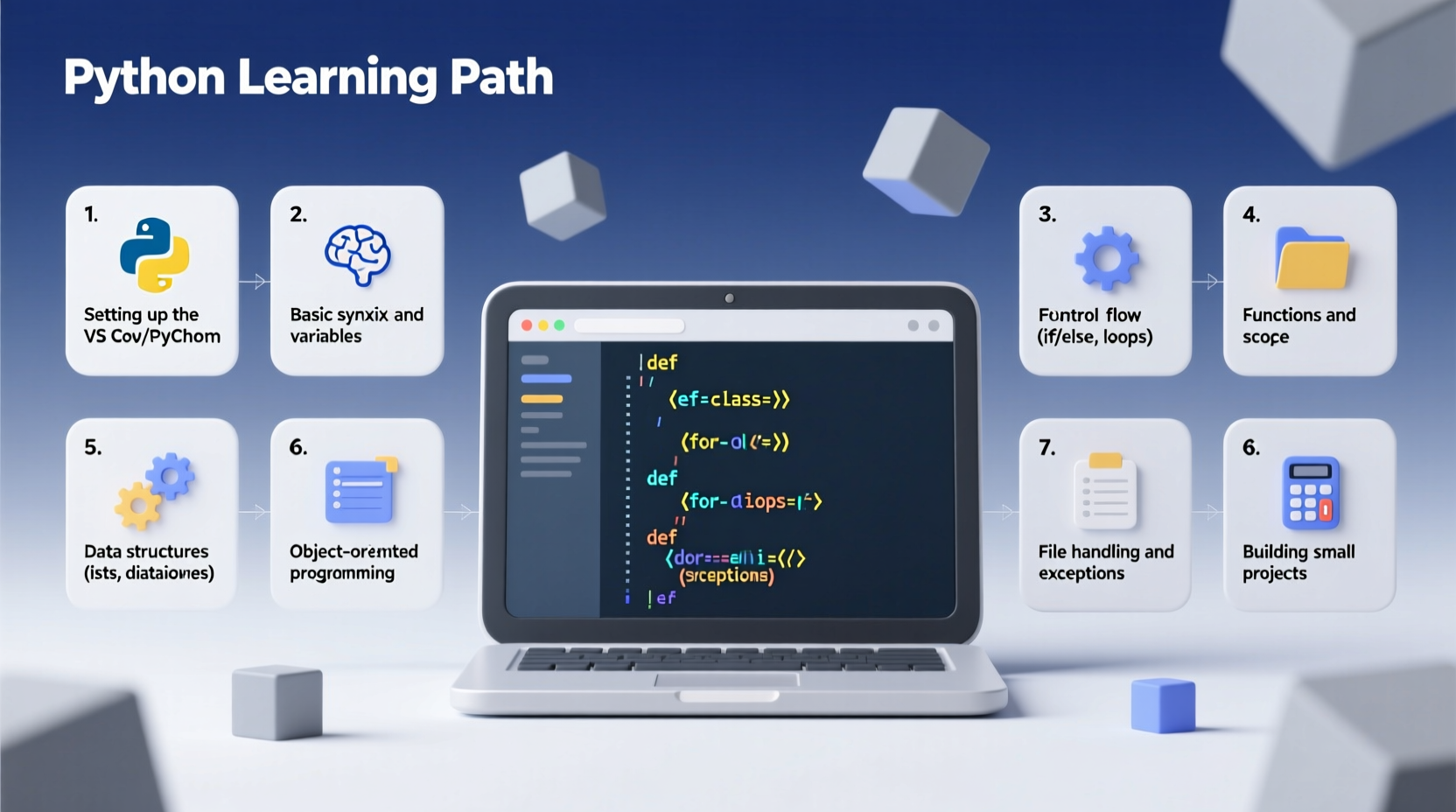
Effective learning follows a progression from fundamentals to application. Jumping ahead too quickly leads to gaps in understanding. The following timeline provides a realistic 12-week roadmap to build strong Python proficiency.
- Weeks 1–2: Basics of Syntax – Variables, data types, operators, conditionals, loops.
- Weeks 3–4: Data Structures – Lists, tuples, dictionaries, sets, and string manipulation.
- Weeks 5–6: Functions and Modules – Writing reusable functions, importing libraries, scope, and error handling.
- Weeks 7–8: File I/O and Libraries – Reading/writing files, working with JSON, using built-in modules like
osanddatetime. - Weeks 9–10: Object-Oriented Programming – Classes, objects, inheritance, encapsulation.
- Weeks 11–12: Mini Projects – Build a to-do list app, a number guesser, or a simple web scraper using
requestsandBeautifulSoup.
This sequence ensures conceptual layers are built gradually. Each week should include at least 5 hours of active coding, not passive watching.
Apply Knowledge Through Practical Projects
Theory alone doesn’t produce skill. Real mastery comes when you solve problems that don’t have clear answers. Start small, but finish what you start. A completed project—even a simple one—teaches more than ten abandoned tutorials.
Consider building these beginner-friendly applications:
- A calculator that handles basic operations
- A weather app using a free API (e.g., OpenWeatherMap)
- A script that renames multiple files in a folder
- A quiz game using multiple-choice questions stored in a dictionary
Each project reinforces different concepts: input/output, logic, external requests, and data organization. As you work, document your process. Write comments in your code and keep a learning journal. Reflecting on challenges deepens retention.
Mini Case Study: From Zero to Automation Script
Sarah, a marketing analyst with no prior coding experience, committed to learning Python for 30 minutes daily. She started with online exercises on variable assignment and loops. By week six, she wrote a script that automatically consolidated daily campaign reports from CSV files into a single summary sheet. Her manager noticed the efficiency gain, and she was later assigned to the company’s data automation team. Sarah didn’t aim for mastery overnight—she focused on solving one real problem at a time.
Use Best Practices to Accelerate Progress
Many learners stall because they adopt inefficient habits early on. Following industry-standard practices from day one sets you apart.
| Do | Don’t |
|---|---|
Write readable code with meaningful variable names (e.g., user_age instead of ua) |
Use single-letter variables or vague names like data, temp |
| Add comments to explain why, not what | Comment every obvious line (e.g., # add 1 to x) |
| Break code into functions with clear purposes | Write long scripts with no structure |
| Test code incrementally | Write 100 lines before running anything |
| Use version control (Git) even for small projects | Skip backups or rely only on local files |
“Programming is the art of telling computers what to do in a language they can understand—and so can you six months from now.” — Guido van Rossum, Creator of Python
Checklist: Building Strong Foundations
- ✅ Understand how variables and data types work
- ✅ Master
if,for, andwhilestatements - ✅ Practice list comprehensions and dictionary operations
- ✅ Write at least three reusable functions
- ✅ Handle errors using
try-exceptblocks - ✅ Read and write data from files
- ✅ Complete one end-to-end project with user input
- ✅ Use Git to commit your code daily
Overcome Common Challenges
Frustration is normal when learning to code. You’ll encounter bugs, confusing error messages, and moments when nothing seems to work. These are not signs of failure—they’re part of the process.
When stuck, use the “Rubber Duck Debugging” method: explain your code line by line to an inanimate object (or a friend). Often, the act of verbalizing reveals the issue. Also, leverage communities like Stack Overflow, Reddit’s r/learnpython, or Discord coding servers. But before asking for help, search thoroughly—your question has likely been answered before.
Avoid tutorial hell: endlessly watching videos without building anything. Allocate 20% of your time to learning and 80% to doing. Tutorials are maps; coding is the journey.
FAQ
How long does it take to master Python?
Mastery is a spectrum. You can become proficient in core concepts within 3–6 months with consistent effort. True mastery—comfort with advanced topics like concurrency, decorators, and design patterns—takes years of applied experience. Focus on progress, not perfection.
Do I need to learn algorithms and data structures right away?
Not immediately. Begin with practical programming. Once you're comfortable with functions and data structures like lists and dictionaries, gradually introduce algorithmic thinking through platforms like LeetCode or Codewars. Prioritize utility first, optimization later.
Can I get a job with just Python?
Yes, especially in roles like data analysis, backend development, automation engineering, or scientific computing. Pair Python with domain-specific tools (e.g., Pandas for data, Flask for web, Selenium for testing), and build a portfolio that demonstrates applied skills.
Conclusion
Becoming proficient in Python isn’t about speed—it’s about consistency, purpose, and practice. Follow a structured path, build real things, and embrace the struggle of problem-solving. Every expert developer once stared at a blank screen unsure of what to type. What separates them is persistence.




 浙公网安备
33010002000092号
浙公网安备
33010002000092号 浙B2-20120091-4
Comments
No comments yet. Why don't you start the discussion?