
Doubling numbers is one of the most common operations in daily math—from calculating tips and splitting bills to estimating travel time or scaling recipes. While it may seem basic, doing it quickly and accurately in your head can save time, reduce errors, and build mathematical confidence. The good news? You don’t need advanced training. With a few clever strategies, anyone can double any number—large or small—in seconds.
These techniques are rooted in number patterns, place value understanding, and mental chunking. Once internalized, they become automatic, transforming what once felt like calculation into instant recall. Whether you're managing finances, helping a child with homework, or just sharpening your mind, mastering these tricks pays off every day.
Break It Down: The Power of Place Value
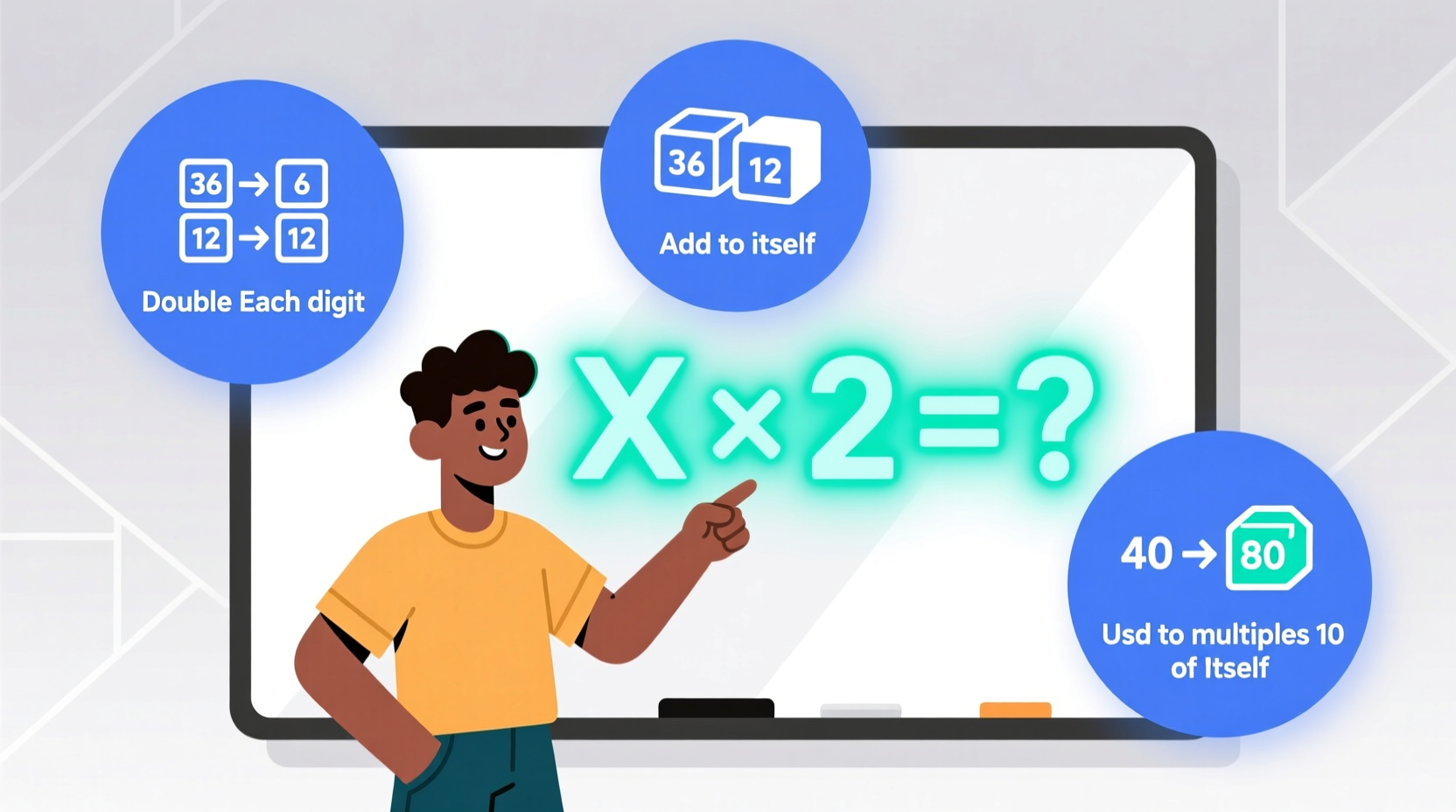
The foundation of fast doubling lies in understanding how numbers are built. Every digit in a number has a place value—ones, tens, hundreds, and so on. Instead of trying to double an entire large number at once, break it into smaller, manageable parts.
For example, take 346. Rather than attempting to compute 346 × 2 directly in your head, split it:
- Double the hundreds: 300 × 2 = 600
- Double the tens: 40 × 2 = 80
- Double the ones: 6 × 2 = 12
Add them together: 600 + 80 = 680; 680 + 12 = 692. Done.
This method works for any number. The key is to process one place at a time, left to right, which aligns with how we naturally read numbers.
Use Rounding to Simplify First
Sometimes, a number is close to a round figure, making it easier to double after a slight adjustment. This technique is especially useful when dealing with odd or irregular digits.
Take 78. It’s 2 less than 80. Double 80 to get 160, then subtract the double of 2 (which is 4). So, 160 – 4 = 156.
Similarly, for 149: Round up to 150 → 150 × 2 = 300 Subtract the extra: 1 × 2 = 2 Final result: 300 – 2 = 298
This rounding strategy reduces cognitive load by turning messy numbers into clean, familiar ones. Over time, your brain will automatically recognize when a number is “close” to a multiple of 10 or 100 and apply this trick instinctively.
“Mental math isn’t about memorizing answers—it’s about recognizing patterns and using shortcuts that make computation fluid.” — Dr. Alan Reyes, Cognitive Math Educator
Step-by-Step Guide: How to Double Any Number in 4 Steps
Follow this reliable sequence to double any number, regardless of size:
- Identify place values: Break the number into hundreds, tens, and ones (e.g., 573 = 500 + 70 + 3).
- Double each part: Multiply each component by 2 separately (500×2=1000, 70×2=140, 3×2=6).
- Adjust if needed: If any part becomes a two-digit result (like 7×2=14), carry over the tens digit to the next higher place.
- Add sequentially: Combine results from left to right: 1000 + 140 = 1140; 1140 + 6 = 1146.
Let’s test it with 864:
- 800 × 2 = 1600
- 60 × 2 = 120 → 1600 + 120 = 1720
- 4 × 2 = 8 → 1720 + 8 = 1728
Answer: 1728. No calculator needed.
Advanced Trick: Double Digit by Digit with Carryover
Once comfortable with decomposition, try doubling digit by digit from left to right while managing carryovers mentally.
Example: 678
- Start with 6 → 6×2 = 12 → write down \"12\"
- Next, 7 → 7×2 = 14 → add the 1 from 14 to the last digit of current total (12 → becomes 13), keep the 4 → now \"134\"
- Then, 8 → 8×2 = 16 → add 1 to 4 → becomes 5, keep 6 → final: 1356
This method mimics traditional multiplication but keeps everything in your head. It’s faster once mastered and works well for three- and four-digit numbers.
Do’s and Don’ts When Doubling Numbers Mentally
| Do’s | Don’ts |
|---|---|
| Break large numbers into smaller parts | Try to double everything at once without structure |
| Use rounding for near-multiples of 10 | Ignore carryovers when doubling digits |
| Practice regularly with real-life numbers | Assume you’re “bad at math” and avoid trying |
| Double-check with estimation (e.g., 490 ≈ 500 → ~1000) | Rely solely on memory without a system |
Real-Life Example: Grocery Shopping Under Time Pressure
Sarah is at the store comparing bulk deals. One brand sells 18 oz of pasta for $2.98. She wants to know the price per 36 oz to compare with another package priced at $6.10 for 36 oz.
Instead of pulling out her phone, she doubles $2.98:
- $2.98 is close to $3.00
- Double $3.00 = $6.00
- But she added 2 cents, so double that too: 2¢ × 2 = 4¢
- Subtract: $6.00 – $0.04 = $5.96
She instantly knows the 36 oz equivalent would cost $5.96—cheaper than the $6.10 alternative. She saves money and time, all thanks to a quick mental double.
Checklist: Build Your Doubling Fluency in 7 Days
Use this checklist to develop speed and accuracy:
- ✅ Day 1: Practice doubling all single-digit numbers (1–9) until instant
- ✅ Day 2: Double two-digit numbers ending in 0 (e.g., 30, 70, 90)
- ✅ Day 3: Work on numbers like 24, 57, 89 using breakdown method
- ✅ Day 4: Apply rounding trick to numbers like 48, 69, 197
- ✅ Day 5: Double three-digit numbers under 300
- ✅ Day 6: Challenge yourself with 400+, including carryovers
- ✅ Day 7: Test yourself with random numbers from receipts or clocks
By the end of the week, doubling will feel natural, even under pressure.
Frequently Asked Questions
Can these tricks work for decimals?
Absolutely. Treat decimals like whole numbers first, then adjust the decimal point. For example, to double 4.7: double 47 to get 94, then place the decimal back: 9.4. The logic holds because 4.7 × 2 = (47 × 2) ÷ 10 = 94 ÷ 10 = 9.4.
What if I make a mistake in my head?
Mistakes are part of learning. To minimize them, use estimation as a sanity check. If you double 148 and get 266, ask: Is that reasonable? 150 × 2 = 300, so 266 is too low. Recalculate—correct answer is 296.
Is it worth learning this instead of using a phone calculator?
Yes. Mental math improves focus, memory, and numerical intuition. In situations where you need a fast judgment—shopping, budgeting, or teaching kids—being able to double instantly gives you an edge. Plus, it keeps your brain sharp.
Conclusion: Own Your Number Sense
Doubling numbers isn’t just a party trick—it’s a fundamental skill that strengthens your overall numeracy. These methods are not reserved for math whizzes; they’re practical tools anyone can learn. With consistent practice, what once required concentration becomes second nature.
Start small. Use the breakdown method. Embrace rounding. Track your progress. Before long, you’ll find yourself calculating twice as fast—and with twice the confidence.




 浙公网安备
33010002000092号
浙公网安备
33010002000092号 浙B2-20120091-4
Comments
No comments yet. Why don't you start the discussion?