
Addition is one of the foundational operations in mathematics. While it may seem simple at first glance, truly mastering addition goes beyond memorizing facts. It involves understanding number relationships, developing mental strategies, and building confidence through consistent practice. Whether you're a student learning arithmetic for the first time, a parent helping a child with homework, or an adult refreshing basic math skills, a structured approach can make all the difference.
Confidence in math doesn’t come from speed alone—it comes from clarity, consistency, and comprehension. By breaking down addition into manageable components and applying proven techniques, anyone can improve their fluency and accuracy.
Understanding the Core Concepts of Addition
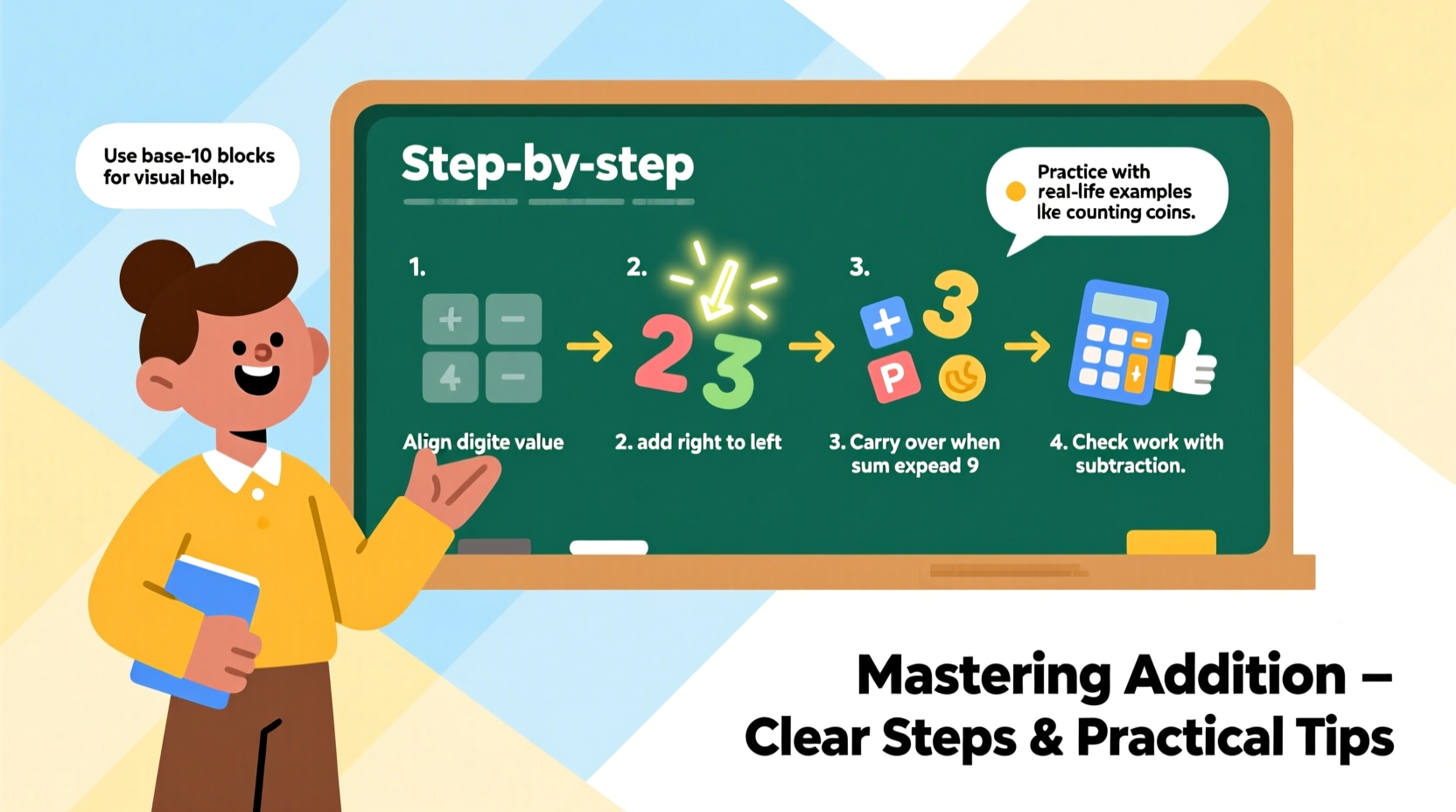
Before diving into complex problems, it's essential to understand what addition represents. At its core, addition is the process of combining two or more quantities to find their total. This concept applies whether you're counting apples, calculating expenses, or solving algebraic expressions later on.
The symbols used in addition are straightforward: the plus sign (+) indicates that numbers are being combined, and the equals sign (=) shows the result. For example, 3 + 5 = 8 means three items combined with five items gives a total of eight.
Key terms to know include:
- Addends: The numbers being added together.
- Sum: The result of adding the addends.
- Carrying (or regrouping): Used when the sum of digits in a column exceeds 9, especially in multi-digit addition.
Building a solid conceptual foundation prevents confusion as problems become more complex. Visual tools like number lines or counters can help internalize how values increase when combined.
Step-by-Step Guide to Mastering Addition
Follow this progressive path to develop strong addition skills over time. Each step builds upon the previous one, ensuring no gaps in understanding.
- Start with Number Recognition and Counting
Ensure comfort identifying numbers and counting forward confidently up to at least 100. This forms the basis for everything that follows. - Practice Adding Within 10
Focus on single-digit combinations (e.g., 4 + 3, 7 + 2). These are known as \"basic facts\" and should eventually be recalled instantly. - Use Manipulatives and Visual Aids
Objects like blocks, beads, or drawings help visualize the act of combining groups. Seeing physical representations strengthens abstract thinking. - Learn Mental Math Strategies
Teach methods such as “counting on” (starting from the larger number and counting up), using doubles (e.g., 6 + 6 = 12), and near-doubles (e.g., 6 + 7 = 13). - Move to Multi-Digit Addition
Introduce place value concepts. Align numbers vertically by ones, tens, hundreds, etc., and add column by column, carrying when necessary. - Incorporate Word Problems
Apply addition to real-world scenarios. This develops critical thinking and helps distinguish when addition is the appropriate operation. - Build Speed and Accuracy Through Practice
Use timed drills sparingly and only after understanding is secure. Focus on accuracy first, then gradually increase pace.
Effective Tips for Building Confidence in Addition
Math anxiety often stems from feeling overwhelmed or fearing mistakes. The following tips create a positive learning environment and promote steady progress.
- Break problems into smaller parts. Tackle one digit or column at a time to avoid mental overload.
- Double-check work systematically. Re-add columns from bottom to top or use estimation to verify reasonableness (e.g., 47 + 38 should be close to 50 + 40 = 90).
- Use color-coding for place values. Highlight ones, tens, and hundreds in different colors to reduce alignment errors.
- Verbalize the process aloud. Saying each step (“7 plus 5 is 12, write down 2, carry the 1”) reinforces memory and catches errors early.
- Practice daily—even for just 10 minutes. Consistency matters more than long, infrequent sessions.
“Fluency in basic operations like addition frees up cognitive space for higher-level problem-solving.” — Dr. Linda Chen, Mathematics Education Researcher
Common Pitfalls and How to Avoid Them
Mistakes are part of learning, but recognizing common errors helps correct them efficiently. The table below outlines frequent issues and solutions.
| Common Mistake | Why It Happens | How to Fix It |
|---|---|---|
| Forgetting to carry over | Distracted during regrouping or misunderstanding place value | Circle the carried number clearly; say it aloud while writing |
| Misaligning digits | Poor handwriting or rushing | Use graph paper or draw vertical columns; write neatly |
| Adding instead of subtracting in mixed problems | Over-reliance on pattern recognition without reading carefully | Underline the operation symbol before solving |
| Memorizing without understanding | Focusing only on speed tests too early | Use manipulatives and word problems to build meaning |
Real Example: Maria’s Progress in Math Class
Maria, a fourth-grader, struggled with multi-digit addition. She often forgot to carry numbers and became frustrated during timed quizzes. Her teacher noticed she was trying to memorize procedures without grasping why they worked.
To help, Maria began using base-ten blocks to model problems like 247 + 186. She physically grouped ten ones into a ten rod and moved it to the tens column. After several hands-on sessions, she started visualizing the process mentally.
She also adopted a checklist (see below) to guide her written work. Within six weeks, her accuracy improved from 60% to over 90%, and her confidence soared. She even volunteered to explain addition strategies to classmates.
Checklist for Accurate Addition
Use this checklist every time you solve an addition problem until the habits become automatic.
- ☐ Write numbers neatly, aligning ones, tens, and hundreds in columns.
- ☐ Start adding from the rightmost column (ones place).
- ☐ If a sum is 10 or greater, write down the ones digit and carry the tens digit.
- ☐ Add the carried number to the next column’s total.
- ☐ Double-check each column after finishing.
- ☐ Estimate the answer to see if your result is reasonable.
Frequently Asked Questions
Is it okay to use fingers or counting tools?
Yes, especially in the early stages. Using fingers, tally marks, or counters is a valid strategy that supports number sense. As fluency grows, reliance on these tools naturally decreases.
How do I help a child who hates math?
Focus on making math relevant and low-pressure. Incorporate games, cooking activities, or shopping trips where addition is used naturally. Avoid negative language around math and emphasize effort over perfection.
When should students stop using visual aids?
Visual aids should be phased out gradually—not eliminated abruptly. Once a learner demonstrates consistent accuracy and understanding without them, transition to mental math. Some learners benefit from periodic return to visuals during new challenges.
Conclusion: Build Strong Foundations for Lifelong Success
Mastering addition isn't about rushing to finish worksheets—it's about cultivating a deep, lasting understanding of how numbers work together. With clear steps, consistent practice, and supportive strategies, anyone can develop confident math skills. The ability to add accurately and efficiently opens doors to more advanced topics and real-world decision-making.




 浙公网安备
33010002000092号
浙公网安备
33010002000092号 浙B2-20120091-4
Comments
No comments yet. Why don't you start the discussion?