
For collectors, displaying a high-end action figure isn’t just about shelf space—it’s about storytelling. The Agent Venom figure, with its sleek symbiote design, dynamic articulation, and comic-accurate detailing, demands more than passive placement. Whether you’re showcasing a premium sixth-scale statue or a poseable 6-inch release, how you position and present the figure dramatically impacts its visual impact. A well-posed Agent Venom doesn’t just sit on a shelf; it leaps into the scene, commanding attention and evoking narrative tension.
Professional collectors and display artists understand that posing is both an art and a science. It requires knowledge of anatomy (even in superhuman forms), balance, composition, and environmental context. This guide breaks down actionable strategies to elevate your Agent Venom display from static to cinematic.
Understanding Agent Venom’s Character for Authentic Poses
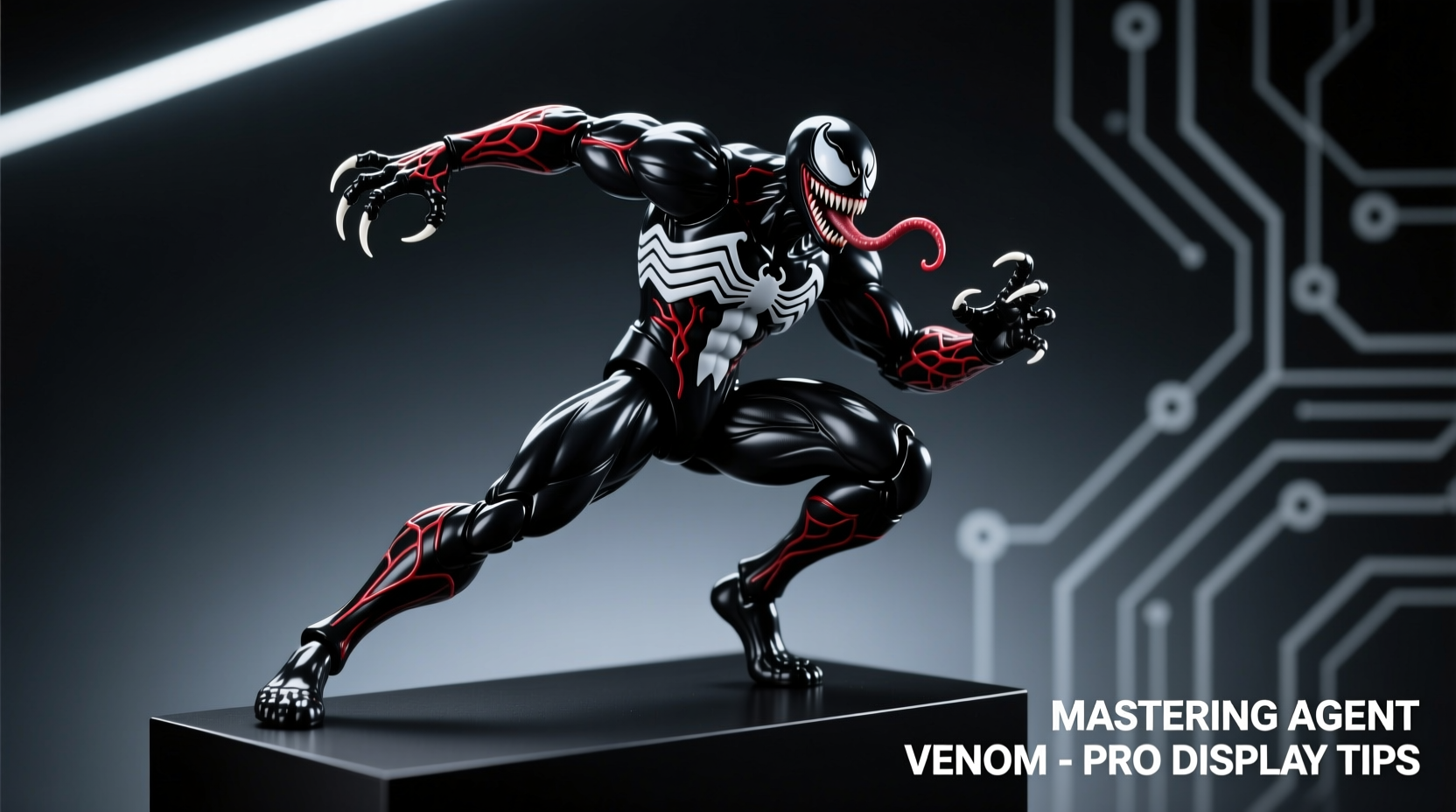
Before adjusting a single joint, consider who Agent Venom is. As Flash Thompson bonded with the Venom symbiote under government sanction, his persona blends military precision with alien aggression. Unlike the chaotic menace of full Venom, Agent Venom carries a controlled intensity—strategic, disciplined, yet capable of explosive power. This duality should inform every pose.
A slumped, crouching stance may suit classic Venom, but Agent Venom thrives in poised readiness: one foot forward, fists clenched, head tilted slightly as if scanning for threats. Think of him mid-takedown, mid-leap, or standing tall after neutralizing a target. His posture should reflect tactical awareness, not mindless rage.
“Agent Venom is a soldier first. His poses should communicate readiness—not just strength, but purpose.” — Daniel Reyes, Comic Collectibles Curator at Metro Display Studios
Step-by-Step Guide to Dynamic Posing
Follow this five-step process to create compelling, stable poses that highlight your figure’s details and character.
- Start with the base stance: Choose between grounded stability (feet shoulder-width apart) or dynamic imbalance (one leg raised, weight shifted). For action scenes, use the latter; for authoritative presence, the former.
- Set the spine and hips: Tilt the pelvis slightly forward to simulate forward momentum. Avoid perfectly upright torsos unless aiming for parade rest.
- Position arms for intent: One arm extended as if striking or web-swinging, the other guarding the torso. Elbows should be bent naturally, not locked.
- Angle the head and gaze: Turn the head toward an imagined threat or focal point. Most figures have fixed eyes, so orientation matters—rotate the entire head to direct focus.
- Test stability and adjust: Gently nudge the figure. If it wobbles, widen the stance or use discreet support rods hidden behind the figure.
Essential Accessories and Display Enhancements
Pose alone isn’t enough. Context elevates realism. Consider pairing your Agent Venom with environment-specific props:
- Spider-Man or Carnage figures for confrontation scenes
- Cityscape backdrops or broken concrete bases
- LED strips to simulate moonlight or neon city glow
- Clear acrylic rods to mimic web lines mid-swing
For solo displays, a themed diorama base reinforces narrative. A cracked asphalt texture with glowing fissures suggests a battle aftermath. Even subtle touches—a tiny SHIELD insignia half-buried in rubble—add depth.
Do’s and Don’ts of Accessory Pairing
| Do | Don’t |
|---|---|
| Match scale (6” figure with 6” accessories) | Mix scales haphazardly (e.g., 12” buildings with 3” figures) |
| Use LED lighting to highlight key features | Over-light to the point of washing out details |
| Anchor loose parts (webs, capes) with clear supports | Allow floppy limbs or accessories to droop unnaturally |
| Align theme with character origin (military base, NYC alley) | Use irrelevant props (e.g., tropical palm trees) |
Lighting Techniques to Highlight Pose and Texture
Lighting transforms a good pose into a gallery-worthy display. Symbiote suits like Agent Venom’s thrive under directional lighting that accentuates texture. The gooey ridges, muscular definition, and glossy finish respond dramatically to contrast.
Use a two-point lighting setup: a key light from the front-left at 45 degrees to cast defined shadows across the musculature, and a softer fill light opposite to reduce harshness. For dramatic effect, add a backlight to separate the figure from the wall, creating a halo around the silhouette—perfect for emphasizing the flowing tendrils of the symbiote.
Avoid overhead ambient lighting alone—it flattens dimensionality. Instead, integrate small spotlights or recessed shelf LEDs focused solely on the figure.
Mini Case Study: From Shelf Ornament to Centerpiece
Mark T., a collector from Austin, TX, owned a highly articulated Agent Venom (Marvel Legends series) for over a year but displayed it in default standing mode. After researching dynamic posing, he reimagined the figure mid-combat leap. He used a custom 3D-printed base resembling a crumbling building corner, positioned the legs in a forward thrust, one arm extended with a web accessory, and angled the head downward as if targeting prey.
He installed a warm spotlight above and a blue LED strip along the back edge of the case. The transformation was immediate—guests consistently noticed the display, and Mark won “Best Diorama” at a local collector meetup. His feedback: “I didn’t realize how much story I could tell with just one figure until I stopped treating it like a statue.”
Checklist: Professional-Level Display Setup
Ensure your Agent Venom display meets pro standards with this checklist:
- ✅ Figure is securely posed with no risk of tipping
- ✅ Pose reflects Agent Venom’s military-symbiote hybrid identity
- ✅ Lighting emphasizes texture and depth, not glare
- ✅ Base or backdrop complements the character’s world
- ✅ All accessories are in scale and purposefully placed
- ✅ Display case is dust-free and UV-protected if near sunlight
- ✅ No visible support wires or adhesives from viewing angle
Frequently Asked Questions
Can I leave my Agent Venom in a dynamic pose long-term?
Yes, but rotate poses every few months to prevent stress on joints, especially in cheaper plastics. High-end figures with metal skeletons handle prolonged posing better.
How do I prevent paint wear on frequently adjusted joints?
Limit excessive posing adjustments. When necessary, gently flex joints and avoid twisting at extreme angles. Apply a micro-dab of silicone lubricant (designed for action figures) if stiffness occurs.
Is it worth investing in a display case?
Absolutely. A UV-filtering, dust-resistant case preserves paint, prevents oxidation of rubber parts, and enhances presentation. Magnetic closures and anti-reflective glass make a noticeable difference in professional setups.
Final Thoughts: Make Your Collection Tell a Story
Mastering Agent Venom figure poses isn’t just about technical skill—it’s about vision. Every tilt of the head, every extension of the arm, contributes to a silent narrative. When done right, your display stops being a mere object and becomes a moment frozen in time: the instant before impact, the breath after victory, the quiet vigilance of a soldier bonded to something far greater than himself.
Take a step back. Look at your current setup. Is it reflecting the full potential of the figure? Adjust one joint. Add one light. Introduce one prop. Small changes compound into stunning results. Your collection deserves more than storage—it deserves storytelling.




 浙公网安备
33010002000092号
浙公网安备
33010002000092号 浙B2-20120091-4
Comments
No comments yet. Why don't you start the discussion?