
Artificial intelligence is no longer a futuristic concept—it’s a foundational technology reshaping industries from healthcare to finance, logistics to entertainment. But transitioning from understanding AI concepts to building functional, scalable intelligent systems requires more than just theoretical knowledge. It demands mastery of practical programming techniques, familiarity with modern tools, and a disciplined approach to problem-solving. Whether you're developing a recommendation engine, training a computer vision model, or designing autonomous agents, success hinges on your ability to integrate data, algorithms, and infrastructure effectively.
Foundations of AI Programming
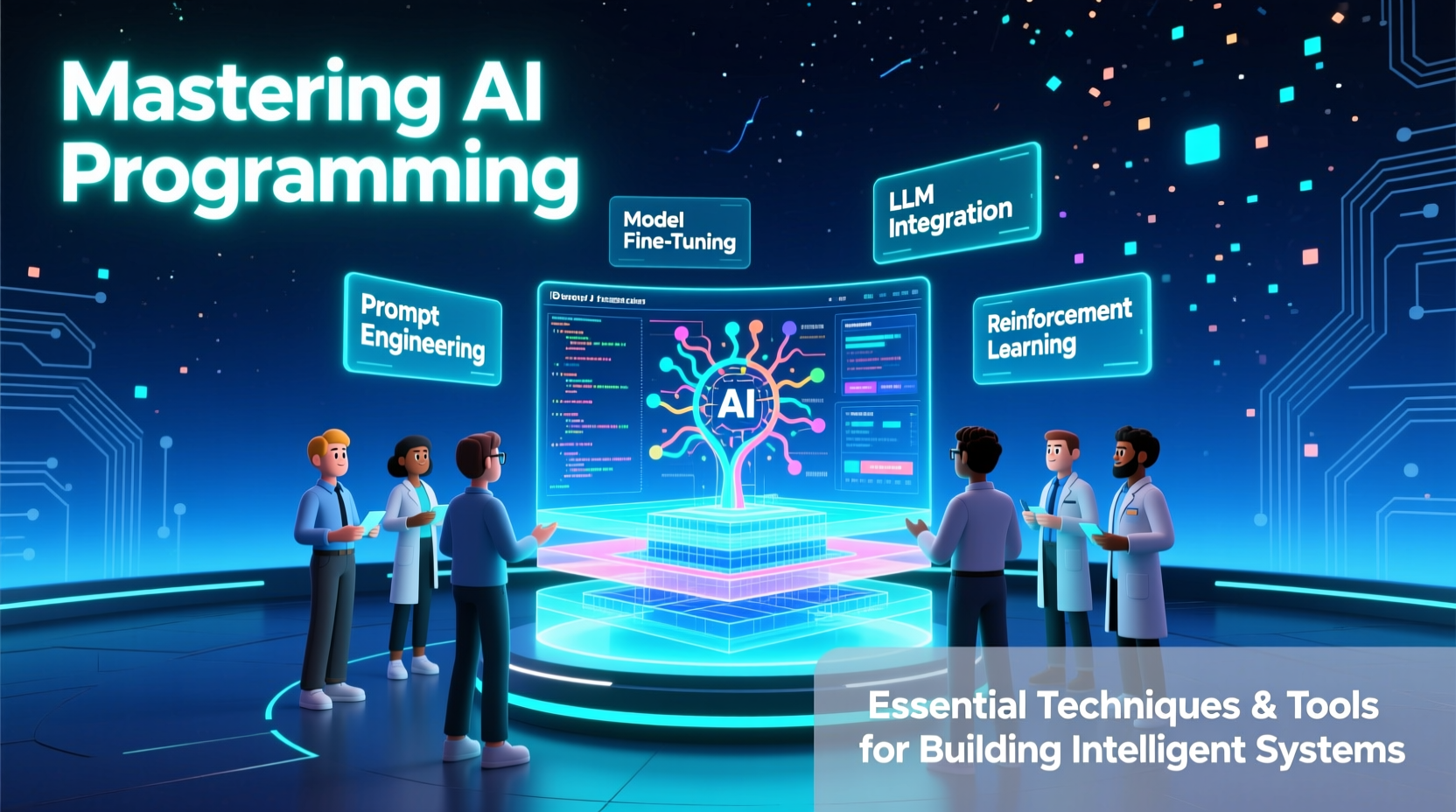
Before diving into complex models, it's crucial to establish a strong foundation in the core principles of AI programming. This includes proficiency in linear algebra, probability, and optimization—mathematical frameworks that underpin most machine learning algorithms. Equally important is fluency in programming languages like Python, which dominates the AI ecosystem due to its simplicity and extensive library support.
Modern AI development relies heavily on frameworks such as TensorFlow, PyTorch, and Scikit-learn. These tools abstract low-level complexity, allowing developers to focus on model design rather than implementation details. However, true mastery comes not from using these tools blindly, but from understanding how they work under the hood—such as how gradient descent optimizes neural networks or how backpropagation computes gradients efficiently.
Essential Tools in the AI Developer’s Toolkit
The right tools streamline development, enhance collaboration, and ensure reproducibility. Below is a comparison of key platforms used in AI programming today:
| Tool | Primary Use Case | Strengths | Limitations |
|---|---|---|---|
| PyTorch | Research & dynamic modeling | Dynamic computation graph, excellent debugging, strong community | Less optimized for production deployment |
| TensorFlow | Production & large-scale systems | Strong deployment options (TF Lite, TF.js), Keras integration | Steeper learning curve, static graphs in earlier versions |
| Scikit-learn | Classical ML (regression, classification) | Simplicity, consistent API, great for beginners | Limited support for deep learning |
| Hugging Face Transformers | NLP tasks | Pre-trained models, easy fine-tuning, active open-source community | Can be resource-intensive without optimization |
Complementing these are version control systems like Git, experiment tracking tools such as MLflow or Weights & Biases, and containerization platforms like Docker and Kubernetes, which help maintain consistency across development and deployment environments.
Step-by-Step Guide to Building an Intelligent System
Creating a robust AI system follows a structured workflow. Here’s a proven sequence:
- Define the Problem Clearly: Identify whether the task is classification, regression, clustering, or generation. A vague objective leads to poor model performance.
- Collect and Preprocess Data: Gather high-quality, representative data. Clean missing values, normalize features, and handle class imbalances.
- Select an Appropriate Model Architecture: Start simple—a logistic regression or decision tree may outperform a neural network on small datasets.
- Train and Validate Iteratively: Use cross-validation and monitor metrics like accuracy, precision, recall, or F1-score depending on the use case.
- Optimize Hyperparameters: Employ techniques like grid search, random search, or Bayesian optimization to tune learning rates, batch sizes, and network depth.
- Evaluate on a Holdout Test Set: Never assess final performance on data used during training or validation.
- Deploy and Monitor: Use APIs (e.g., FastAPI or Flask) to serve models and implement logging to track predictions and drift over time.
“AI isn’t magic—it’s meticulous engineering wrapped in statistical insight.” — Dr. Anika Patel, Senior Research Scientist at OpenAI
Common Pitfalls and How to Avoid Them
Even experienced developers fall into traps that compromise model effectiveness. Awareness is the first step toward prevention.
- Data Leakage: Including future information in training data inflates performance artificially. Always split data temporally when applicable.
- Overfitting: When a model memorizes training data instead of generalizing. Use regularization, dropout, or early stopping to combat this.
- Ignoring Ethics: Biased data leads to biased models. Audit datasets for representation and test outputs across demographic groups.
- Poor Reproducibility: Random seeds should be fixed, and dependencies pinned to ensure results can be replicated.
Mini Case Study: Improving Customer Support with AI
A mid-sized SaaS company struggled with rising customer service volumes. Their initial attempt involved deploying a generic chatbot trained on unrelated conversations, which resulted in inaccurate responses and frustrated users. After reassessing their approach, the team collected actual support tickets, categorized intents, and fine-tuned a BERT-based model using Hugging Face. They implemented intent recognition and response routing, reducing average resolution time by 40%. Continuous monitoring allowed them to retrain weekly, adapting to new product features and user queries. The lesson? Domain-specific data and iterative refinement beat off-the-shelf solutions every time.
Best Practices Checklist
To consistently build effective AI systems, follow this actionable checklist:
- ✅ Define clear, measurable objectives before writing code
- ✅ Profile and clean data thoroughly—garbage in, garbage out
- ✅ Use version control for both code and datasets (e.g., DVC)
- ✅ Benchmark against baseline models before scaling complexity
- ✅ Implement automated testing for data quality and model performance
- ✅ Monitor model behavior post-deployment for concept drift
- ✅ Prioritize interpretability, especially in regulated domains
Frequently Asked Questions
Do I need a PhD to master AI programming?
No. While advanced degrees help in research roles, many successful AI engineers are self-taught or have bootcamp backgrounds. Practical experience, project portfolios, and continuous learning matter more in applied settings.
How do I choose between PyTorch and TensorFlow?
Choose PyTorch if you're in research, prototyping, or prefer dynamic computation graphs. Opt for TensorFlow if you're focused on production deployment, mobile integration, or enterprise environments. Both are industry standards, so familiarity with either is valuable.
Can AI models work with small datasets?
Yes, through transfer learning. By leveraging pre-trained models (e.g., ResNet for images or BERT for text), you can fine-tune on limited data and achieve strong performance without massive labeled datasets.
Conclusion: From Learning to Impact
Mastering AI programming isn’t about mastering one algorithm or tool—it’s about cultivating a mindset of experimentation, rigor, and user-centric design. The most impactful intelligent systems aren’t necessarily the most complex; they’re the ones that solve real problems reliably and ethically. As you advance, focus not just on writing smarter code, but on asking better questions. What problem are you solving? Who benefits? How will it evolve?
The tools and techniques covered here form a foundation, but your journey doesn’t end here. Build projects, contribute to open source, share your findings, and stay curious. The future of intelligent systems isn’t built by spectators—it’s shaped by those willing to code, test, fail, and try again.




 浙公网安备
33010002000092号
浙公网安备
33010002000092号 浙B2-20120091-4
Comments
No comments yet. Why don't you start the discussion?