
Academic writing demands precision, and proper citation is non-negotiable. The American Psychological Association (APA) style is one of the most widely used formats in social sciences, education, and psychology. Yet, even experienced writers can stumble when formatting citations correctly. Missteps in APA style can undermine credibility, affect grades, or lead to accusations of plagiarism—even unintentionally. This guide breaks down the entire APA citation process into clear, actionable steps so you can cite sources confidently and accurately.
Understanding the Purpose of APA Style
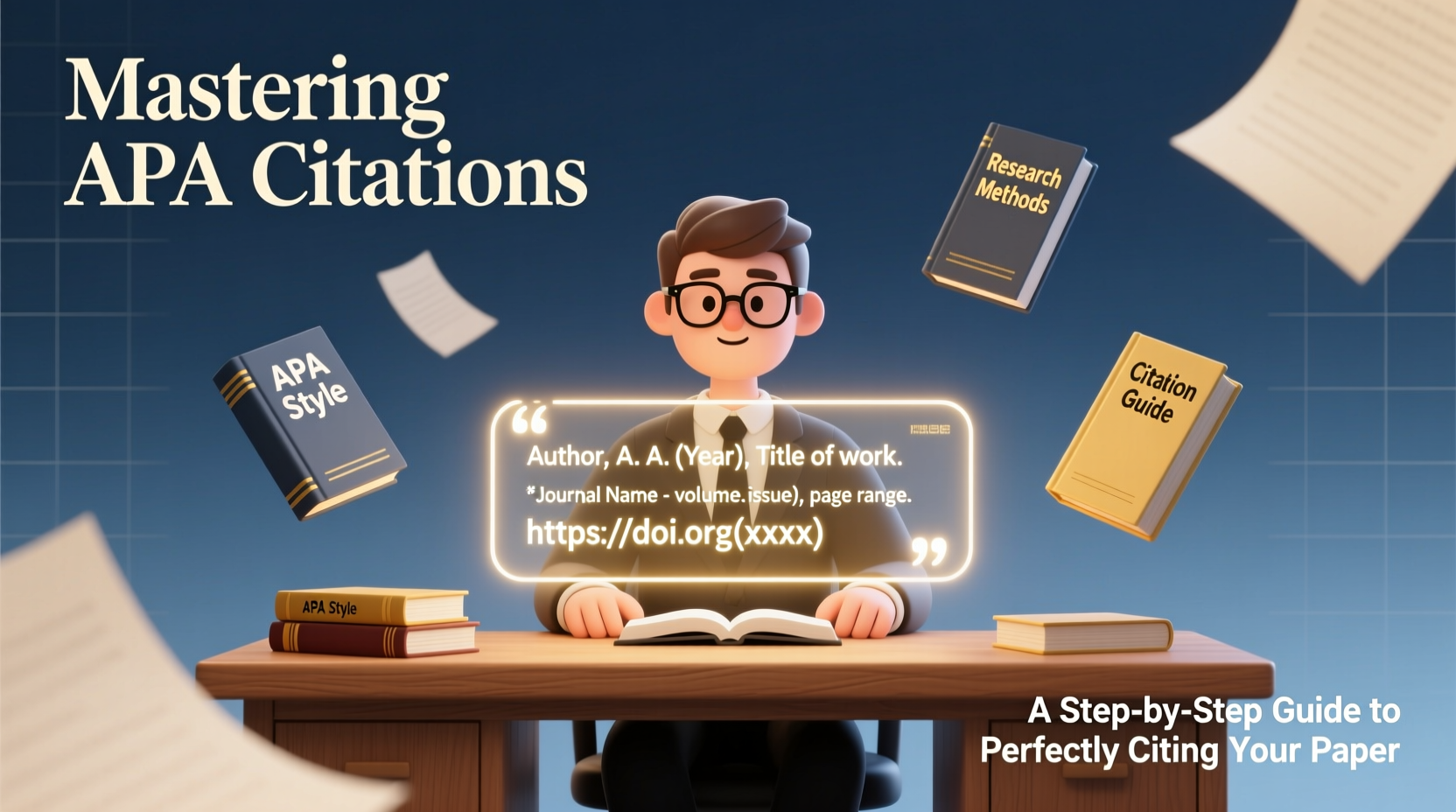
APA style was developed to promote clarity, consistency, and academic integrity in scholarly writing. Beyond just listing sources, APA citations give credit where it’s due, allow readers to verify claims, and situate your work within existing research. The 7th edition, currently in use, streamlines many rules from earlier versions, making digital sources easier to cite and reducing redundancy.
The two core components of APA citation are in-text citations and the reference list. In-text citations briefly identify the source within your writing, while the reference list at the end provides full details for every cited work. Both must align precisely—every source in the text must appear in the references, and vice versa.
“Clear and consistent citation isn’t just about rules—it’s about respect for intellectual property and scholarly conversation.” — Dr. Rebecca Thompson, Academic Writing Consultant
Step-by-Step: Formatting In-Text Citations
In-text citations in APA follow the author-date format. They appear in parentheses and include the author’s last name and the year of publication. Here’s how to apply them correctly across different scenarios:
- One author: (Smith, 2020)
- Two authors: Include both names every time: (Johnson & Lee, 2019)
- Three or more authors: Use the first author followed by “et al.”: (Martinez et al., 2021)
- Direct quote: Add the page number: (Brown, 2018, p. 45)
- Narrative citation: When the author is part of the sentence, only the year follows in parentheses: Smith (2020) argued that...
Special Cases in In-Text Citations
- Organization as author: Use the full name the first time, then abbreviate if commonly recognized: (National Institutes of Health [NIH], 2022), later (NIH, 2022).
- No author: Use the title in quotation marks for articles or in italics for books: (“Climate Trends,” 2021).
- No date: Use “n.d.”: (Taylor, n.d.).
Constructing a Flawless Reference List
The reference list appears on its own page at the end of your paper, titled “References” (centered, not bolded). Entries are alphabetized by the author’s last name and formatted with a hanging indent. Each entry follows a specific structure depending on the source type.
Basic Book Format
Author, A. A. (Year). Title of book (Edition). Publisher.
Journal Article with DOI
Author, B. B., & Author, C. C. (Year). Title of article. Journal Name, Volume(Issue), Page range. https://doi.org/xxxx
Webpage with No Author
Title of page. (Year, Month Date). Site Name. URL
| Source Type | Required Elements | Common Pitfalls |
|---|---|---|
| Book | Author, Year, Title, Publisher | Forgetting italics on book titles |
| Journal Article | DOI or URL, volume/issue, italics placement | Omitting DOI when available |
| Website | Retrieval date only if content changes over time | Using “Retrieved from” unnecessarily |
| Edited Chapter | In A. Editor & B. Editor (Eds.), Book title | Misplacing editor names |
Real Example: From Draft to Correct Citation
Lena, a psychology student, wrote a paper on cognitive behavioral therapy. In her first draft, she cited a key study like this:
According to a recent analysis, CBT significantly reduces anxiety symptoms in adolescents (Miller, 2020).
She then listed the source as:
Miller, J. (2020). New findings on CBT. Journal of Clinical Psychology, 76(3), 45–60.
After reviewing APA guidelines, Lena realized she missed the DOI and italicized the wrong elements. She corrected it to:
Miller, J. K., & Reynolds, L. (2020). Efficacy of cognitive behavioral therapy in adolescent anxiety disorders. Journal of Clinical Psychology, 76(3), 45–60. https://doi.org/10.1002/jclp.22912
This small change ensured compliance with APA 7th edition standards and strengthened her paper’s professionalism.
Checklist for Perfect APA Citations
Before submitting your paper, run through this checklist to catch errors early:
- ✅ All in-text citations have a matching entry in the reference list
- ✅ Every reference entry is alphabetized by author’s last name
- ✅ Hanging indent applied to all reference entries
- ✅ Italicized book and journal titles (not article titles)
- ✅ Used “&” instead of “and” between authors in references
- ✅ Included DOIs for journal articles (formatted as URLs)
- ✅ Page numbers included for direct quotes in-text
- ✅ Proper capitalization: Only first word and proper nouns capitalized in titles
- ✅ No “Retrieved from” unless content is designed to change (e.g., Wikipedia)
- ✅ All author names correctly formatted: Last name, Initials
Frequently Asked Questions
Do I need a DOI for every journal article?
If a DOI is available, always include it. If not, provide the URL of the journal’s homepage (not a database link like EBSCO). Never use a library access link.
How do I cite a source quoted in another source?
Use secondary citation: (Smith, 2015, as cited in Jones, 2020). Only list Jones in your references, since that’s the source you actually read.
Should I include URLs for print sources?
No. Print books and journals without a digital counterpart do not require URLs. Only add URLs or DOIs for online sources.
Final Tips for Mastery
Consistency is the hallmark of professional academic writing. While citation tools like Zotero, Mendeley, or Word’s built-in generator can help, they’re not infallible. Always review auto-generated citations against official APA guidelines. The Purdue OWL (Online Writing Lab) remains one of the most trusted free resources for up-to-date APA examples.
Also, remember that context matters. Some disciplines or instructors may have slight variations in expectations. When in doubt, ask for clarification. Better to confirm than to assume.
“The best researchers aren’t those who never make mistakes—they’re the ones who care enough to get the details right.” — Prof. Alan Reyes, Department of Educational Psychology
Take Action Today
Perfecting APA citations isn’t about memorizing every rule—it’s about developing a systematic approach. Start by auditing one of your past papers using the checklist above. Identify patterns in your errors, whether it’s misplaced italics or missing DOIs, and build habits to correct them. With practice, accurate citation becomes second nature. Your professors—and future self—will thank you.




 浙公网安备
33010002000092号
浙公网安备
33010002000092号 浙B2-20120091-4
Comments
No comments yet. Why don't you start the discussion?