
In a world driven by digital technology, binary numbers form the foundation of how computers process information. Every email sent, every image viewed, and every command executed relies on sequences of 0s and 1s. While binary may seem cryptic at first glance, it follows a logical system that anyone can learn with clarity and practice. Understanding binary decoding isn’t just for computer scientists—it’s a valuable skill for students, hobbyists, developers, and curious minds who want to grasp how digital systems work at their most fundamental level.
The Basics of Binary: What Is It?
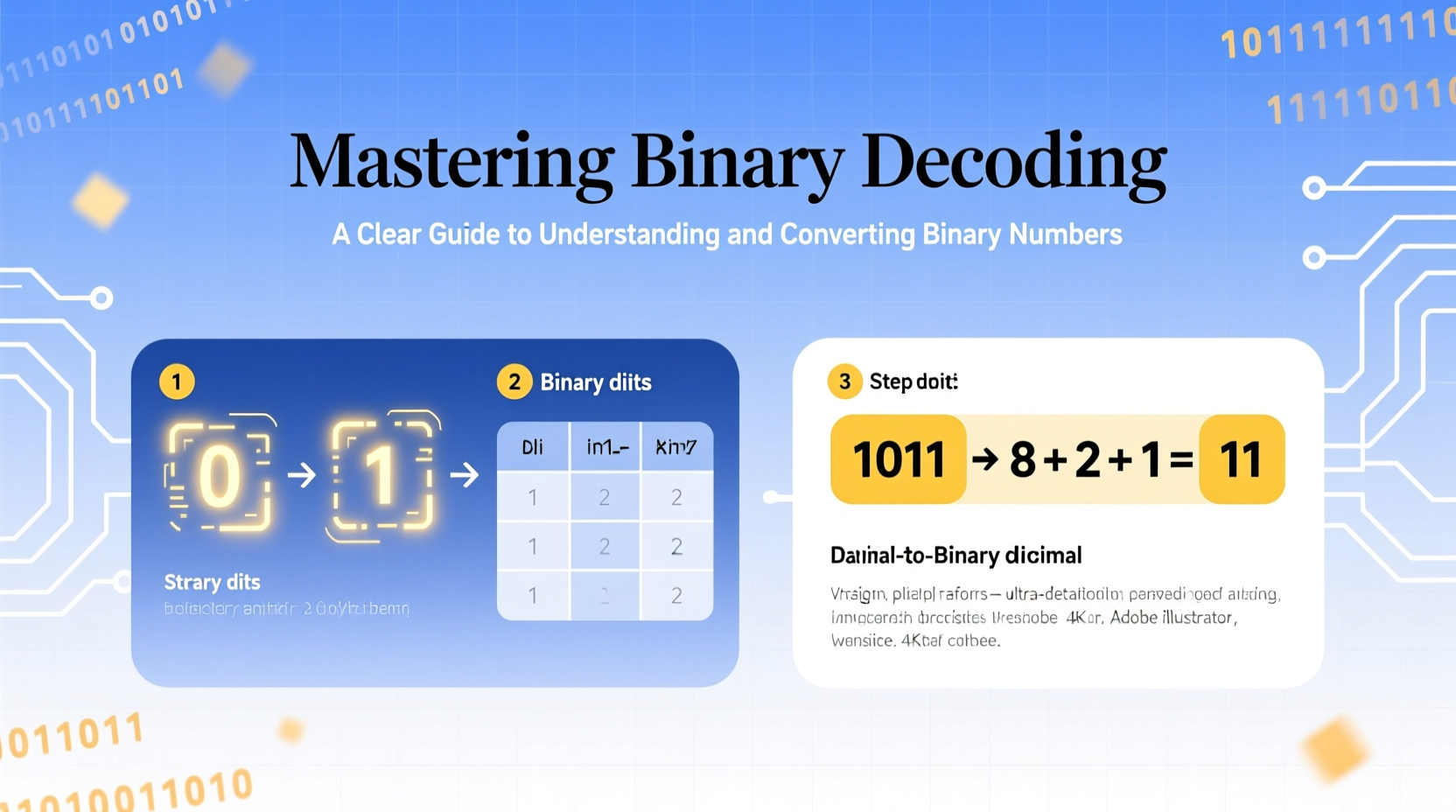
Binary is a base-2 numeral system, meaning it uses only two digits: 0 and 1. This contrasts with the decimal (base-10) system we use daily, which includes digits from 0 to 9. In computing, each binary digit—called a \"bit\"—represents an on (1) or off (0) state in electronic circuits. Groups of bits form larger units: 8 bits make a byte, which can represent values from 0 to 255.
The position of each bit in a binary number corresponds to a power of 2, starting from the rightmost bit (which represents \\(2^0 = 1\\)). As you move left, each position doubles in value: \\(2^1 = 2\\), \\(2^2 = 4\\), \\(2^3 = 8\\), and so on. This positional notation allows compact representation of large values using combinations of just two symbols.
How to Convert Binary to Decimal
Converting binary to decimal involves summing the powers of 2 where a '1' appears in the binary sequence. Let's walk through an example: converting 11010011 to decimal.
- Write down the binary number:
1 1 0 1 0 0 1 1 - Assign powers of 2 from right to left: \\(2^7\\) to \\(2^0\\)
- Map each bit to its place value:
- \\(2^7 = 128\\) → 1 → include
- \\(2^6 = 64\\) → 1 → include
- \\(2^5 = 32\\) → 0 → skip
- \\(2^4 = 16\\) → 1 → include
- \\(2^3 = 8\\) → 0 → skip
- \\(2^2 = 4\\) → 0 → skip
- \\(2^1 = 2\\) → 1 → include
- \\(2^0 = 1\\) → 1 → include
- Add included values: \\(128 + 64 + 16 + 2 + 1 = 211\\)
The binary number 11010011 equals 211 in decimal. With consistent practice, this method becomes intuitive.
Decimal to Binary Conversion Made Simple
To convert a decimal number back to binary, use repeated division by 2 and track the remainders. Let’s convert 186.
- Divide 186 by 2 → Quotient: 93, Remainder: 0
- Divide 93 by 2 → Quotient: 46, Remainder: 1
- Divide 46 by 2 → Quotient: 23, Remainder: 0
- Divide 23 by 2 → Quotient: 11, Remainder: 1
- Divide 11 by 2 → Quotient: 5, Remainder: 1
- Divide 5 by 2 → Quotient: 2, Remainder: 1
- Divide 2 by 2 → Quotient: 1, Remainder: 0
- Divide 1 by 2 → Quotient: 0, Remainder: 1
Now, read the remainders from bottom to top: 10111010. That’s the binary equivalent of 186.
| Decimal | Binary | Hexadecimal |
|---|---|---|
| 0 | 0000 | 0 |
| 5 | 0101 | 5 |
| 10 | 1010 | A |
| 15 | 1111 | F |
| 255 | 11111111 | FF |
Practical Applications and Real-World Example
Binary isn’t just theoretical—it powers real systems. Consider network communication, where IP addresses are processed in binary. A subnet mask like 255.255.255.0 translates to 11111111.11111111.11111111.00000000 in binary, defining which part of an IP address identifies the network versus the device.
“Understanding binary helps engineers debug low-level protocols and optimize data transmission.” — Dr. Alan Reed, Computer Systems Architect
Mini Case Study: Sarah, a junior developer, struggled to understand why her IoT device wasn’t responding to commands. After reviewing the data packets, she noticed a misaligned flag bit in the control byte. By decoding the binary payload, she discovered that a single flipped bit was disabling the receive mode. Correcting the configuration resolved the issue—demonstrating how binary literacy can solve real technical problems.
Common Pitfalls and How to Avoid Them
- Miscounting bit positions: Always start from the right (least significant bit) as \\(2^0\\).
- Forgetting leading zeros: An 8-bit representation of 5 is
00000101, not101. - Confusing binary with Boolean logic: While both use 0 and 1, binary is numerical; Boolean is logical (true/false).
Step-by-Step Guide to Master Binary Decoding
Follow this structured approach to build confidence and fluency:
- Learn the powers of 2 up to 256: Memorize \\(2^0\\) through \\(2^8\\).
- Practice 8-bit conversions daily: Pick random numbers between 0–255 and convert them.
- Use grid paper or tables: Align bits with their place values visually.
- Verify with tools: Cross-check your manual results using a calculator or online converter.
- Apply knowledge: Decode simple ASCII characters (e.g., ‘A’ = 65 =
01000001). - Advance to hexadecimal: Learn how binary groups into nibbles (4 bits) for hex conversion.
Essential Checklist for Binary Mastery
- ✅ Understand that binary is base-2
- ✅ Know the value of each bit position in an 8-bit byte
- ✅ Convert binary to decimal accurately
- ✅ Convert decimal to binary using division method
- ✅ Recognize common binary patterns (e.g., all 1s = 255)
- ✅ Apply binary concepts to real-world data formats
Frequently Asked Questions
Why do computers use binary instead of decimal?
Computers rely on electrical signals that are either on (1) or off (0). Binary provides a reliable, noise-resistant way to represent data using these two states. Transistors, the building blocks of processors, operate most efficiently in two distinct modes, making binary ideal for digital electronics.
Can binary represent fractions or negative numbers?
Yes. Fractions are handled using floating-point formats (like IEEE 754), where parts of the binary sequence represent the exponent and mantissa. Negative numbers are typically represented using two’s complement notation, which flips the bits and adds one to indicate negativity while preserving arithmetic consistency.
Is binary still relevant today with high-level programming?
Absolutely. Even if you're not writing assembly code, understanding binary improves debugging, memory management, and performance optimization. It’s essential for fields like cybersecurity, embedded systems, and data compression.
Conclusion: Unlock the Language of Machines
Binary decoding is more than a technical exercise—it’s a gateway to understanding the language of modern technology. Whether you're troubleshooting network issues, studying computer science, or simply satisfying intellectual curiosity, mastering binary empowers you to see beyond the surface of digital systems. The patterns will soon become second nature, revealing elegance in what once seemed impenetrable.




 浙公网安备
33010002000092号
浙公网安备
33010002000092号 浙B2-20120091-4
Comments
No comments yet. Why don't you start the discussion?