
Blackjack is one of the few casino games where skill can shift the odds in your favor. While luck plays a role in short-term outcomes, long-term success comes down to discipline, knowledge, and strategic precision. Among the most powerful tools in a skilled player’s arsenal is card counting—a method that tracks the ratio of high to low cards remaining in the deck. When applied correctly, it gives players a measurable edge over the house. This guide breaks down card counting into actionable steps, explains common systems, and provides practical advice for mastering the technique without drawing unwanted attention.
Understanding the Basics of Card Counting
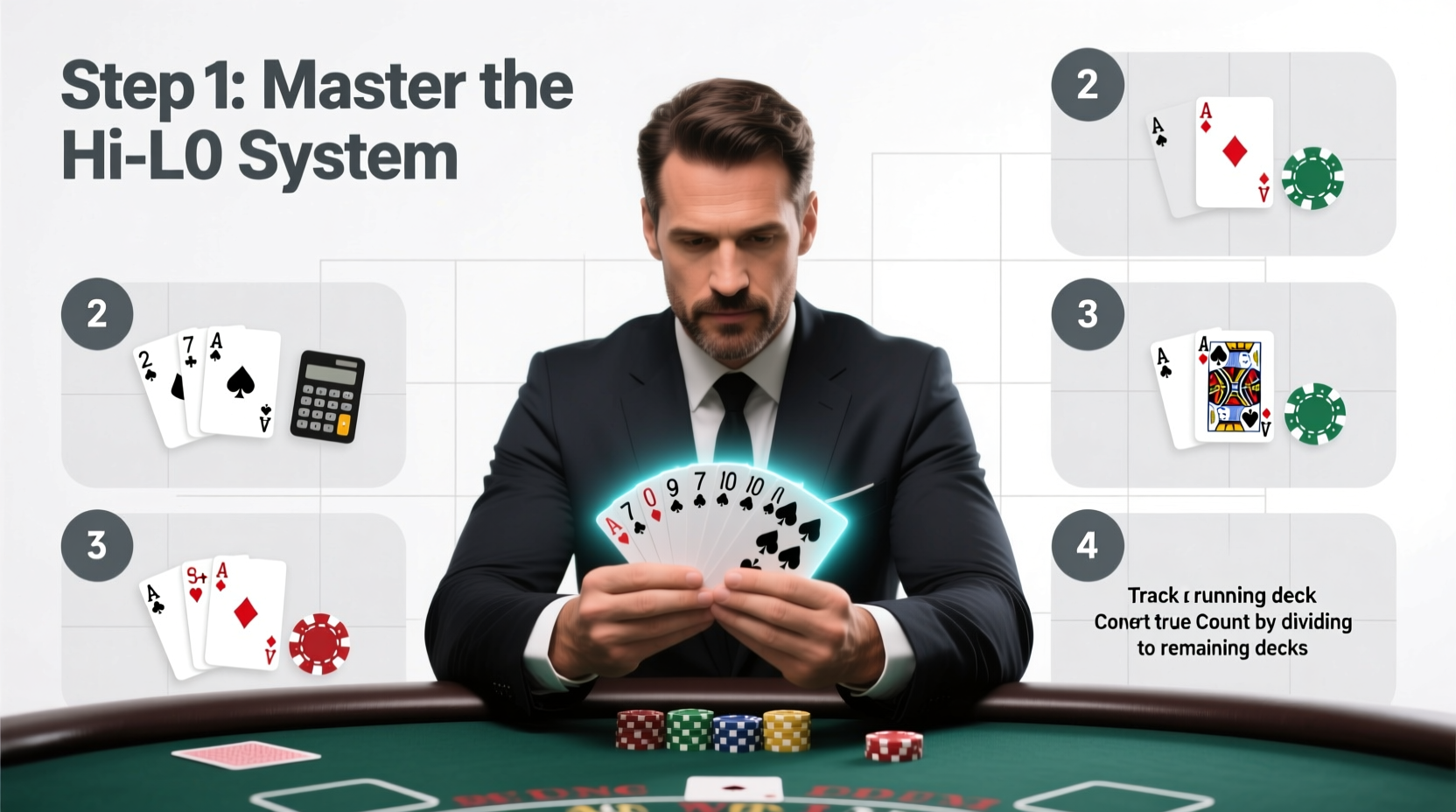
Card counting doesn’t involve memorizing every card dealt. Instead, it relies on a running tally based on card values. High cards (10s, face cards, and Aces) benefit the player because they increase the chances of landing blackjacks and successful double downs. Low cards (2 through 6) favor the dealer, who must hit until reaching 17 or higher. By tracking which types of cards have been played, you can estimate whether the remaining shoe is rich in player-friendly high cards or dealer-friendly low ones.
The core principle is simple: when the count is high, bet more; when it's low, bet less or leave the table. The goal isn't to win every hand but to maximize wins during favorable conditions.
The Hi-Lo System: A Practical Entry Point
Among various counting methods, the Hi-Lo system remains the most accessible and widely used. It assigns each card a value:
- +1: 2, 3, 4, 5, 6
- 0: 7, 8, 9
- –1: 10, J, Q, K, A
As each card is revealed, you adjust your running count accordingly. For example, if the first five cards are 4 (+1), 10 (–1), 7 (0), 2 (+1), and King (–1), your running count is 0.
In multi-deck games (common in casinos), convert the running count into a \"true count\" by dividing it by the estimated number of decks remaining. If your running count is +6 and roughly two decks remain, the true count is +3. This adjustment accounts for depth of penetration and ensures accuracy across different shoe sizes.
“Card counting isn’t about genius-level memory—it’s consistency, focus, and knowing when to act.” — Michael Konik, author of *The Smart Money: Inside the Hidden World of Sports Gambling*
Step-by-Step Guide to Building Your Counting Skill
Becoming proficient takes time and deliberate practice. Follow this structured timeline to develop fluency:
- Learn the point values of your chosen system (Hi-Lo recommended).
- Practice with a single deck: Flip one card at a time and maintain a running count. Aim to complete the full deck with a final count of 0 (since there are equal positive and negative values).
- Increase speed: Use a metronome app or timer to challenge yourself—work toward completing a deck in under 30 seconds with perfect accuracy.
- Add distractions: Practice while listening to music, watching TV, or having conversations to simulate real casino noise.
- Simulate gameplay: Deal hands to imaginary players and the dealer, updating the count after each card.
- Introduce betting correlation: Adjust fake bets based on the count—smaller bets at negative counts, larger ones at +2 or higher.
- Test in low-stakes environments: Visit local casinos or use live dealer online platforms to apply skills under pressure.
Key Strategies for Avoiding Detection
Casinos tolerate skilled players—but only up to a point. Once identified as a counter, you may be asked to stop playing blackjack or even barred. To extend your longevity at the tables, adopt camouflage tactics:
| Do | Don’t |
|---|---|
| Vary bet sizes gradually | Jump from minimum to maximum bets abruptly |
| Mix basic strategy deviations naturally | Make unusual plays consistently only when the count is high |
| Talk casually with dealers and other players | Appear overly focused or mechanical |
| Take occasional breaks or switch tables | Play for hours straight with intense concentration |
| Occasionally tip dealers | Act suspiciously when surveillance cameras pan your way |
Real Example: A Night at a Las Vegas Strip Casino
James, an experienced hobbyist counter, arrived at a mid-tier Strip casino during a weekday afternoon. He joined a six-deck shoe game with a $10 minimum bet. Over the first hour, he maintained a neutral count, betting $10–$15 per hand and chatting with the dealer about sports. As penetration passed 60%, the running count climbed to +8. With roughly two decks left, the true count reached +4—a strong player advantage.
Instead of doubling his bet immediately, James waited two rounds, then increased to $40. Over the next few hands, he received two blackjacks and a successful double down on 11. He cashed out after a $320 profit, thanked the dealer, and moved to craps for an hour before returning later under a different pit section. His behavior never triggered heat, and he avoided facial recognition alerts by wearing sunglasses intermittently.
This case illustrates how discipline, pacing, and behavioral awareness matter just as much as counting accuracy.
Essential Checklist Before Going Live
Before stepping into a casino with the intent to count, ensure you’ve mastered these fundamentals:
- ✓ Accurately maintain a running count through a full deck within 25 seconds
- ✓ Correctly calculate true count in multi-deck shoes
- ✓ Memorize and execute perfect basic strategy for the game rules you’ll face
- ✓ Simulate betting spreads (e.g., 1–12 units) without hesitation
- ✓ Handle distractions without losing count
- ✓ Recognize common rule variations (S17 vs H17, DAS, surrender) and their impact on strategy
- ✓ Have a bankroll large enough to withstand variance (at least 50 times your max bet)
Frequently Asked Questions
Is card counting illegal?
No, card counting is not illegal under U.S. federal law. It is considered a legal form of advantage play. However, casinos are private properties and can refuse service to anyone they suspect of gaining an edge. Being caught may result in being banned or escorted off premises.
Can I count cards in online blackjack?
In most online casinos using random number generators (RNGs), cards are effectively reshuffled after every hand, making counting useless. However, some live dealer games with continuous shoe shufflers or poor penetration offer limited opportunities. Even then, detection software and frequent reshuffling minimize effectiveness. Online counting is generally not profitable.
How much of an edge can I gain?
A skilled counter using Hi-Lo and optimal strategy can achieve a 0.5% to 1.5% edge over the house under favorable conditions. This doesn’t guarantee profits every session but increases expected value over thousands of hands. Success requires patience and emotional control.
Conclusion: Turn Knowledge Into Advantage
Mastering blackjack card counting is not a shortcut to riches—it’s a disciplined pursuit that blends math, psychology, and operational stealth. The real challenge lies not in learning the system, but in applying it consistently while blending in. With enough practice, you can transform blackjack from a game of chance into one of calculated opportunity.
Start small, train daily, and treat every session as part of a longer journey. Whether you’re playing for recreation or aiming to make consistent gains, the principles outlined here lay the foundation for lasting success. The cards don’t care who you are—but they do respond to those who understand them best.




 浙公网安备
33010002000092号
浙公网安备
33010002000092号 浙B2-20120091-4
Comments
No comments yet. Why don't you start the discussion?