
A well-placed brooch can elevate an outfit from simple to sophisticated, adding personality, structure, and a touch of vintage elegance. Yet, many overlook one critical detail: proportion. The size of your brooch relative to your dress type determines whether it enhances or overwhelms your look. A delicate piece on a voluminous gown may vanish, while an oversized statement brooch on a slim sheath can dominate the silhouette.
Understanding how to match brooch scale with dress design ensures your accessory complements rather than competes. From neckline balance to fabric weight and occasion context, several factors guide the ideal choice. With thoughtful selection, a brooch becomes more than decoration—it becomes an intentional extension of style.
Dress Silhouette and Brooch Proportion
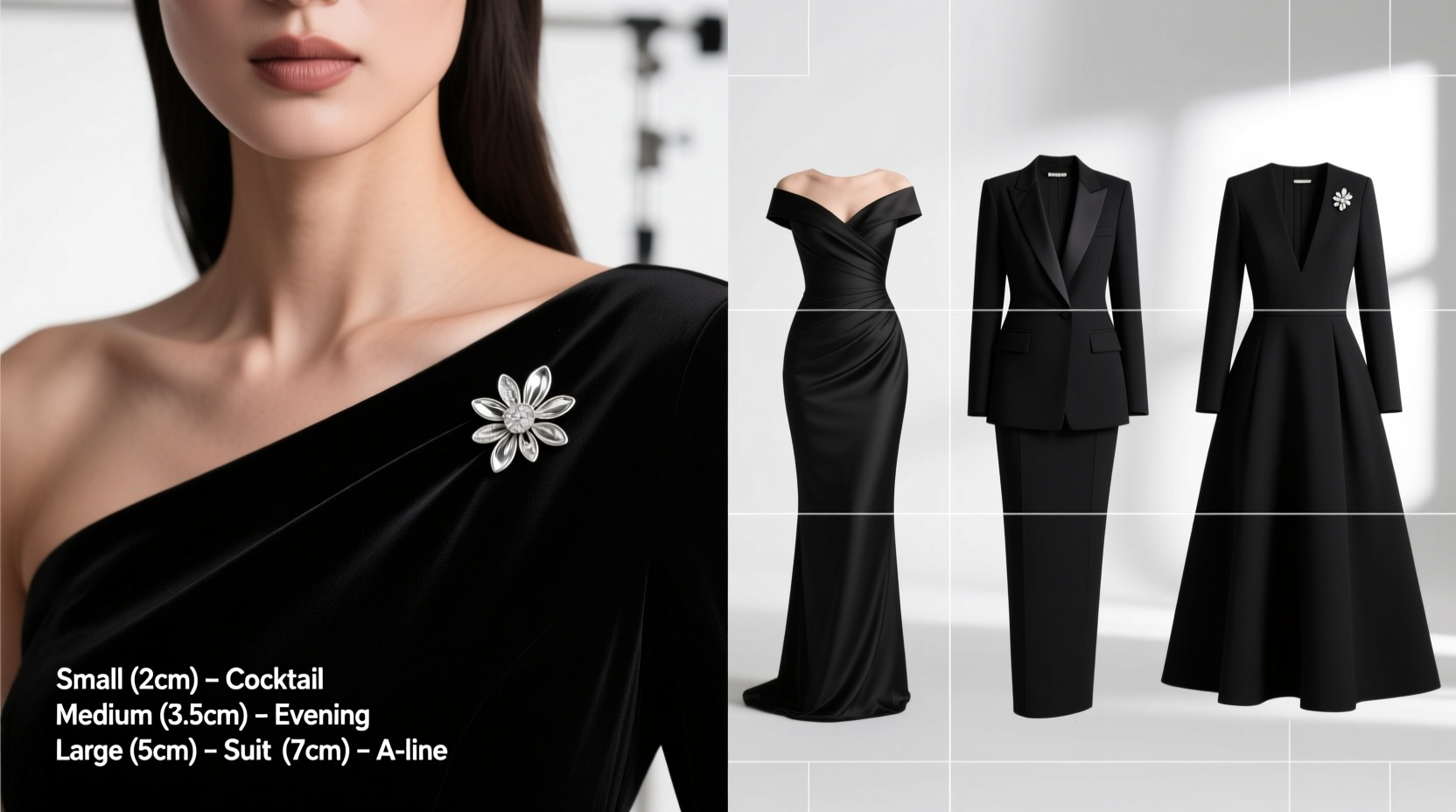
The shape and volume of a dress dictate how much visual weight an accessory can carry. A full ballgown commands a bolder accent, whereas a minimalist slip dress calls for subtlety. Consider these pairings:
- Voluminous dresses (ballgowns, A-line, tiered skirts): Opt for medium to large brooches (1.5–3 inches). These anchor the eye without getting lost in fabric folds.
- Fitted styles (sheath, bodycon, pencil-cut): Choose small to medium brooches (0.75–1.5 inches) to maintain clean lines and avoid overcrowding.
- Empire waist or high-hemline designs: A centered brooch just below the bust works best—size should be moderate (1–2 inches) to emphasize the waist without distorting proportions.
- Asymmetrical cuts: Use a single bold brooch as a focal point near the shoulder or hip to enhance the imbalance intentionally.
Neckline Compatibility and Placement Logic
The neckline frames the upper body and directly influences where and how big a brooch should be. Misplaced accessories disrupt harmony; strategic ones refine it.
| Neckline Type | Recommended Brooch Size | Best Placement |
|---|---|---|
| Scoop | Medium (1.25–2\") | Centered at collarbone base |
| V-neck | Vertical or elongated, medium-large | Along the center seam, stopping above the bust |
| Boatneck | Small to medium (1–1.5\") | Off-center, near one shoulder |
| Turtleneck | Small or pin-style (under 1\") | At the side of the neck or clipped to folded fabric |
| Strapless | Medium-large (1.5–2.5\") | Centered at the top edge or cascading diagonally |
For deep V-necks, consider a brooch that mirrors the angle—its shape should follow the line, not cross it abruptly. On boatnecks, asymmetry prevents stiffness. With strapless styles, larger brooches compensate for the lack of straps by providing visual interest where shoulders meet the torso.
Fabric Weight and Structural Balance
Delicate fabrics like chiffon or silk organza cannot support heavy or oversized brooches without distortion. Conversely, structured wools and faille can handle substantial pieces.
Lightweight materials call for lightweight accessories. A 3-inch rhinestone brooch on a sheer blouse may cause sagging or create an unflattering pull. Instead, choose flat-backed or resin-based options under 1.5 inches. For heavier fabrics—such as crepe, satin duchesse, or wool crepe—you can explore dimensional brooches with depth and heft.
“Balance is everything. A brooch should sit naturally on the fabric, not fight against it.” — Clara Montague, Vintage Accessory Curator at The Atelier Archive
Consider texture, too. Matte brooches suit matte fabrics; shiny pieces amplify luster in satins and sequins. Avoid clashing finishes unless making a deliberate contrast—for example, pairing a rustic copper brooch with raw-edged linen for bohemian flair.
Step-by-Step Guide: Choosing Your Ideal Brooch Size
Follow this five-step process to ensure perfect sizing for any dress:
- Assess the dress silhouette. Is it full, fitted, or fluid? This determines the maximum visual weight the garment can carry.
- Identify the focal zone. Common areas: neckline, waist, shoulder, or hip. Choose one primary placement to avoid clutter.
- Match brooch size to focal area. As a rule: smaller zones (like lapels) need smaller brooches; broader zones (bustlines, sashes) allow larger ones.
- Test in context. Pin the brooch and view yourself in a full-length mirror from multiple angles. Does it draw attention appropriately?
- Adjust for occasion. Daywear favors subtlety (under 1.5\"); evening wear allows drama (up to 3\").
Real-World Example: Styling for a Garden Wedding
Sophia wore a tea-length floral cotton voile dress with cap sleeves and a sweetheart neckline to a spring garden wedding. She initially selected a large art deco brooch (2.8\") for her left shoulder but noticed it overwhelmed the softness of the fabric and pulled the sleeve slightly out of place.
She switched to a 1.25\" enamel butterfly brooch, placing it just off-center at the neckline’s peak. The smaller size harmonized with the dress’s whimsical print and lightweight weave. The final look was cohesive, elegant, and seasonally appropriate—proof that downsizing often elevates sophistication.
Brooch Styling Checklist
Before fastening your brooch, run through this checklist:
- ✅ Brooch size aligns with dress volume (not too small, not overpowering)
- ✅ Placement enhances, not distracts from, facial features
- ✅ Material and finish complement the fabric (e.g., no sharp edges on delicate lace)
- ✅ Securely fastened with a sturdy pin back or safety catch
- ✅ Appropriate for the event (professional, romantic, festive, etc.)
- ✅ Balanced with other accessories (e.g., if wearing bold earrings, keep brooch modest)
Frequently Asked Questions
Can I wear multiple brooches on one dress?
Yes, but only if they’re small and arranged with intention. Cluster three tiny brooches along a neckline for vintage flair, or align miniature pins down a button placket. Avoid scattering large brooches—they compete for attention and create visual chaos.
What size brooch works best on a blazer paired with a dress?
For a tailored blazer over a dress, stick to 1–1.75\". Place it at the lapel’s lower tip—the traditional “brooch point.” Larger brooches risk overlapping the dress neckline and creating imbalance.
Are vintage brooches harder to size correctly?
Vintage pieces often have unique dimensions and weights. Always assess them in context. Many vintage brooches are larger by modern standards, so use them sparingly—often as standalone statements on otherwise minimal dresses.
Final Thoughts: Style with Intention
Brooch styling is an art of precision and proportion. The ideal size isn’t dictated by trends alone, but by the dialogue between accessory and attire. When chosen thoughtfully, a brooch doesn’t just decorate—it defines.
Whether you’re accenting a work dress or transforming a heirloom gown, take a moment to evaluate scale, structure, and setting. Let each brooch serve a purpose: to highlight, to balance, to express. In doing so, you master not just accessorizing, but the deeper craft of personal style.




 浙公网安备
33010002000092号
浙公网安备
33010002000092号 浙B2-20120091-4
Comments
No comments yet. Why don't you start the discussion?