
Building a mechanical clock is more than a hobby—it’s an act of patience, precision, and reverence for centuries of engineering tradition. While modern life runs on digital time, there’s profound satisfaction in crafting a timepiece that ticks by gears, springs, and balance wheels you’ve assembled by hand. This guide walks through the essential principles, materials, and methods required to build your own functional clock, whether as a beginner or an aspiring horologist.
The Foundations of Mechanical Timekeeping
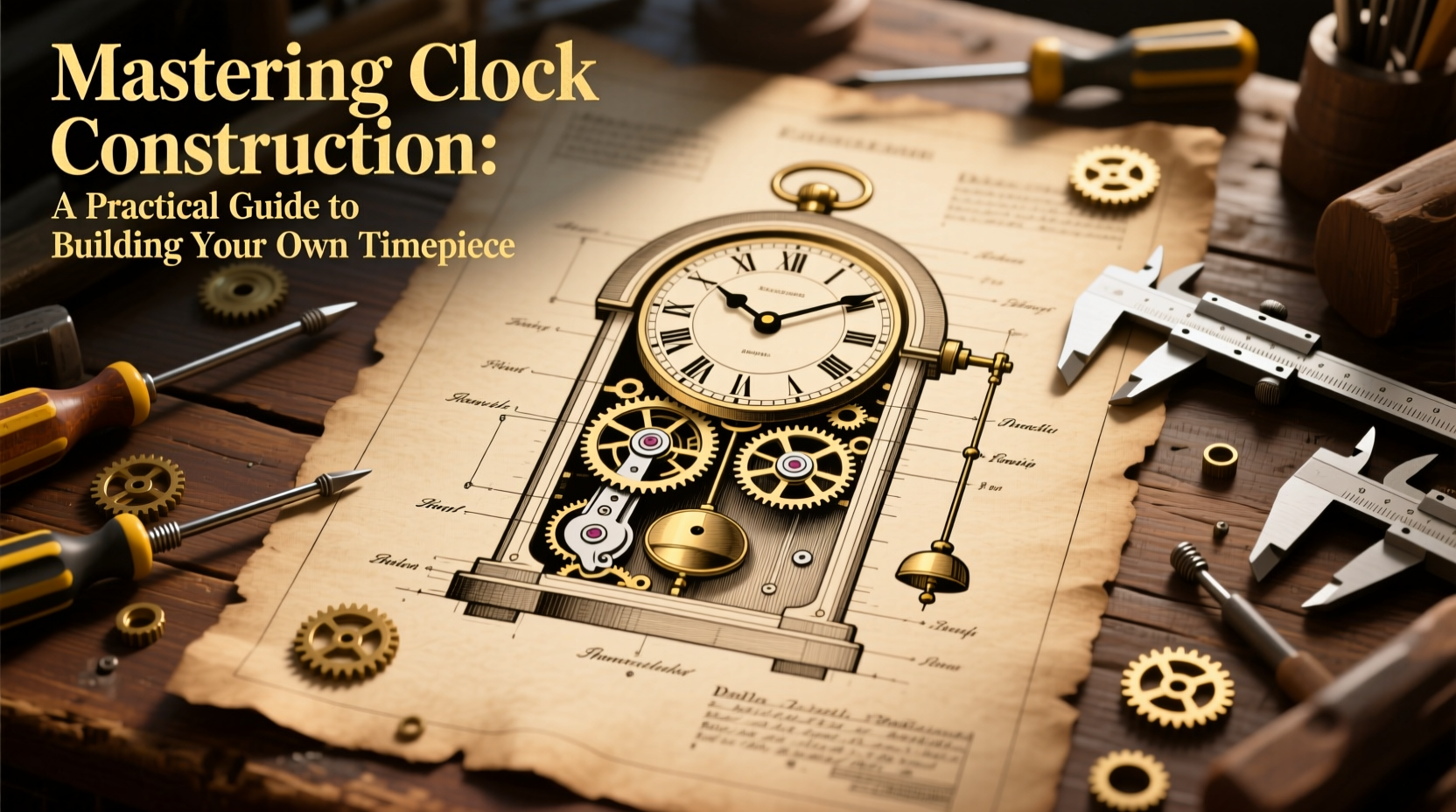
Before assembling parts, it's crucial to understand how mechanical clocks work. At its core, a clock converts stored energy—usually from a wound spring or hanging weight—into regulated motion through an escapement mechanism. This regulation ensures the hands move at a consistent rate. The three primary systems in any mechanical clock are:
- Power Source: Typically a mainspring or weight that stores potential energy.
- Timebase: The oscillator—most commonly a pendulum or balance wheel—that governs timing accuracy.
- Escapement: The mechanism that releases energy in precise increments, driving the gear train forward one step at a time.
Understanding these components allows you to design or modify a clock system with confidence. For beginners, starting with a weight-driven pendulum clock simplifies calibration and troubleshooting.
Essential Tools and Materials
Constructing a clock doesn’t require industrial machinery, but precision tools make all the difference. Most components can be fabricated using hand tools if access to a workshop is limited.
| Tool/Material | Purpose | Recommended Specs |
|---|---|---|
| Micrometer or Digital Caliper | Measuring gear teeth, shaft diameters | 0.01mm precision |
| Pillar Drill or Precision Hand Drill | Creating aligned holes in plates | Variable speed, adjustable table |
| Fine Files and Burnishers | Smoothing gear edges and pivots | Needle files, diamond-coated |
| Bronze or Brass Sheet (1–3mm) | Frame and gear blanks | Easily machinable, corrosion-resistant |
| Steel Rod (1–2mm diameter) | Arbor and pinion construction | Hardened steel for durability |
| Lubricating Oil (Clock-specific) | Reducing friction in pivots | Synthetic, low-viscosity |
Many hobbyists begin with laser-cut brass kits available online, which provide pre-designed gears and frames. However, true mastery comes from designing and fabricating components independently.
Step-by-Step: Building a Pendulum Clock Movement
Follow this sequence to construct a basic weight-driven, pendulum-regulated wall clock. This process assumes moderate workshop skills and approximately 40–60 hours of focused work.
- Design the Gear Train: Calculate gear ratios so the second hand completes one revolution per minute. A typical layout includes a center wheel (60-second rotation), third wheel, fourth wheel (one-minute rotation), and escape wheel (driven by escapement).
- Cut and Finish Plates: Using brass sheet, cut two parallel frame plates. Mark pivot hole positions accurately with a marking gauge and punch. Drill holes slightly undersized, then ream to exact diameter.
- Manufacture Gears: Cut gear blanks from brass. Use a dividing head or protractor to mark tooth positions. Cut teeth with a fine jeweler’s saw or use a gear cutter if available. Polish flanks to reduce friction.
- Assemble Arbors and Pivots: Turn steel arbors on a lathe to match gear bores. Create polished pivots at each end (typically 0.8–1.2mm). Ensure smooth rotation with minimal wobble.
- Install Escapement: Mount the anchor escapement between the escape wheel and pendulum rod. Adjust drop and lock so the pallet stones engage cleanly with escape teeth.
- Attach Power System: Install a going barrel or connect a cord to a suspended weight. Route the cord over a pulley to transfer force smoothly into the first gear.
- Test and Regulate: Start the pendulum. Observe beat (tick-tock symmetry). Adjust crutch angle until even. Fine-tune timekeeping by altering pendulum length via a regulating nut.
Common Pitfalls and How to Avoid Them
Even experienced builders encounter setbacks. Recognizing common errors early prevents wasted effort.
- Gear Binding: Caused by misaligned plates or oversized pivots. Always check endshake (axial movement) during assembly.
- Inconsistent Beat: Results in stuttering or stopping. Re-level the clock and adjust the crutch so impulse is symmetrical.
- Power Loss: Friction in multiple stages can stall the train. Polish gear teeth, ensure proper meshing depth, and verify lubrication points.
- Temperature Sensitivity: Metal expands with heat, affecting pendulum period. Use invar rods or compensate in design for better stability.
“Clockmaking teaches humility. Even a deviation of 0.05 millimeters can stop a movement. Precision isn’t optional—it’s the foundation.” — Thomas Rennick, Master Horologist and Restoration Specialist
Real Example: The First Homemade Mantel Clock
Daniel Reyes, a high school physics teacher in Vermont, spent eight months building his first clock after retiring. With no prior machining experience, he started with a book on traditional clock design and purchased a small benchtop lathe. He used recycled brass from old plumbing fittings and crafted every gear by hand filing.
His initial prototype failed to run beyond 30 seconds due to excessive friction in the third wheel. After consulting a local watchmaker, Daniel discovered the arbor was bent by 0.1mm—imperceptible to the eye but catastrophic in motion. He replaced it, adjusted the escapement lock, and achieved continuous operation. His clock now keeps time within ±2 minutes per week and sits proudly on his mantelpiece.
Daniel’s story underscores a key truth: success in clockmaking often lies not in perfection, but in persistence and iterative refinement.
Checklist: Pre-Startup Evaluation
Before winding your clock for the first time, go through this checklist:
- ✅ All gears rotate freely without binding
- ✅ Pivot holes are clean, properly sized, and aligned
- ✅ Escapement engages with correct drop and lock
- ✅ Pendulum swings evenly with no lateral wobble
- ✅ Power transmission is smooth from source to escape wheel
- ✅ Only clock-specific oil applied to pivot points
- ✅ Clock is level and securely mounted
FAQ
Can I build a clock without a workshop?
Yes, but with limitations. Simple wooden clocks with pre-cut gears are feasible using hand tools. For metal movements, access to a drill press and calipers is strongly recommended. Consider joining a makerspace for equipment access.
How accurate can a homemade clock be?
A well-built pendulum clock can achieve ±1 minute per week. Accuracy depends on temperature compensation, consistent power delivery, and regular maintenance. Atomic or quartz clocks are far more precise, but mechanical clocks value craftsmanship over raw accuracy.
What’s the hardest part of building a clock?
Most builders cite the escapement as the most challenging. It requires micro-adjustments and a deep understanding of timing geometry. Patience and observation are critical—many problems resolve with minor tweaks rather than complete disassembly.
Conclusion: Begin Your Journey in Time
Mastering clock construction is a rare blend of science, artistry, and discipline. Each gear shaped, each beat heard, connects you to centuries of innovation. Whether you start with a kit or draft your own plans, the process reshapes your perception of time—not as something merely measured, but as something made.




 浙公网安备
33010002000092号
浙公网安备
33010002000092号 浙B2-20120091-4
Comments
No comments yet. Why don't you start the discussion?