
In a world where creativity fuels childhood development, building block toys remain one of the most enduring and educational tools available. From fostering problem-solving skills to encouraging imaginative storytelling, these toys offer far more than simple entertainment. But as any parent or educator knows, not all blocks are created equal—especially when it comes to mixing sets from different brands or age groups. True mastery lies in understanding compatibility: knowing which pieces connect, which themes align, and how to build a collection that grows with the child without creating frustration or wasted investment.
The challenge isn’t just about avoiding mismatched bricks; it’s about curating a cohesive, expandable ecosystem of play. With dozens of brands on the market—some open-source, others tightly proprietary—the task can feel overwhelming. Yet with the right knowledge, choosing compatible building blocks becomes not only manageable but empowering.
Understanding Brick Dimensions and Connector Systems
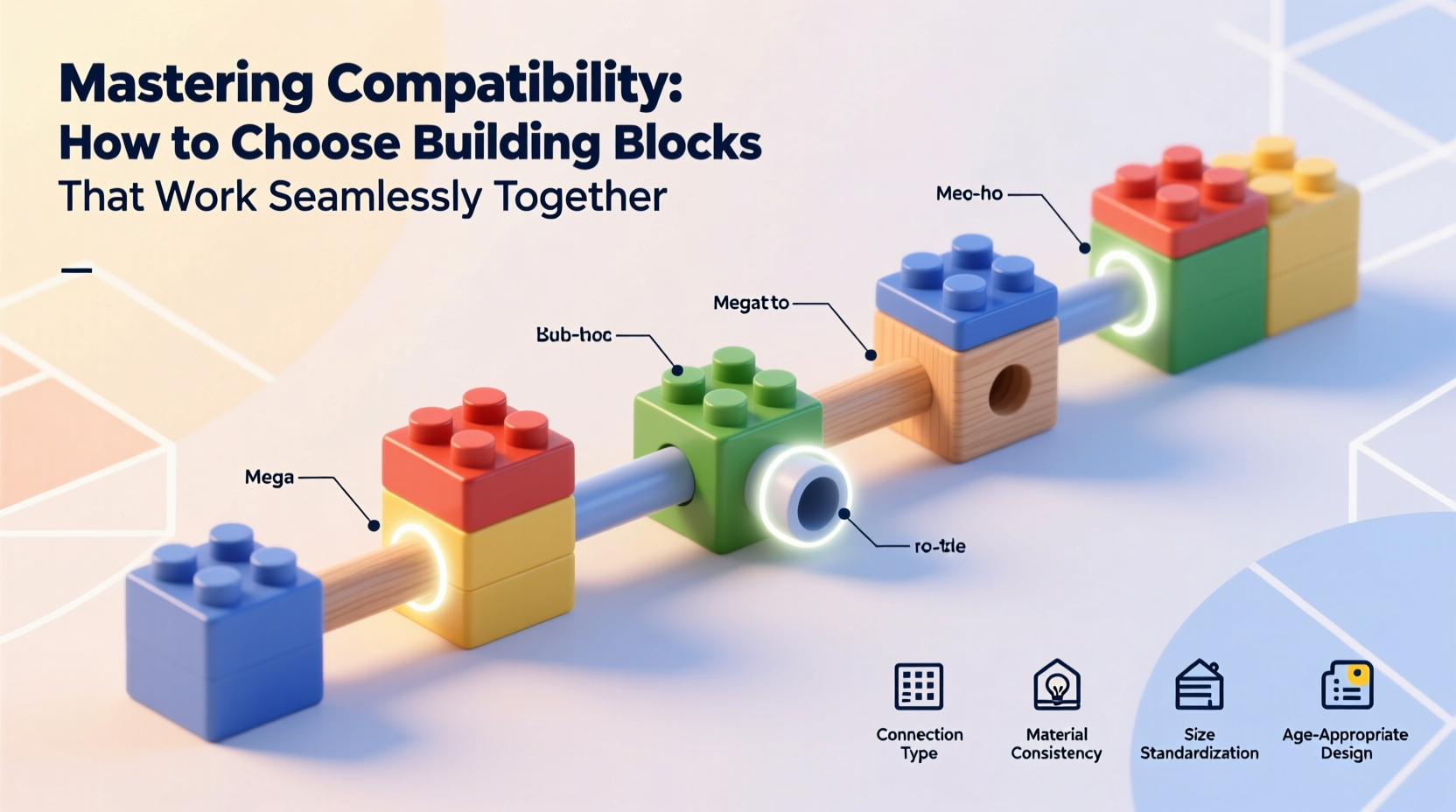
The foundation of compatibility is physical design. Most modern building blocks rely on a stud-and-tube coupling system pioneered by LEGO in the 1950s. This design uses cylindrical studs on top and hollow tubes underneath, allowing bricks to interlock securely while still being easy for small hands to separate.
Brands like Mega Bloks (now Mega Construx), Best-Lock, and Kreo have reverse-engineered this system to varying degrees of success. However, subtle differences in plastic composition, stud diameter, or tube depth can lead to inconsistent connections—either too loose or too tight. Over time, poorly matched bricks may wear each other down or break during disassembly.
Micro-scale blocks, such as those used in LEGO’s Technic or DUPLO lines, operate under different dimensional rules. DUPLO bricks, designed for toddlers, are twice the height, width, and depth of standard LEGO bricks and feature larger studs. While they’re engineered to be compatible with regular LEGO (a smaller brick can attach to the top of a DUPLO piece), the reverse isn’t always stable. Similarly, LEGO Juniors or LEGO Classic sets maintain full compatibility but simplify builds for younger users.
Brand Compatibility: What Works Together—and What Doesn’t
Not all toy companies prioritize interoperability. Some embrace cross-compatibility as a selling point; others protect their designs through patents and unique geometries. The following table outlines major brands and their compatibility with standard LEGO bricks:
| Brand | Compatible with LEGO? | Notes |
|---|---|---|
| LEGO (all lines) | Yes (self-compatible) | DUPLO connects top-down to LEGO; mini-figures not interchangeable with non-LEGO brands. |
| Mega Construx | Largely yes | Slight variance in fit; some users report brittleness over time. |
| Best-Lock | Yes | Budget-friendly alternative; tolerances are close but not perfect. |
| Kreo / Kre-O | Mostly | Designed for Transformers line; some pieces fit, others have modified connectors. |
| Playmobil Building Blocks | No | Uses entirely different connector system; focus on figures and role-play. |
| KNEX | No | Rod-and-connector model; not stackable with brick-style systems. |
| Cobi (brick-based) | Yes | Polish brand using military/historical themes; excellent LEGO fit. |
Third-party manufacturers often emphasize compatibility as a competitive advantage. For example, Cobi markets its precise engineering and strong clutch power as key benefits for LEGO owners looking to expand affordably. Meanwhile, brands like Magformers or Picasso Tiles use magnetic connections, offering creative freedom but zero structural compatibility with stud-based systems.
“True interoperability isn’t just about connecting bricks—it’s about enabling continuity in a child’s creative journey.” — Dr. Lena Patel, Child Development Researcher, University of Edinburgh
Designing a Future-Proof Block Collection
A smart building block strategy considers both immediate fun and long-term value. Children grow quickly, and their interests evolve—from basic stacking at age 3 to complex mechanical builds by age 10. A well-chosen collection should scale accordingly.
Start with foundational sets: neutral-colored basics in various sizes. These allow open-ended play and integrate easily with themed kits added later. Avoid overspending on licensed sets (e.g., superheroes, movie tie-ins) unless the child shows sustained interest, as these often limit versatility and depreciate faster.
Step-by-Step Guide to Building a Compatible System
- Assess current inventory: Take stock of what you already own—brands, piece types, and condition.
- Define primary goals: Is the focus on creativity, STEM learning, or character-based storytelling?
- Select a core brand: Choose one dominant system (e.g., LEGO) as your base for consistency.
- Add compatible supplements: Introduce third-party bricks known for good fit (e.g., Cobi, Best-Lock) to stretch budgets.
- Integrate specialty lines carefully: Use Technic, Boost, or Architecture sets to introduce advanced concepts without disrupting core play.
- Plan for storage and organization: Use labeled bins by size, color, or type to prevent mix-ups and lost pieces.
Real-World Example: The Thompson Family’s Unified Play System
The Thompsons started collecting building blocks when their son, Eli, was four. Initially, they bought random clearance sets—some LEGO, some Mega Bloks, a few off-brand boxes from discount stores. By age six, Eli wanted to combine his spaceship and castle, but the walls wouldn’t stay upright. Bricks slipped apart, wheels didn’t fit axles, and frustration replaced fun.
After consulting online forums and testing sample bricks, they decided to standardize around LEGO as their core system. They donated non-compatible sets and invested in LEGO Classic boxes filled with basic bricks. Later, they added select Mega Construx Pokémon sets because Eli loved the characters—and discovered the bricks connected well enough for display builds, if not structural ones.
Today, at age nine, Eli builds multi-level dioramas using mostly LEGO, with thematic accents from compatible brands. His parents credit the shift with reducing cleanup stress and increasing creative confidence. “He doesn’t waste time forcing pieces together anymore,” says his mother, Rachel. “Now he spends that energy designing.”
Essential Checklist for Choosing Compatible Blocks
- ✅ Verify that new bricks physically attach to your existing collection.
- ✅ Prioritize brands with proven interoperability (e.g., Cobi, Best-Lock).
- ✅ Match age-appropriateness to developmental stage—don’t mix DUPLO and Technic unsupervised.
- ✅ Stick to one primary brand to ensure consistent minifigures, accessories, and instructions.
- ✅ Check material quality—flexible or brittle plastics compromise durability and safety.
- ✅ Consider secondary systems (like KNEX or Magna-Tiles) as complements, not replacements.
- ✅ Organize by compatibility group to avoid confusion during playtime.
Frequently Asked Questions
Can I safely mix LEGO and Mega Construx bricks?
Yes, in most cases. Mega Construx (formerly Mega Bloks) is designed to be largely compatible with LEGO, especially in standard brick sizes. However, some users note slight differences in clutch power—connections may be looser or tighter than expected. Avoid combining them in load-bearing structures unless tested first.
Are third-party building blocks safe and durable?
Many are, but quality varies. Reputable brands like Cobi and Best-Lock meet international safety standards (EN71, ASTM F963) and use ABS plastic similar to LEGO. Avoid unknown brands with poor reviews or unusually soft or chalky materials, as these may degrade faster or pose choking hazards.
Do specialty sets ruin compatibility?
Not inherently, but they require careful integration. For example, LEGO Technic uses pins, beams, and gears instead of traditional bricks. These don’t stack conventionally but can be incorporated into larger builds with adapters. Teach children how to transition between systems so creativity isn’t limited by technical gaps.
Conclusion: Build Smarter, Not Harder
Choosing building block toys that work seamlessly together isn’t just about convenience—it’s an investment in uninterrupted creativity and lasting engagement. When pieces connect reliably, children spend less time struggling and more time inventing. When collections grow cohesively, families avoid redundancy and waste. And when compatibility is mastered, play becomes a continuous journey rather than a series of disjointed attempts.
The best toy collections aren’t defined by quantity, but by harmony. Start with a clear foundation, test additions rigorously, and prioritize systems that support growth. Whether you're equipping a classroom, stocking a playroom, or selecting a gift, remember: the strongest structures begin with thoughtful planning.




 浙公网安备
33010002000092号
浙公网安备
33010002000092号 浙B2-20120091-4
Comments
No comments yet. Why don't you start the discussion?