
Enchanted books are among the most versatile and valuable items in Minecraft. Unlike enchanted gear, which comes pre-applied, enchanted books allow players to selectively apply powerful effects to their tools, weapons, and armor. Whether you're preparing for a deep-mining expedition or gearing up for a battle against the Ender Dragon, understanding how to use and combine enchanted books effectively can dramatically improve your survival and efficiency.
This guide covers everything from acquiring enchanted books to mastering the anvil system for combining enchantments. By the end, you’ll know how to build optimal gear setups, avoid common pitfalls, and maximize your investment in enchantment resources.
How to Obtain Enchanted Books
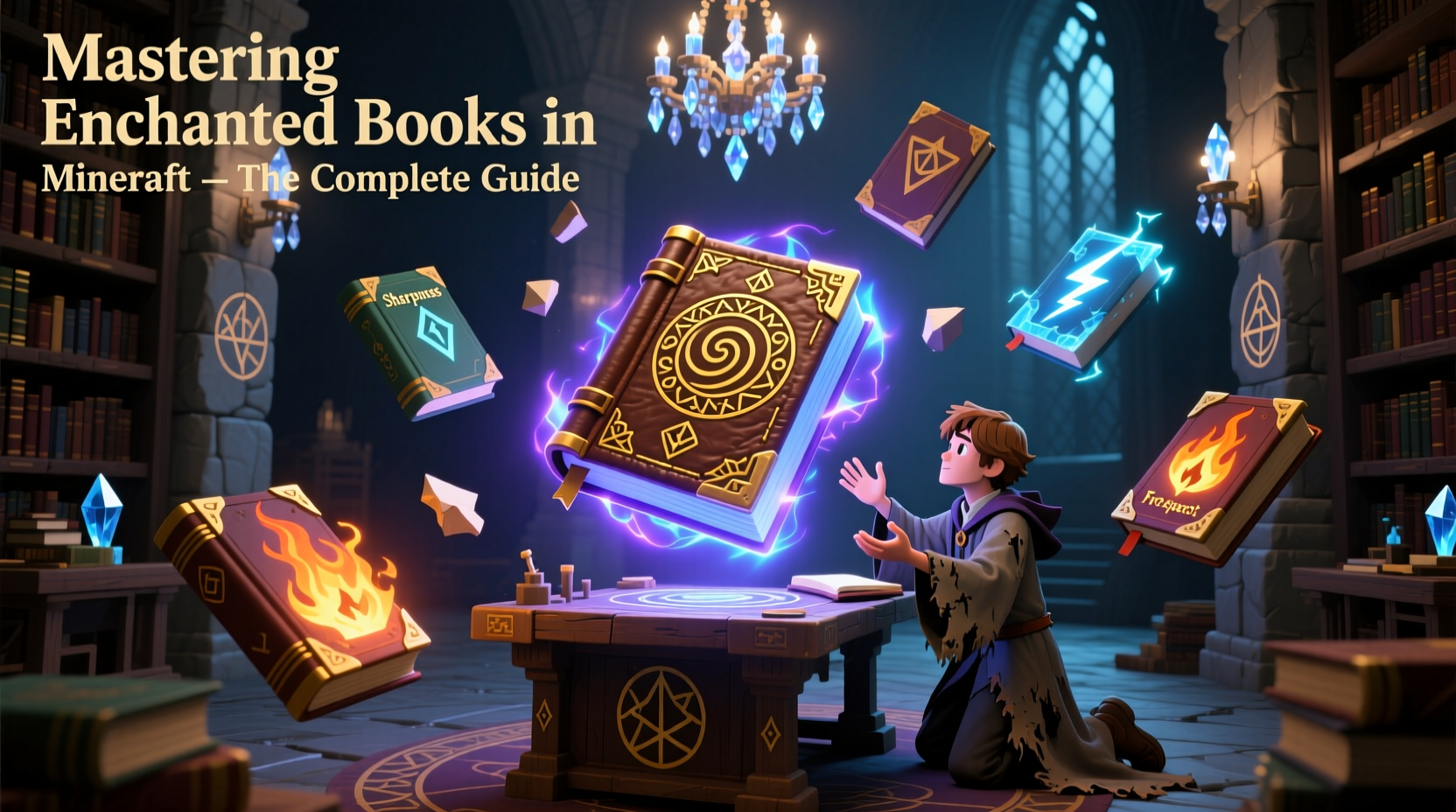
Enchanted books can be acquired through several methods, each with varying levels of reliability and resource cost:
- Villager Trading: Librarian villagers offer enchanted books in exchange for emeralds. With proper village mechanics and trading setup, this becomes a renewable source.
- Looting Chests: Found in structures like dungeons, strongholds, and woodland mansions. These often contain rare enchantments such as Mending or Thorns III.
- Fishing: Using an unenchanted fishing rod, players can catch treasure items, including enchanted books. Adding Luck of the Sea increases the odds.
- Enchantment Table: Place a book on an enchantment table to generate random enchanted books. Higher-level enchantments require more experience and bookshelves.
- Trading with Piglins: In the Nether, offering gold ingots may yield enchanted books, especially those related to combat like Sharpness or Fire Protection.
Applying Enchantments Using an Anvil
The anvil is the primary tool for applying enchanted books to gear. It allows precise control over which enchantments are added without affecting existing ones (in most cases).
- Place the item you want to enchant in the first anvil slot.
- Place the enchanted book in the second slot. <3>Observe the output preview and ensure the enchantment will apply correctly.
- Confirm the action, paying the required experience cost.
Each use increases the \"prior work penalty,\" raising the XP cost for future repairs or enchantments. Renaming items at the anvil does not trigger this penalty, making it a useful strategy to reduce long-term costs.
“Smart anvil use isn’t just about power—it’s about sustainability. A well-managed naming and combining strategy saves hundreds of XP levels over time.” — Alex Turner, Minecraft Mechanics Analyst
Combining Enchantments: Rules and Strategies
Not all enchantments can coexist. Some are incompatible due to game design logic. For example, Sharpness, Smite, and Bane of Arthropods cannot appear together on the same sword. Similarly, Silk Touch and Fortune are mutually exclusive on tools.
When combining enchanted books or items at the anvil, Minecraft follows specific rules:
- If both items have the same enchantment, the higher level is kept, sometimes increasing by one (e.g., two Efficiency IV books may produce Efficiency V).
- Incompatible enchantments cancel each other out and won't transfer.
- Different but compatible enchantments stack onto the target item.
Optimal Enchantment Combos for Key Gear
| Gear Type | Recommended Enchantments | Notes |
|---|---|---|
| Diamond Pickaxe | Efficiency V, Unbreaking III, Mending, Fortune III | Fortune III maximizes ore and resource drops. |
| Netherite Sword | Sharpness V, Fire Aspect II, Knockback II, Sweeping Edge III | Avoid Smite/Bane if fighting diverse mobs. |
| Helmet | Protection IV, Respiration III, Aqua Affinity | Essential for underwater exploration. |
| Chestplate | Protection IV, Unbreaking III, Mending | Mending extends durability significantly. |
| Boots | Protection IV, Feather Falling IV, Depth Strider III, Soul Speed* | *Soul Speed only works on soul soil; don’t combine with others. |
Step-by-Step: Building a Fully Enchanted Diamond Armor Set
Follow this sequence to efficiently enchant a full set of diamond armor using enchanted books:
- Gather Materials: Collect 24 enchanted books covering desired effects (e.g., Protection IV, Unbreaking III, Mending).
- Prepare the Anvil: Ensure you have at least 40+ levels available per major enchantment application.
- Start with Boots: Apply Protection IV, then Unbreaking III, and finally Mending. Rename after each step to minimize XP cost increase.
- Repeat for Leggings, Chestplate, Helmet: Follow the same process, prioritizing high-cost enchantments first.
- Add Specialized Effects: Include Respiration and Aqua Affinity on the helmet if used for diving.
- Store Safely: Keep backup enchanted books in a chest for future repairs or reapplication.
This method ensures minimal XP waste and preserves compatibility across enchantments.
Common Mistakes to Avoid
- Applying incompatible enchantments: Double-check combinations before using the anvil.
- Ignoring the prior work penalty: Failing to rename items leads to exponentially higher repair costs.
- Wasting high-level books on low-tier gear: Save Mending and Protection IV for diamond or netherite equipment.
- Overlooking book durability: Enchanted books themselves don’t degrade, so store them safely for later use.
Mini Case Study: The Overloaded Sword
Jamal spent hours collecting books: Sharpness V, Fire Aspect II, Looting III, and Knockback II. Excited, he applied them all to his iron sword in one go. After the third enchantment, the anvil demanded 42 levels—more than he had. He couldn’t complete the set and lost progress when the server restarted.
He learned to rename the sword after each enchantment, reducing cumulative cost. On his next attempt, he successfully built a fully enchanted diamond sword using the same books, spending less than half the total XP.
FAQ
Can I remove an unwanted enchantment from an item?
No, Minecraft does not allow direct removal of enchantments. However, you can use the grindstone to remove all enchantments and recover some materials, though experience is lost.
Do enchanted books stack in inventory?
No, each enchanted book is a unique item based on its enchantment type and level, so they do not stack.
Is it better to enchant gear directly or use books?
Books offer more control and flexibility. Direct enchanting gives random results, while books let you plan exact combinations, especially when using anvils.
Final Checklist: Mastering Enchanted Books
- ✅ Acquire Books Strategically
- Use librarians, fishing, and raids to collect key enchantments.
- ✅ Understand Incompatibilities
- Know which enchantments conflict (e.g., Silk Touch vs Fortune).
- ✅ Use the Anvil Wisely
- Rename items to reduce prior work penalty and save XP.
- ✅ Combine Books First
- Merge similar books before applying them to gear.
- ✅ Prioritize High-Tier Gear
- Reserve best books for diamond or netherite equipment.
Conclusion
Mastering enchanted books transforms how you interact with Minecraft’s progression systems. They’re not just upgrades—they’re tools of precision, enabling tailored gear builds that match your playstyle. From mining faster with Fortune to surviving longer with Mending, the right combination turns good equipment into legendary gear.




 浙公网安备
33010002000092号
浙公网安备
33010002000092号 浙B2-20120091-4
Comments
No comments yet. Why don't you start the discussion?