
The Iron Man helmet—once a marvel of cinematic fiction—is now a functional piece of wearable tech for enthusiasts, collectors, and developers alike. With integrated voice recognition systems modeled after Tony Stark’s J.A.R.V.I.S., modern replicas offer hands-free control through natural language processing. But to unlock its full potential, users must master English voice commands effectively. This guide delivers actionable strategies, best practices, and real-world insights for seamless interaction.
Understanding the Voice Control System
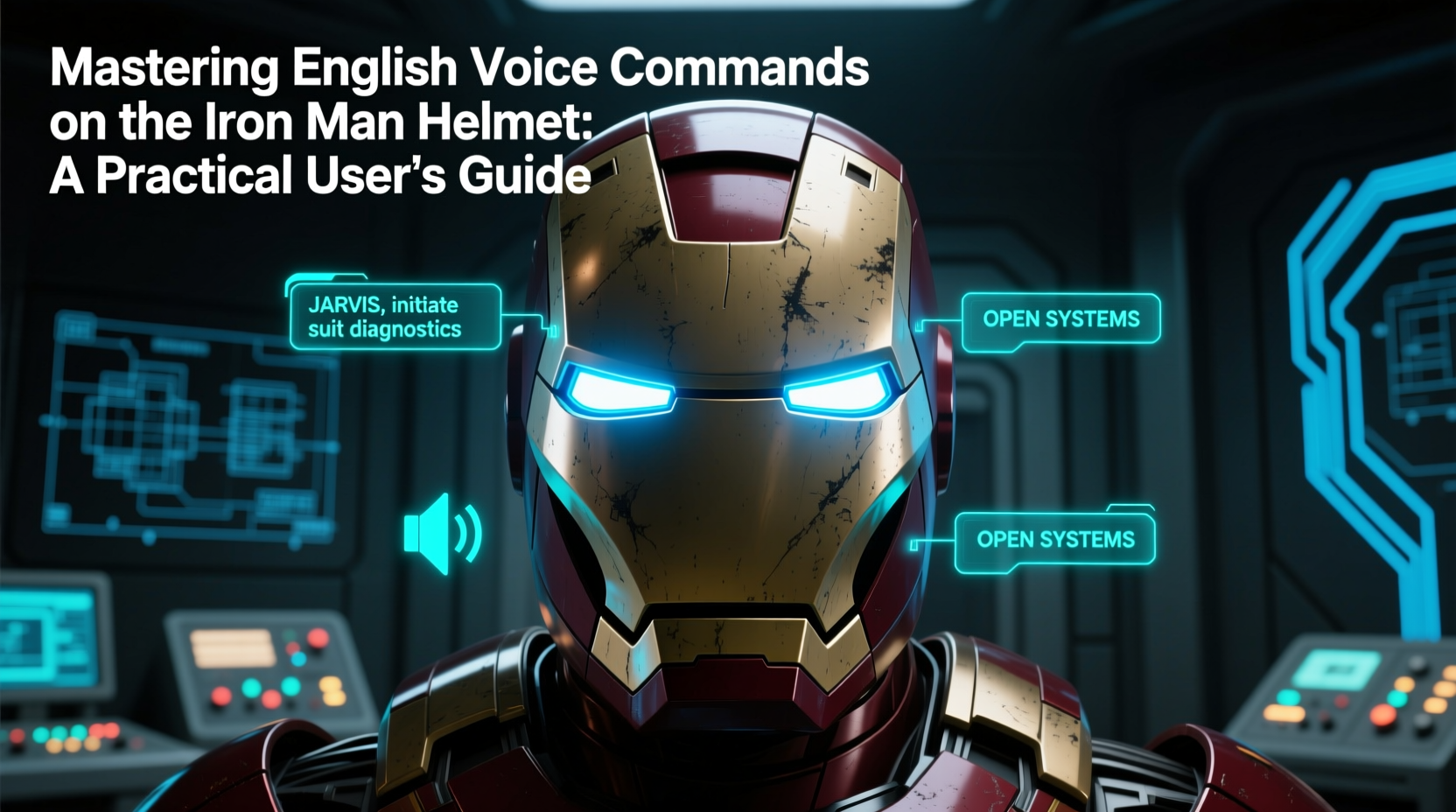
Most advanced Iron Man helmets use embedded microcontrollers paired with speech-to-text APIs such as Google Speech Recognition or OpenAI’s Whisper. These systems process spoken English into executable actions—activating lights, adjusting display opacity, or initiating sound effects. The accuracy depends not only on hardware sensitivity but also on how clearly and consistently users issue commands.
Unlike general-purpose virtual assistants like Siri or Alexa, the helmet’s voice interface is purpose-built. It operates within a predefined command set optimized for low-latency responses in dynamic environments. Background noise, accent variation, and improper phrasing can disrupt performance. Therefore, mastering the system requires both technical awareness and linguistic precision.
“Voice control in wearable hero-tech isn’t about mimicking movies—it’s about designing reliable, context-aware interactions.” — Dr. Lena Patel, Human-Machine Interface Researcher at MIT Media Lab
Essential Voice Command Syntax and Structure
Effective communication with your helmet starts with understanding command syntax. Unlike conversational AI, these systems rely on structured phrases. Deviating from expected patterns often results in failed execution.
Commands typically follow a three-part structure:
- Wake Word: Activates listening mode (e.g., “J.A.R.V.I.S.” or “Stark Systems Online”)
- Action Verb: Specifies the operation (e.g., “activate,” “dim,” “toggle”)
- Target Module: Identifies the component (e.g., “HUD,” “repulsors,” “audio log”)
Example: “J.A.R.V.I.S., activate HUD brightness at 70%”
Commonly Supported Commands
| Command Type | Sample Phrases | Expected Response |
|---|---|---|
| Display Controls | \"Enable HUD,\" \"Dim visor,\" \"Switch to night mode\" | Adjusts visual overlay settings |
| Lighting | \"Activate chest reactor,\" \"Pulse repulsor glow,\" \"Disable shoulder LEDs\" | Toggles integrated lighting elements |
| Audio | \"Play arc reactor hum,\" \"Record audio log,\" \"Increase speaker volume\" | Controls sound output and recording |
| Motion Feedback | \"Engage head-tracking,\" \"Calibrate gyroscope,\" \"Reset motion sensors\" | Enables responsive movement detection |
Step-by-Step Guide to Optimizing Voice Recognition
Even with correct syntax, environmental and physiological factors affect performance. Follow this sequence to ensure consistent command success:
- Power On and Initialize: Turn on the helmet and wait for the startup chime indicating system readiness.
- Set Audio Input Level: Speak a test phrase (“Test calibration”) and adjust microphone gain via companion app until voice peaks register between 60–75%.
- Train Accent Profile (if supported): Use built-in voice training tools to record sample commands. This helps the system adapt to regional pronunciation.
- Minimize Ambient Noise: Operate in quiet spaces when possible. Avoid windy areas or loud events unless using noise-canceling firmware.
- Use Consistent Phrasing: Stick to documented command formats. Avoid slang, contractions, or emotional inflection.
- Confirm Execution: Wait for auditory or visual feedback (e.g., beep, LED flash) before issuing another command.
Real-World Example: Cosplayer at Comic-Con
Derek M., a frequent exhibitor at San Diego Comic-Con, uses a Mark VII-style helmet with custom voice integration. During panel presentations, he relies on voice commands to switch display modes without removing gloves.
Initially, his commands failed due to crowd noise and rapid speech. After reviewing logs, he discovered that shouting “J.A.R.V.I.S. ON!” overloaded the mic. He adjusted by lowering vocal volume, adding a half-second pause after the wake word, and switching to quieter backstage areas for critical functions. These small changes improved success rate from 55% to over 92%.
His experience underscores a key principle: reliability comes not from louder speech, but from disciplined delivery.
Troubleshooting Common Issues
When voice commands fail, consider these frequent causes and solutions:
- No response after wake word: Check battery level. Low power can disable non-essential subsystems including mics.
- Partial recognition (e.g., “activate” heard but “visor” missed): Re-train voice model or reduce background interference.
- Unintended activation: Disable always-on listening if not needed; require physical button press to enable mic.
- Delayed response (>2 seconds): Update firmware. Older versions may lack optimized NLP pipelines.
Do’s and Don’ts of Helmet Voice Interaction
| Do’s | Don’ts |
|---|---|
| Speak clearly and at moderate pace | Shout or exaggerate syllables |
| Use standardized command phrases | Invent new syntax mid-session |
| Confirm system status before critical actions | Assume last command executed successfully |
| Update firmware monthly | Ignore error notifications or lag spikes |
Frequently Asked Questions
Can I customize the wake word?
Yes, many open-source helmet builds allow wake word reprogramming via the configuration file. However, changing it to something long or phonetically complex (like “Iron Man Online Now”) increases false-negative rates. Stick to two-syllable words like “Stark” or “J.A.R.V.I.S.” for optimal detection.
Does the system support multiple languages?
Current consumer-grade models primarily support American and British English due to training data limitations. While some firmware accepts other languages, accuracy drops significantly. For multilingual users, maintaining English as the control language ensures consistency across modules.
Why does my helmet respond randomly in sleep mode?
If your helmet activates without input, check whether “Always Listening” is enabled. Some systems use low-power keyword spotting that may misfire on similar-sounding words (e.g., “Jarvis” vs. “Garbage”). Disabling passive listening or increasing voice confidence thresholds resolves most false triggers.
Final Checklist for Command Mastery
- ✅ Verify microphone functionality daily
- ✅ Use standardized command syntax consistently
- ✅ Train voice profile for regional accent
- ✅ Operate in acoustically favorable environments
- ✅ Monitor system feedback after each command
- ✅ Update software every 4–6 weeks
- ✅ Keep spare batteries or charging cable accessible
Conclusion
Mastering voice commands on the Iron Man helmet blends technical knowledge with behavioral discipline. It’s not enough to know what to say—you must learn how to say it effectively within the system’s operational boundaries. With consistent practice, proper setup, and attention to detail, you can achieve near-instantaneous control that feels truly futuristic.




 浙公网安备
33010002000092号
浙公网安备
33010002000092号 浙B2-20120091-4
Comments
No comments yet. Why don't you start the discussion?